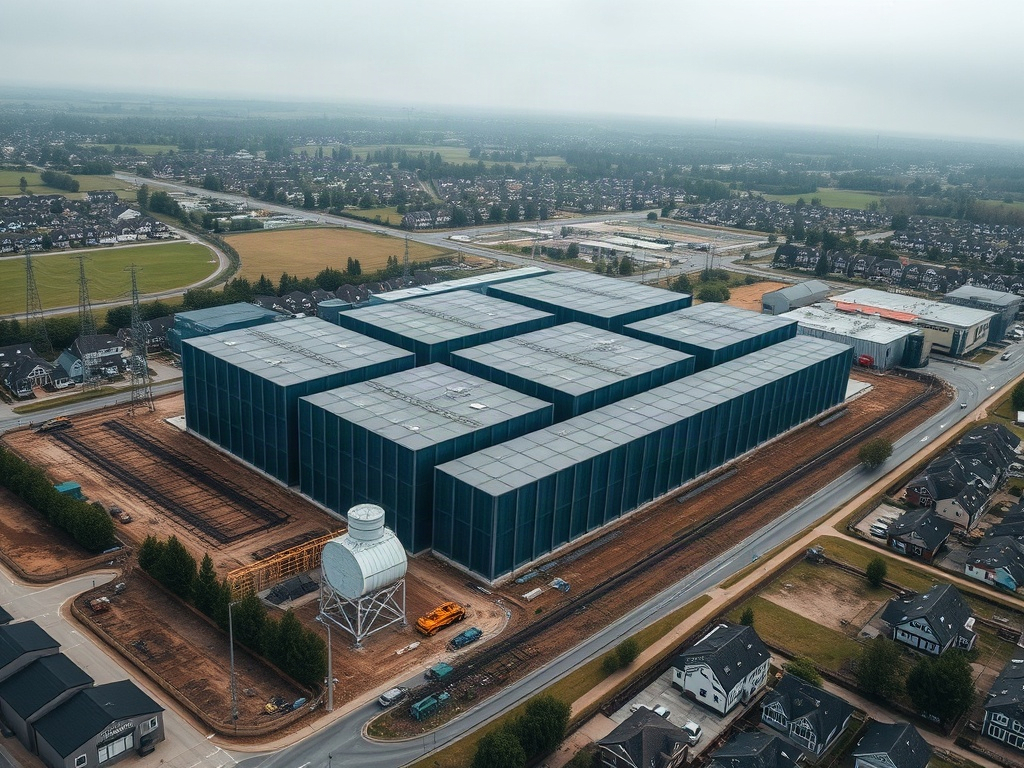

I write this as someone entering a building that looks impeccable from the outside. The facade speaks of growth: the SaaS market was valued at $266 billion in 2024, with projections estimating it will reach around $315 billion by early 2026, and trajectories pushing it towards $1 trillion by 2032. But inside, there are creaks.
TechCrunch named that sound in March 2026: "SaaSpocalypse." The article frames it as the result of intensifying pressures within the software-as-a-service domain, with an unsettling underlying idea: a "new supremacy" emerging due to the commoditization of generative AI colliding with companies' cost controls. There isn't a list of victims, no executives, no specific announcements. Instead, there is something more practical for a CFO or founder: the mechanical pattern.
As a sector grows, the market tolerates inefficiencies. When a technology emerges that alters the cost structure, that tolerance evaporates. In 2026, AI does not just "add functionalities." It changes the load maps of SaaS: where costs accumulate, how revenues are recognized, and how quickly margins break when a pilot transitions to production.
The Symptom Is Not Market Size, but the Reemergence of Marginal Cost
For years, the dominant narrative of SaaS rested on an almost architectural premise: once the product is built, each new customer adds revenue with low marginal cost. This logic enabled models characterized by accelerated growth and heavy business structures because the building was supported by the assumption that, as they scaled, the economic unit improved.
Generative AI alters that geometry. Training, inference, storage, observability, security, and governance turn a part of the value delivery into variable consumption. The briefing accompanying this article points out a statistic that, for me, is equivalent to discovering a subdimensional beam: as GenAI scales, many companies are uncovering cost underestimations of 500% to 1,000%. That is not a minor deviation; it is a miscalculation of loads.
Thus, the phenomenon is better understood as a structural inspection, not an apocalypse. The sector can continue to grow in total value while a significant portion of products and companies becomes economically unviable under real usage. The tension exacerbates because enterprise adoption accelerates: McKinsey reported that 71% of organizations were using GenAI in at least one function by early 2025, and Gartner projects that 80% of companies will deploy GenAI-enabled applications in 2026. Simultaneously, spending on AI-enabled applications could reach $644 billion in 2025, representing a 76.4% year-over-year increase.
In practice, this pushes buyers to demand control and predictability while forcing sellers to rethink their economics. The crack appears when the product promises "intelligence" as an aesthetic finish, but the cost of operating that intelligence grows with usage as if it were a poorly sized electrical installation.
The Typical Load Failure: Selling AI at Fixed Prices with Variable Costs
Classic SaaS defended itself through predictable contracts: seat licenses, module packages, annual renewals. AI introduces a meter: tokens, queries, compute minutes, calls to models, extraction, and generation at scale. If the provider maintains a fixed pricing scheme while their costs are variable and increasing, the margins become a fragile component.
Hence the shift highlighted in the briefing: the turn toward hybrid and usage-based models. This is not just a pricing trend; it is a financial engineering correction. If the cost to serve a customer can multiply tenfold when the pilot takes off, the price must capture that asymmetry, or the provider ends up subsidizing the customer's success.
This point connects to another data set from the same briefing: the growth of medium SaaS firms was already slowing down. In 2022, the top quartile of companies with $1M to $30M ARR grew at 62.1%, compared to 78.9% in 2021. In other words, even before AI became ubiquitous, the tailwind was weakening. With a cost structure becoming more sensitive to usage, the slowdown not only reduces valuation; it also reduces the capacity to absorb mistakes.
Here is where many organizations fall into vanity metrics: they celebrate adoption, activations, and “engagement” with AI features, but fail to tie that behavior to a clear monetization mechanism and consumption control. An AI product that is "widely used" can literally be a proportional loss to its success.
In this context, the responsible way to operate is to treat AI as a cost line that requires governance: limits, budgets, observability by customer and by use case, and contractual conditions that define what is included and what is charged separately. Without that instrumentation, the business resembles an industrial plant without meters rather than scalable software.
Atomization as Defense: Less “suite,” More Fine-Tuning Among Segment, Use Case, and Channel
As marginal costs rise, the strategy of selling “everything to everyone” becomes riskier, not less so. AI accelerates this dynamic for two reasons.
First, because “intelligence” is becoming commoditized. If many providers can integrate similar generative capabilities, the differential shifts from simply having AI to where it is applied and what measurable result it produces. Second, because each use case has a distinct cost footprint. It's not the same to automate a meeting summary as it is to execute an extensive document analysis chain with security and auditing requirements.
The rational defense is atomization: a precise fit between a segment, a specific task, and an acquisition channel that does not require burning cash indefinitely. Instead of an “AI suite for enterprises,” what’s sustainable tends to be “AI for this process, in this industry, under these constraints, charged in this manner.”
The industry already hints at the move toward specificity: the briefing notes that the real estate and construction vertical shows a 75% median ARR growth, which typically occurs when there is a clear operational problem and a buyer who understands the value. In such verticals, the conversation doesn’t revolve around “having AI,” but rather reducing times, errors, risks, or increasing conversions in a specific flow.
Atomization also changes the channel. A horizontal product can scale with mass marketing, but a product that affects critical processes—and also consumes variable resources—needs shorter consultative sales cycles and clear usage expectations. If the channel promises the moon and the contract does not cap consumption, the first serious deployment turns into a margin black hole.
This is where the “SaaSpocalypse” becomes natural selection: models that can precisely state which customer they need, how much it costs to serve them in production, and how to charge for that production without the buyer feeling their footing has been moved survive.
Consolidation and Discipline: The Market Rewards Those Who Turn Fixed Costs into Controlled Variables
Another relevant indicator of the moment is consolidation: 2,698 M&A transactions in 2025, a record according to the briefing. When a market consolidates to that extent, it is not just appetite; it is reordering. Buyers seek scale, access to clients, data, and products that already have fit, while many sellers seek an exit before the cost of competition rises.
AI accelerates that reordering for a straightforward reason: operating generative models with enterprise quality demands investment in infrastructure, security, compliance, and reliability. For some companies, it will be easier within a group with more cash or shared infrastructure. For others, the viable path will be to specialize so much that their efficiency becomes their defense.
Simultaneously, buying companies are tightening spending controls. Gartner forecasts that spending on enterprise software will rise at least 40% by 2027 driven by AI, which paradoxically increases the pressure to optimize contracts. When budgets grow, so does visibility into waste. The typical result is renegotiation, tool rationalization, and demands for pricing models that connect value with consumption.
In this new equilibrium, financial discipline ceases to be a “good habit” and becomes a survival requirement. The models that perform best are those that:
The “SaaSpocalypse,” read this way, does not announce the end of SaaS. It marks the end of one type of SaaS: the one that believed it could sell promises of unlimited automation with fixed prices and creative cost accounting.
The New Norm: The Surviving SaaS Is One That Can Be Budgeted as a Machine
TechCrunch in March 2026 describes this as intensifying pressures: massive sector growth, AI becoming a commodity, and enterprise cost controls. My structural reading is more concrete: SaaS is ceasing to be “just software” and is increasingly resembling an operating system with measurable consumption. This forces a redesign of blueprints.
A provider that wants to emerge unscathed needs three capabilities that were previously optional. First, instrumentation: knowing how much each customer costs in production, not in a demo. Second, pricing mechanics: hybrid or usage-based, but with guardrails, thresholds, and packages that make spending governable. Third, focus: a proposition that fits into a specific segment and process, where AI is not the décor but the engine that reduces a verifiable cost or risk.
Markets do not punish ambition; they punish structures that cannot withstand the real load. Companies do not fail for lack of ideas, but because the pieces of their model fail to fit together to create measurable value and sustainable cash.