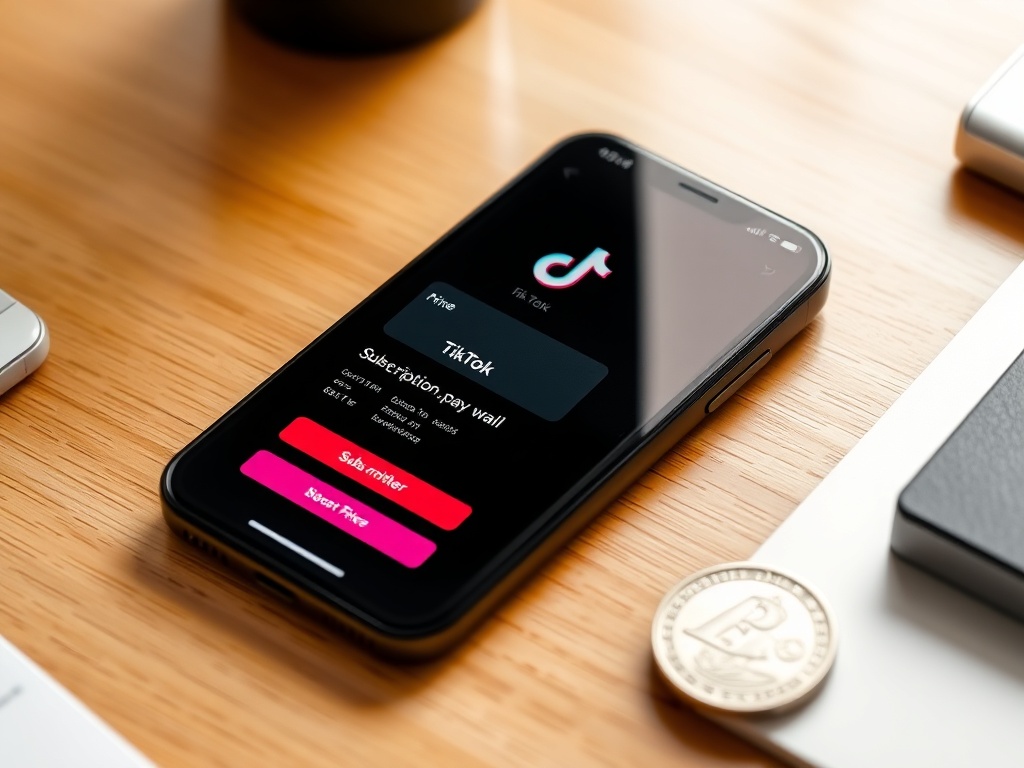

TikTok charges you for not tracking you — and in doing so reveals the new price of privacy
Last week, TikTok announced in the United Kingdom something that has been quietly taking shape for years: a subscription at £3.99 per month allowing users over the age of 18 to use the app without advertising and, more importantly, without their data being used for advertising purposes. This is not an experiment. It is the first official launch in an English-speaking market, and it marks the moment when a platform that built its business on free attention and hyper-personalized advertising puts an explicit price tag on opting out of that circuit.
The news seems modest. A subscription button, a reasonable monthly figure, a press release with predictable statements. But beneath that surface lies a structural shift in the logic by which social platforms negotiate with their users, and understanding that shift requires looking at what happened before the button ever existed.
What changed before there was anything to announce
The advertising model of social networks has always depended on an asymmetry: the user surrenders data in exchange for free access, without that surrender being a conscious act or an informed decision. For years, that asymmetry was the status quo, and nobody questioned it because the free nature of the service worked as a sufficient screen. The European GDPR began to erode that screen in 2018, but its impact on the advertising model was gradual and, for a long time, more rhetorical than operational.
What accelerated the change was a combination of accumulated regulatory pressure and a direct precedent: Meta launched its ad-free subscription version in the United Kingdom in the autumn of 2025, after its "pay or consent" model was rejected by European Union regulators in November 2024. The European rejection was not a footnote. It was the signal that the argument of "free access is sufficient consent" no longer holds up legally in certain markets. And the United Kingdom, with its own post-Brexit data protection framework, operated as more permeable ground for that model to survive and become legitimized.
TikTok invented nothing here. It took the mould that Meta had already tested and applied it to its own user base. But that does not make the move any less significant. It makes it more so: when a second platform of comparable scale adopts the same architecture of choice, the model ceases to be an individual response to regulation and begins to be the new convention of the industry.
The condition that made this announcement possible was not an internal strategic epiphany. It was a legal friction that could no longer be ignored, combined with a competitive precedent that reduced the risk of going first. The subscription button did not appear because someone at TikTok decided that privacy mattered. It appeared because the cost of not offering it began to outweigh the cost of doing so.
The business model that fragments without breaking
To understand what this move means financially, one must look at the mechanics of the exchange that TikTok is formalizing. Under the previous model, all users surrendered data and saw advertising with no intermediate options. Advertising revenues depended on the total scale of users and the density of profiling: more data from more people generated more value for advertisers. It was a model of enforced homogeneity.
The ad-free subscription introduces a segmentation that did not previously exist. Users who pay £3.99 per month exit the advertising inventory, which reduces the volume of data available to advertisers, but preserves a monetizable relationship with that user through a direct channel. Users who do not pay remain within the original advertising model, with active personalization and data collection. The platform, in theory, loses nothing in either case.
What does change is the composition of revenue. A platform that previously depended almost exclusively on advertising begins to build a subscription revenue stream that, while marginal in the short term, has distinct financial characteristics: it is recurring, predictable, and does not depend on advertising spending cycles or the measurement algorithms that advertisers periodically call into question.
The move also resolves a legitimacy problem that platforms have been dragging along for years. The regulatory argument that "the user has a choice" becomes more solid when there is a real option, with an explicit price and clear conditions. That does not eliminate the questions about how real that choice actually is when free access remains the norm and paying to avoid being profiled implies that profiling is the default — but it does give TikTok a more robust argument in front of ICO regulators and in the face of potential future litigation.
The economics of the model rest on a critical assumption: that the conversion rate to the subscription is low enough not to materially erode the advertising inventory. If too many users pay, the advertising model is hollowed out. If almost no one pays, the subscription is a regulatory shield at near-zero cost. TikTok, with the behavioral data it holds on its own users, has almost certainly already produced a reasonably precise estimate of where that rate will land.
Why £3.99 is a price that is not really about money
The chosen price is not arbitrary and deserves analytical attention. £3.99 per month is approximately the same range that Meta charged for its subscription version in the United Kingdom. This is not a coincidence of market pricing: it is a signal that both platforms are converging toward a reference price for what we might call the cost of exiting the advertising circuit.
That price must be low enough not to generate rejection for being unaffordable, but high enough that the majority of users will not adopt it as a default. In markets where disposable income varies widely, £3.99 per month may be irrelevant for one segment of users and prohibitive for another. The net effect is that the population that chooses to pay tends to concentrate among users with greater purchasing power and greater awareness of privacy — who are, paradoxically, exactly the users who represent lower marginal value for mass-performance advertisers that already found them difficult to convert.
There is another possible reading of the price: £3.99 establishes an implicit market value for the data of a TikTok user in the United Kingdom. If that is what it costs to opt out, then the platform is saying, implicitly, that this is the minimum value it assigns to having access to your data for one month. For advertisers, that figure is relevant as a reference point for how much TikTok is charging for the right to profile its users. For regulators, it is a data point that will eventually enter the debates about whether the price reflects genuine consent or an institutionalized power asymmetry.
The most relevant test of whether this model has commercial legs is not initial adoption, which is always low in launches of this type. It is whether the subscriber retention rate at six months holds up and whether subscription revenue grows organically without the need for aggressive price adjustments. TikTok ran tests with this model in 2023, when users in the United Kingdom saw screenshots featuring a price of $4.99 per month. The fact that it took three years to officially launch it suggests that internal tests did not generate unequivocal signals of demand, and that the final push was more regulatory than commercial.
The price paid by those who do not pay
The most revealing aspect of this model is not the subscription itself. It is what its very existence says about the user who chooses not to subscribe.
Before the option to pay existed, all users were in the same position: they surrendered data because there was no alternative. The asymmetry was structural, but it was equal for everyone. With the introduction of the subscription, that asymmetry becomes an active choice. The user who does not pay can no longer argue that they had no options. They chose the advertising model. Or, more precisely, they chose not to pay to exit it.
That semantic shift is significant for regulators, who have spent years arguing that consent on free platforms is not genuine because there is no real alternative. Now there is an alternative, even if it comes with a price. The regulatory argument becomes more complicated because the platform can respond that the user made an informed choice. The question that will remain open — and that ICO regulators will likely explore — is whether a choice between paying to protect your privacy or surrendering it for free constitutes free consent in the sense required by the GDPR, or whether it is simply the monetization of the right to privacy that the legal framework supposedly guarantees without economic conditions attached.
Meta faced exactly that question in the European Union and the answer was negative: the model was rejected because European regulators considered that offering a paid alternative does not equate to free consent when the default is the surrender of data. The United Kingdom took a different path, and that post-Brexit divergence has practical consequences that will continue to reveal themselves over the next two or three years of implementation.
What TikTok achieved with this launch is positioning itself on the right side of the regulation currently in force in the market where it operates, without compromising its core model. The subscription does not materially threaten advertising revenues. It significantly reduces regulatory risk. And it establishes a precedent that, if the ICO tolerates it without challenge, becomes the de facto standard for any social platform operating in the United Kingdom that needs to demonstrate it offers genuine choice to its users.
The industry that for two decades treated privacy as a regulatory cost to be minimized has just found the way to turn it into a revenue stream. That does not resolve the question of whether the model is fair. But it does change, in a permanent way, who has the incentives to keep things exactly as they are.