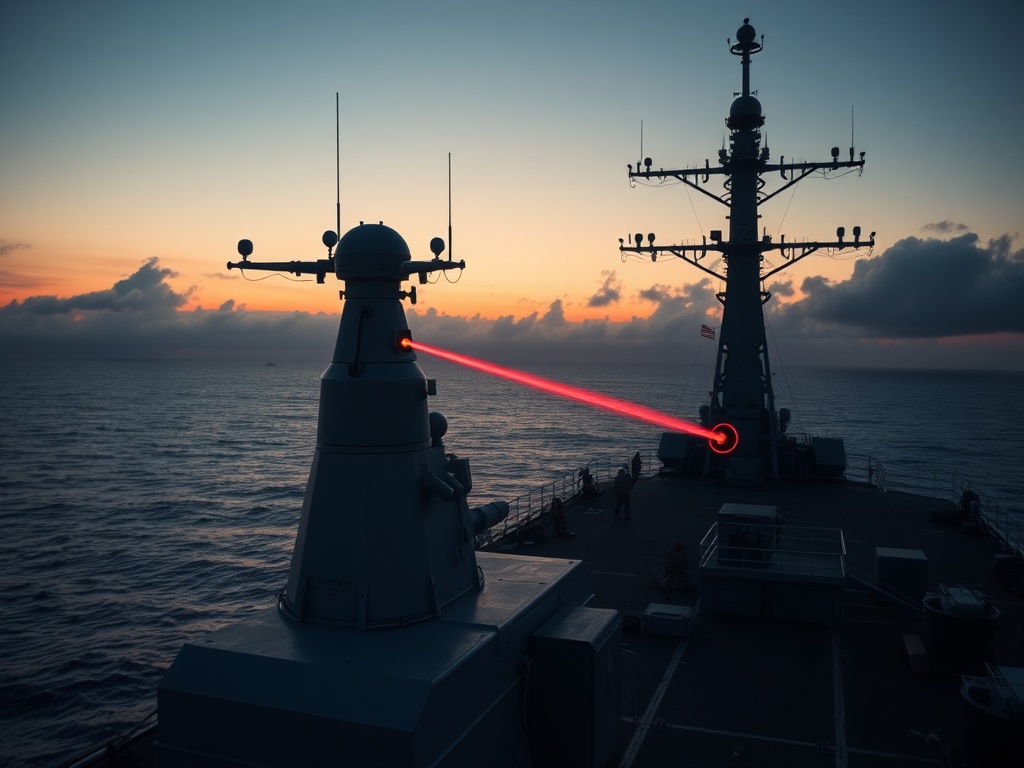

The defense industry has repeatedly touted an alluring idea: high-energy laser weapons as the solution to ammunition shortages, resupply challenges, and interception costs. In promotional material, the concept is simplified to a catchy phrase: an “almost infinite” number of shots as long as power is available. To any public or private CFO, this phrase hints at a drastic reduction in logistics, inventory, and supply chain vulnerabilities.
However, a recent analysis by Fast Company pops that bubble with uncomfortable precision: the supposed "infinite magazine" is not infinite in an operational sense. The limitation shifts from a box of ammunition to a series of measurable constraints: dwell time over the target, losses due to atmospheric conditions, cooldown and recovery cycles, and above all, the ability to address parallel attacks when an adversary saturates the sky with multiple simultaneous threats.
As a strategist focusing on shared value creation, my interest isn't merely whether the technology works. I'm focused on how the value is distributed among contractors, armed forces, taxpayers, and industrial suppliers when “almost infinite” promises are made to drive purchasing decisions. The issue isn't moral; it's economic: when actual performance is less than imagined, someone pays the difference, and it's seldom the one who penned the slogan.
The Illusion of Infinite Ammo: A Throughput Promise
When Raytheon (RTX) touts “low cost per shot” and “almost infinite shots,” they are packaging two proposals into one. The first is financial: photons are cheaper than missiles. The second is operational: sustained capability without pause for reloading. In air defense, the latter promise is as significant as the former because the central issue isn't just intercepting; it's the ability to intercept multiple times and in a timely manner.
Here lies the detail often omitted in presentations: continuous wave lasers must maintain the beam on the target for several seconds to inflict damage—the well-known dwell time. Operationally, this turns each “shot” into a sustained service. A missile or projectile can be launched in fractions of a second and travels autonomously. The laser, on the other hand, requires sustained attention from the system on that target.
This requirement has immediate implications for saturation scenarios. In an attack involving multiple drones or loitering munitions, kinetic defense can launch interceptors in parallel (limited by inventory, yes, but with physical simultaneity). The laser, unless equipped with multiple beams or stations, operates sequentially. The myth of the “infinite magazine” conflates “ammunition” with “service capacity per unit time.” What ultimately matters for military outcomes is throughput: how many targets can be engaged per minute under real conditions.
The programs highlighted in this report illustrate why this discussion is far from academic. In 2023, Lockheed Martin delivered a 300-kilowatt Valkyrie prototype to the Department of Defense under the Army’s IFPC-HEL program, while the Navy operates HELIOS with 60 kilowatts, expandable to 120, and is testing 150–300-kilowatt systems against anti-ship cruise missiles. Power is increasing, but the bottleneck doesn't disappear; it just changes form. On the cost ledger, the laser may lower the cost per attempt; on the capacity ledger, the system competes against time.
Physics Introduces Hidden Costs That Make "Infinite" Finite
The story of the “infinite magazine” operates under one condition: “as long as there is power.” However, in a mobile or shipboard military system, that power isn't an abstract outlet; it's about generation, storage, conversion, and thermal dissipation, each with its limits.
Operational evidence appears within two players of the ecosystem itself. On one hand, Electro Optic Systems promotes its 150-kilowatt Apollo laser as capable of “unlimited shots with external power,” but admits to a limit of “over 200 engagements stored” using internal energy. This statement is significant because it reveals what many promises hide: the “unlimited” nature depends on supply and thermal regimes. In a vehicle or ship, the system competes for power with sensors, mobility, communications, and other subsystems.
On the flip side, the Army itself, while specifying the Enduring High Energy Laser (E-HEL), incorporates the concept of a reload cycle: a recovery period of no more than four minutes to “restore the magazine to original conditions.” This is an explicit translation of finitude. It’s not about reloading a box of bullets; it's about recuperating a system that has accumulated heat, wear, and optical mismatches.
To this, we must also add the atmosphere as an operational tax. An analysis by the Naval Postgraduate School (2014) cited in the briefing highlights how turbulence, humidity, fog, and smoke increase the time needed to achieve the same effect, thus reducing effective energy on the target. In other words, in the real world where wars are fought, lasers do not operate in a laboratory. When the beam degrades, dwell time increases; when dwell time increases, throughput decreases; when throughput decreases, more hardware is needed to sustain defense.
The economic consequence here is direct: if the “cost per shot” decreases, but maintaining throughput necessitates doubling or tripling stations, installed power, or cooling systems, the total capacity cost may rise. The promise is maintained in one metric (cost per event) while the real expenditure shifts to the system's CAPEX and its integration.
The Budget Is Shifting Towards a Narrative That Buys Optionality
The U.S. Department of Defense invests around $1 billion annually in directed energy weapons, according to a 2023 GAO report. This funding doesn’t just buy prototypes; it acquires a form of strategic optionality: the ability to defend against inexpensive drones without consuming costly interceptors. In a context of proliferating low-cost threats, this logic makes sense.
The issue arises when the “almost infinite” narrative is used as a substitute for a real capacity discussion. In terms of acquisition, this phrase encourages a simplified comparison: costly and finite missile versus cheap and infinite laser. What is left out is the cost of ensuring availability: continuous power, thermal dissipation, optical maintenance, training, and integration with sensors and target prioritization doctrines.
The cited programs indicate that the armed forces are already internalizing some of that complexity. The Army is testing lasers integrated into layered defenses alongside kinetic systems like M-SHORAD. This hybrid design signals that lasers are not a universal replacement but a complementary solution that works well in certain ranges and conditions.
For contractors, the incentive is clear. If the buyer believes they are acquiring “practically unlimited ammunition,” they can justify purchases that would otherwise be tough to defend in audits and before legislators. For the public buyer, there is incentive too: to reduce pressure on interceptor inventories and replenishment. The distributive risk arises if the expectation of “infinity” leads to underfunded force plans against saturation attacks, and subsequent corrections require more budget, platforms, and maintenance.
In practice, money does not disappear; it reallocates: from ammunition to energy, thermal dynamics, integration, and redundancy.
Winning the Narrative War Is Costly If Not Aligned with Performance
Keith Krapels from the Army Space and Missile Defense Command’s Technical Center described laser technology as “quite mature” and called for increased production at “scale.” Lt. Gen. Robert Rasch detailed the range of systems being pursued, from 10 to 300 kilowatts, with a focus on E-HEL pending fiscal year 2026 funding. These statements align with a shift: the discussion is no longer whether laser systems are viable but how to industrialize them.
This transition from prototype to scale is precisely where the myth of the infinite magazine can turn costly. Industrialization requires specifying performance under real conditions, not just peak power. It also necessitates recognizing that if dwell time governs the clock, “firepower” isn't merely purchased with kilowatts; it is acquired through system architecture: multiple channels, target queues, coordination with sensors, and target assignment doctrines.
When an organization buys a simplified promise and subsequently discovers in operation that there are thermal pauses, smoke degradation, or simultaneity limitations, the correction typically manifests in two forms: adding kinetic layers or adding more lasers. In both cases, total costs rise. From a value chain perspective, the sustainable output is aligning contracts, indicators, and planning with expected performance from the outset. This safeguards the end user, avoids reactive over-investment, and ensures that the provider is rewarded for performance, not just narrative.
The strategic conclusion is clear: the “infinite magazine” is a useful metaphor for marketing and budgets, but it is a poor measure for defense design. Capacity should be assessed in targets per minute under weather, smoke, vibration, and saturation.
The Competitive Advantage Lies in Selling Verifiable Capacity
If the laser reduces the cost per attempt and preserves interceptors, its value is significant. However, the buyer can’t pay for that value twice: once in the promise of unlimited shots and again in the additional CAPEX necessary to compensate for throughput limits.
Economic equilibrium is achieved when the defense market stops buying “infinite” and begins purchasing operational metrics that tie incentives together: average dwell time per target type, expected degradation due to atmospheric conditions, thermal recovery times, and sustained capacity over temporal windows. With these variables, the cost per shot ceases to be an isolated figure and transforms into cost per defended capacity.
In this transition, those who create value are those who can demonstrate consistent performance in non-ideal scenarios and design hybrid integration without selling smoke. Those who lose out are the buyers financing “almost infinite” narratives and discovering too late that finitude remains—manifested as thermal waits, dwell time seconds, and additional budgets to support the defense volume they thought they had purchased.