
Maruti regains lost ground with its first real market share gain in six years
There is a number that summarizes six years of strategic history in the Indian automotive industry: 42%. That is the market share that Maruti Suzuki India Limited recorded in April 2026, the first month of fiscal year 2026-27. The previous year had closed at 39%. The difference of three percentage points may sound modest in the abstract. Viewed from the inside, it represents the first material share gain since the company dominated more than 51% of the market in fiscal year 2019-20.
What happened between those two moments was not a crisis or an operational catastrophe. It was something quieter and, in a certain way, more instructive: Maruti decided for years that its business model — centered on small entry-level cars with high penetration in mid-sized cities — was robust enough to survive the massive shift of the Indian consumer toward SUVs. And the market answered it with data for half a decade.
---
How you lose market share without losing sales
The paradox of Maruti between 2020 and 2025 is that the company kept selling a great deal. There was no collapse in revenue or dramatic loss of stock market position. What happened was more gradual and structurally more dangerous: the market was growing faster in segments where Maruti was not present, and competitors occupied that space.
Tata Motors and Mahindra & Mahindra built SUV portfolios that connected with an Indian middle class that was beginning to prefer greater ground clearance, more robust aesthetics, and more prominent technological features. Kia India and MG Motor India arrived with modern design and prices that captured urban buyers willing to pay more. Meanwhile, Maruti was defending its stronghold in low-price hatchbacks, a segment that steadily lost relative prominence even if it never disappeared entirely.
The result was a sustained drop in market share: 51% in FY20, 47.7% in FY21, 43.4% in FY22, 41.3% in FY23, 41.7% in FY24, 40.9% in FY25, and 39% at the close of FY26. A downward curve that was not spectacular at any individual point but which, taken as a whole, described a company that had lost approximately twelve percentage points of market share over six years. That, in a market as large as India's, amounts to ceding millions of units to rivals.
The question that this rebound compels us to ask is not whether Maruti grew again — the April 2026 data are emphatic — but when the organization recognized that its internal map no longer corresponded to the territory.
---
The cost of believing the cycle would correct itself
There is a pattern that appears with some frequency in dominant companies: when the market moves in a direction that does not coincide with the company's historical strengths, the first institutional reaction is usually to wait. The implicit logic is that cycles correct themselves, that consumers eventually return to the familiar value proposition, and that the installed base of distribution and brand is sufficient protection.
Maruti had reasonable arguments for that position for a time. Its dealer network is the most extensive in India. Its cost efficiency in small cars is difficult to replicate. Its after-sales service has a penetration that no recent rival can match. Those strengths did not disappear.
But the SUV market in India was not a passing episode. It was a structural reconfiguration of the preferences of urban and semi-urban consumers. And during the years when Maruti trusted that its existing model was enough, its rivals were not waiting: they were launching models, building brand image, and capturing cohorts of buyers who in many cases had never bought a Maruti and were not going to start with one.
The diagnosis does not require attributing bad faith or incompetence to any specific team. What the historical record of market share does show is that the organization took several annual cycles to commit productive and product resources at the scale that the SUV segment required. The opening of new capacity at Kharkhoda and the planned expansion at Hansalpur are moves that imply multi-year capital investment. The moment at which that investment was committed indicates when, internally, the company stopped betting that the cycle would correct itself on its own.
---
What is driving the rebound and how sustainable it is
The April 2026 data are specific, and it is worth reading them carefully before drawing broad conclusions.
Maruti Suzuki's total domestic sales reached 191,122 units, its highest monthly figure ever in the local market. SUVs grew 141.6% year-on-year. Small cars — Alto, WagonR, and similar segments — rose 74.4% year-on-year. Exports totaled 40,054 units. The global total was 239,646 units, compared to 179,791 in April of the previous year.
There are three simultaneous mechanics operating here, and distinguishing them matters for evaluating sustainability.
The first is unlocked capacity. The second production line at Kharkhoda entered operation recently, and a fourth line at Hansalpur — with additional capacity of 250,000 vehicles — is scheduled for the second quarter of the fiscal year. Part of April's growth simply reflects the fact that the company can now manufacture and deliver what it previously had on waiting lists. That is real, but not indefinitely expansive: new capacity has a limit, and once absorbed, growth will have to come from genuine incremental demand.
The second mechanic is the recovery of the small car segment. Sales of mini cars — Alto and S-Presso — more than doubled compared to the same month of the previous year, reaching 16,275 units from 6,776. Earlier analyst commentary noted that adjustments to GST had revitalized demand in the entry-level segment. If that is indeed part of the impulse, that growth must be understood as partially dependent on a policy condition that can change. It is not a cause for alarm, but it is a factor to keep on the radar.
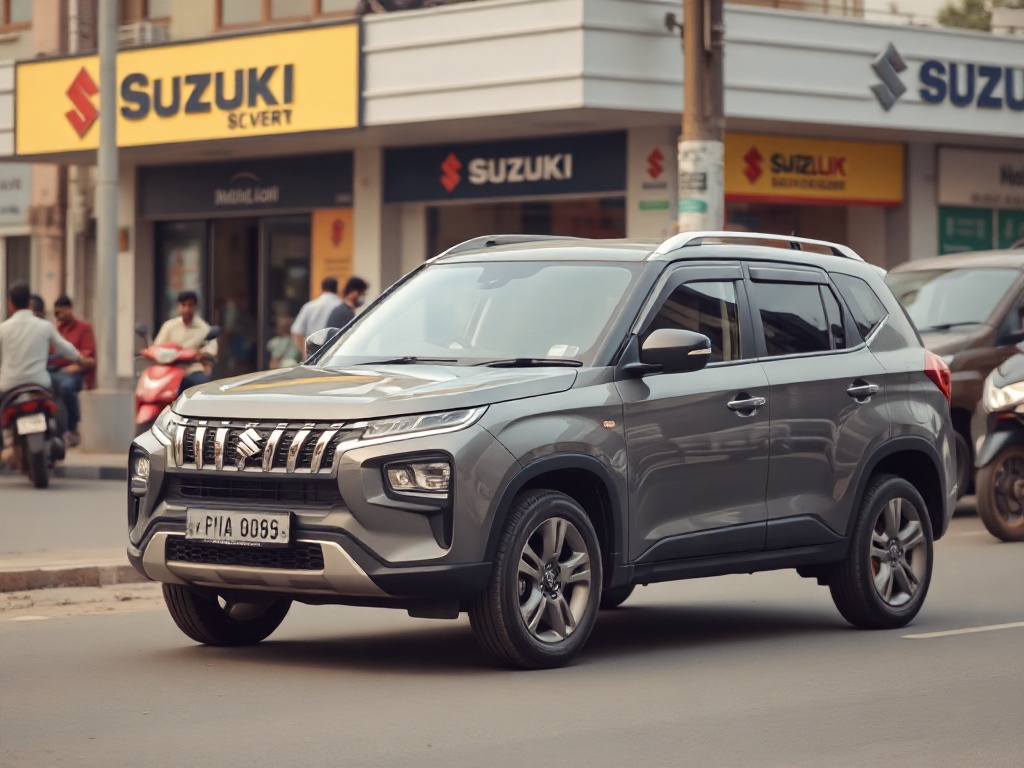
The third mechanic is the real traction of the expanded SUV portfolio. This is the data point that is most strategically interesting. A growth of 141.6% in SUVs is not a capacity effect or a fiscal policy effect: it is volume the company did not have and is capturing now. If that figure holds in Q2 and Q3 of the fiscal year — quarters without the tailwind of a "low base effect" from twelve months ago — then Maruti will have demonstrated that its repositioning in SUVs was not merely a statistical artifact but a genuine capture of share in the market's highest-growth segment.
Channel inventory levels are also revealing: only 17 days of stock, compared to typically higher levels during periods of lower demand. That implies the company is selling faster than it is accumulating inventory and has room to continue delivering without having to resort to aggressive incentives that would erode margins.
---
What this case reveals about the speed of corporate course correction
Maruti Suzuki took approximately six years to rebuild its market position after it began to lose it. Part of that time was portfolio adjustment — developing, launching, and validating new SUV models takes years — but part was also time for internal recognition: accepting that the historical strategy of concentrating on small cars was insufficient to defend market share in a market that was moving on.
That lag period has a cost that the numbers capture with precision. Twelve percentage points of market share lost over six years, in a market that grew during that period, represents an accumulated volume of sales that went to Tata, Mahindra, Kia, and others. Some of those buyers have already built loyalty with their new brands. Not all of them are coming back.
What makes the current moment interesting is that Maruti is not simply recovering position in the segments where it was always strong. The SUV growth at the level shown by the April 2026 figures suggests it is capturing buyers who were not previously its own. That is different from recovering returning share: it is expansion share in a segment that is new for the company.
The question that the executive teams of its competitors should be analyzing right now is how much of the ground they gained between 2020 and 2025 is truly theirs — earned through built customer loyalty — and how much was simply the result of a temporarily disoriented incumbent that has just reoriented itself. Because Maruti has the largest distribution network in India, cost efficiency that is difficult to match in volume segments, and now additional productive capacity that will be operational before the year is out.
The rebound does not guarantee that the company will recover the 51 percentage points of FY20. That level corresponded to a less competitive market and a different consumer profile. But the data from the first months of FY27 indicate something more concrete and actionable: that the distance between a dominant company that lost its footing and its competitors who took advantage of that can close faster than those competitors had anticipated. The advantage built upon the absence of a rival is more fragile than the one built upon one's own superiority.