
The JBS Strike Reveals the Hidden Cost of Ignoring Meat Processing Workers
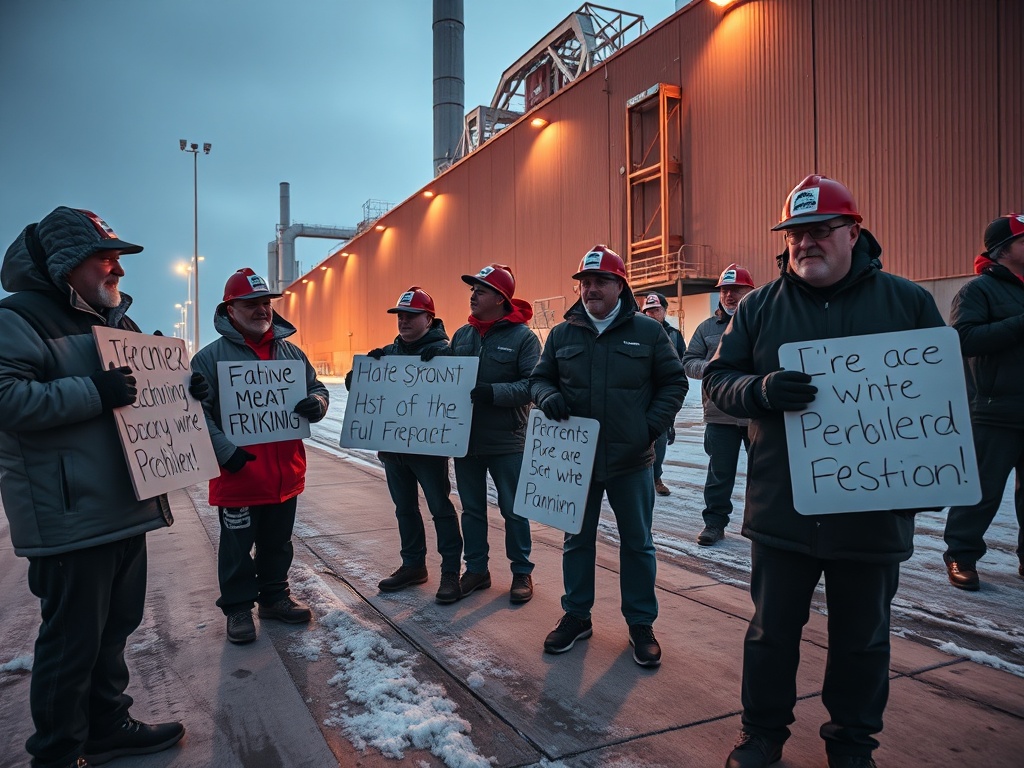
At 5:30 a.m. on March 16, 2026, with below-freezing temperatures in Greeley, Colorado, 3,800 workers from Swift Beef Co. — owned by JBS USA, the largest meatpacking company in the nation — crossed the threshold from negotiation to strike. This was not an impulsive act. Ninety-nine percent of the workforce had voted weeks prior to authorize the walkout. Eight months of negotiations had failed. The UFCW Local 7 union had filed formal complaints with the National Labor Relations Board for unfair labor practices.
What happened in Greeley marked the first strike in a U.S. beef processing plant since 1985. Forty-one years of labor silence in an industry that, instead of resolving its internal tensions, has simply compressed them until they exploded.
The Arithmetic JBS Chose to Ignore
The contract JBS presented included a 60-cent-per-hour raise in the first year, followed by 30-cent increases in the subsequent two years. The company touted this as a solid offer, aligned with the national contract negotiated with UFCW International in 2025. The problem is that the numbers don’t add up when viewed comprehensively.
UFCW Local 7 President Kim Cordova explained the actual mechanics: the increases in health costs — 22 cents per hour — absorbed most of the raise, leaving a net gain of just 8 cents per hour. In Colorado, one of the states with the highest cost of living, that is not a wage proposal; it’s a disguised cut.
Adding to this, JBS had ramped up production line speeds from 390 to 420 animals per hour without any compensatory adjustment in pay or safety conditions. The company also did not reimburse employees for personal protective equipment, which costs hundreds of dollars. The equation is straightforward: more volume, more physical risk, less purchasing power. This is not a contractual disagreement; it’s a cost structure that transfers operational risks onto the workers while capturing the benefits at the top.
When a company with 109,000 employees across nine countries and 132 processing facilities comes to negotiations with an offer equivalent to a net gain of 8 cents per hour, it is not reflecting financial tightness. It is revealing what it values and what it disregards.
Four Decades of Silence Does Not Equate to Four Decades of Peace
The most revealing detail of this situation isn’t the scale of the strike but its rarity. The meatpacking industry in the U.S. has gone over four decades with virtually no formal labor conflicts. The last comparable event was the Hormel strike in Minnesota in 1985, which lasted over a year and included violent confrontations between police and protesters.
This prolonged quietude is not evidence of harmony. It’s proof of concentrated power. The consolidation of the sector into a few giant players — with JBS leading the pack — has structurally reduced the bargaining power of workers. Job alternatives in communities dependent on a single plant are limited. The pressure to avoid losing jobs in high-turnover, high-risk environments acts as a silent suppressor of conflict.
What happened in Greeley is the collapse of that suppression mechanism. And it came just when external circumstances amplified every disturbance: the U.S. cattle inventory hit its lowest point in 75 years as of January 1, 2026, with 86.2 million animals, a 1% decrease from the previous year. The closure of a plant in Lexington, Nebraska, in January of that same year had already stressed the supply chain. The Trump administration was negotiating a trade deal with Argentina to try to lower consumer meat prices. JBS chose this moment to take negotiations to the brink.
The company announced that it would operate two shifts at the plant during the strike and move production to other facilities. This incurs real operational costs, in logistics, coordination, and overtime in receiving plants, which were not factored into any financial models prior to the strike.
What a Homogeneous Board Cannot See from Above
There’s a question that doesn’t appear in JBS’s press releases but should be on its board’s agenda: who on the decision-making table has direct experience with what happens on the floor of a processing plant at 20 degrees below zero, processing 420 animals per hour, with protective equipment paid for out of pocket?
Corporate risk models tend to quantify precisely what is easy to measure: cattle prices, line efficiency, cut margins. What they quantify poorly, or outright ignore, is the accumulated fragility at the operational base. Eight months of failed negotiations are not a technical accident. They are a symptom of an organization that lacks real mechanisms to process signals coming from below. The information was available: 99% of the workers voted in favor of the strike. This is not a surprise that arises overnight. It is the result of months of distrust that a board with more diverse perspectives — including the viewpoint of those living the operation from within — could have detected before it turned into a walkout that halts a critical facility for the national protein supply.
Kim Cordova articulated it strategically: unless JBS wants this kind of disruption for Colorado’s economy, it should negotiate in earnest. This is not union rhetoric. It is a cost projection.
Organizations that build genuinely decentralized information networks, where those closest to the actual risks have effective channels to communicate upwards, do not reach this point. Not because they are more generous, but because they are more efficient at processing early warning signals. The social capital within an organization, the trust that allows a shift supervisor to raise a complaint without reprisal, or a worker to point out a safety risk without fear of losing their job, is not a cultural benefit. It’s operational intelligence infrastructure.
JBS has 132 facilities. If the Greeley model replicates in other plants, the company is not facing a labor relations problem. It faces an organizational architecture issue that its books have yet to price correctly.
The Low-Cost Model Has an Expiration Date
The strategy that led to this strike has coherent internal logic in the short term: compress labor costs, maximize line speed, minimize concessions in collective negotiations. It works while the context allows it.
When cattle inventories are at historic lows, when meat prices are a matter of federal public policy, when a strike in a single facility can stretch the national supply, the low-cost model at the base of the operational chain becomes the most expensive risk on the balance sheet. Not in abstract terms: in terms of lost production, relocation costs, regulatory pressure, and the precedent it sets for the remaining 131 facilities.
Leaders who read this story as a one-off labor conflict are looking at the tree. The trend it reveals is systemic: organizations that have built their competitiveness on the sustained extraction of value from their operational base are structurally fragile when the external environment stops absorbing those internal tensions.
The next time a board meets to review operating margins, it’s worthwhile for everyone in that room to look at their peers. If everyone shares the same professional background, the same distance from actual operations, and the same assumptions about what constitutes fair compensation, they’re viewing the numbers through the same blind spot. Shared blind spots do not cancel each other out; they amplify. This is not a problem of values. It is a measurable competitive vulnerability, and Greeley has just demonstrated exactly what the cost is.