
Two Million Dollars Buried Under Ice and No Safety Net to Cushion the Fall
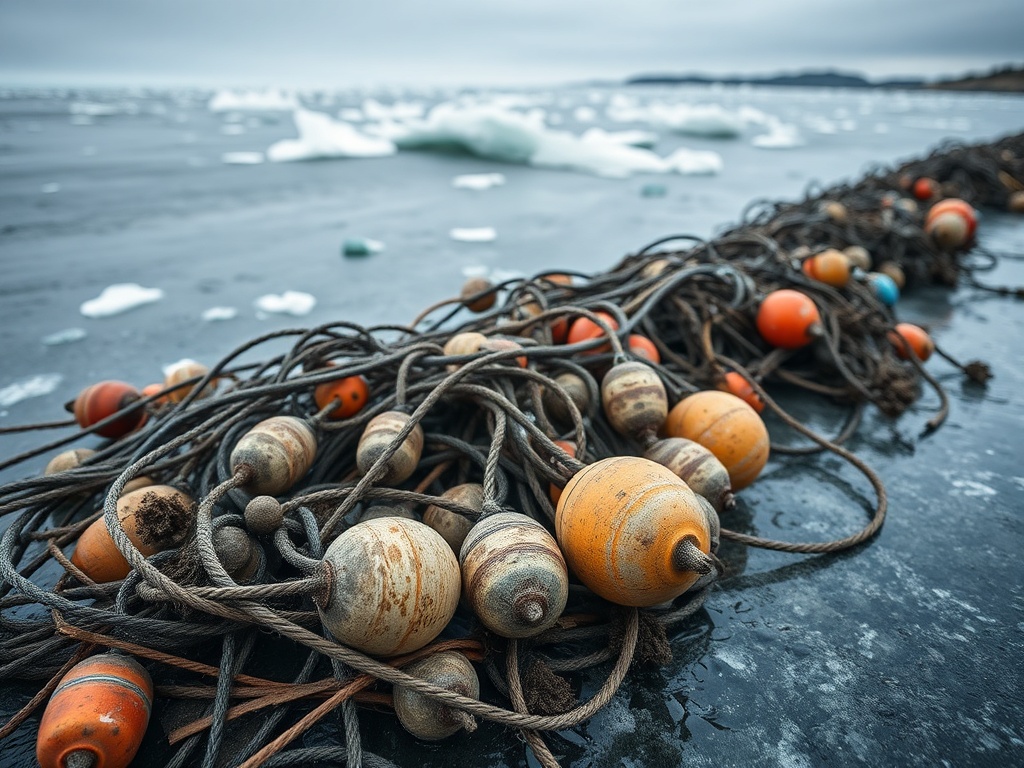
Ray Smith opened the spring season of 2026 and found devastation. Of the 2.6 million oysters that his company, Toasted Oysters, had deployed in the Great South Bay, only 20% remained. The ice had severed harvest lines, the waves scattered the equipment, and approximately two-thirds of the production infrastructure simply disappeared. The loss wasn't only of product; it represented years of effort. The oysters planted in 2026 won't be ready until 2027 or 2028. The immediate financial impact for the entire industry exceeds two million dollars, with a documented 44% drop in the January harvest already recorded.
Federal representative Nick LaLota requested a disaster declaration for fisheries under the Magnuson-Stevens Act, a mechanism that would unlock emergency funds. The agency confirmed it is assessing the request. Meanwhile, producers are left waiting.
This is the newsworthy fact. My analysis goes deeper.
When the Periphery Collapses Alone
What interests me most about this crisis is not the ice. It’s the invisible architecture that left these producers with no options at the moment of impact. Toasted Oysters is the name appearing in all reports, but the oyster industry of Long Island is composed of small and medium-sized independent operations, lacking vertical integration, income diversification, and, apparently, any collective response mechanisms to external shocks.
That’s the pattern I want to audit: an industry that grew steadily between 2020 and 2025, with an estimated annual production increase of 15%, but channeled that growth towards more volume rather than more structural resilience. When the demand for oysters skyrocketed by 20 to 30% annually between 2023 and 2025, driven by culinary trends and post-pandemic recovery, Long Island producers focused on scaling up harvests. Reasonable. But this growth was built on a foundation of operational isolation that no good sales year could disguise.
The consequence is mathematical: when the ice hit, each producer faced the crisis from their own silo. There is no evidence in the available reports of mutual contingency funds among producers, previous agreements for supply substitution, or differentiated agricultural insurance contracts for extreme climatic events. The call to Congress was the only available containment mechanism, and that process takes months to activate, if it even does.
This is not a failure of character or ability. It is the predictable result of a vertically constructed network, where each node works for the final market, but with no horizontal ties between peers that allow for collective absorption of shocks. Such a network does not fail under normal conditions. It spectacularly fails when the first tail event occurs.
The Hidden Cost of Not Building Collective Capital
The quantifiable damage is just the starting point, not the ceiling. The more than two million dollars in immediate losses are the visible surface. Beneath operates a cost structure that exacerbates the scenario: replenishing two-thirds of the equipment in a medium-scale operation may cost $500,000 or more per company. Multiplied by the number of affected producers, the projected impact by 2027-2028 could escalate between five and ten million dollars if there is no effective intervention.
But there’s another cost that financial statements do not yet capture: the erosion of market positioning. With a 44% drop in the January harvest, New York distributors are already pivoting toward suppliers from Virginia and Canada. These business ties do not automatically revert when Long Island resumes production. The market has a short memory for prices but a long memory for supply reliability.
Here is where the absence of a horizontal network among producers extracts its highest price. A cooperative with cross-supply agreements could have absorbed some of the demand while certain producers recovered. An industry contingency fund capitalized in good years could have covered equipment replenishment without relying on federal bureaucracy. None of these structures appears to be mentioned in the available reports, suggesting they simply do not exist or exist to such a minimal extent that they triggered no response.
The business model of this industry relies on product quality and loyalty from restaurants and bars in New York City, which absorb approximately 70% of regional production during peak season. That loyalty is valuable, but it is a fragile asset when supply is interrupted for months. Commercial trust is built over years and lost in a season without product.
Growing Without a Net Is Not a Strategy, It’s a Bet
What this crisis exposes with surgical precision is the difference between growing and consolidating. Long Island had years of genuine growth: rising demand, steady prices, expansion of operations. But growth without the accumulation of collective capital, without mechanisms for risk transfer among peers and without shared response infrastructure, is simply a bet that there won't be harsh winters.
There will be harsh winters. Climate data already indicated significant ice events in 2018 and 2023. The 2026 event was not a statistical surprise: it was the escalation of a documented trend. An industry with management teams more diverse in perspectives, with producers from different generations and backgrounds sharing intelligence on climate patterns, and with links to local scientific communities like the one supported by the Billion Oyster Project, would have processed that signal differently. Operational homogeneity not only produces the same products: it creates the same blind spots.
Mike Miezianka, co-owner of Toasted Oysters, was direct: he called for help to "rebuild and repair the infrastructure needed to make Long Island oyster farming a viable industry again." That statement deserves attention. He didn’t say the industry was destroyed; he said it needs infrastructure to be viable. This implies that the resilience infrastructure, not just the productive one, was never fully constructed.
The federal disaster declaration, if approved, will inject between one and five million dollars in emergency aid. That capital can stabilize the short term. But if producers use it exclusively to replenish individual equipment and revert to the same isolated operating model, the next extreme winter will find them exactly in the same position.
The capital this industry needs is not just financial. It is the capital that is built when producers consciously decide that collective success is a condition for their individual success. The networks forged before the crisis are the only ones that work during it. Those improvised after the disaster are just public relations efforts.
Any executive reading this analysis who thinks it only applies to Long Island oyster farmers should reassess how many of their strategic suppliers operate under the same isolation scheme. And they should do it before the next winter, not after.
---
Observe the room at your next board meeting. Identify how many genuinely distinct perspectives on climate risk, supply chain, or market dependence are represented around that table. If everyone arrived at the same position through the same path, in the same industry, with the same references, they inevitably share the same blind spots, and the ice they did not anticipate is already forming somewhere they are yet to look.