
SME D Bank bets on manufacturing and reveals where the money is in Thailand
Thailand's Small and Medium-sized Enterprise Development Bank (SME D Bank) has just made a move that few analysts outside Southeast Asia are reading correctly. The institution announced its intention to raise by 10 percentage points the proportion of its portfolio allocated to the manufacturing sector, moving from the current 30% to 40% before the end of 2026. Behind that number lies a strategic bet that goes far beyond credit policy: it is a signal of where the Thai state believes the next engine of productivity for its SMEs will be found.
To understand the magnitude of the move, it must be placed in its numerical context. SME D Bank holds an active loan portfolio exceeding 100 billion baht (approximately 2.8 billion US dollars). Its disbursement target for 2026 is 80 billion baht, slightly above the 79 billion recorded the previous year. In the first quarter, it had already placed 19.8 billion baht, surpassing its partial target by 300 million. An institution that operates with that level of precision does not announce a 10-percentage-point shift in its sectoral composition without a very specific prior portfolio analysis.
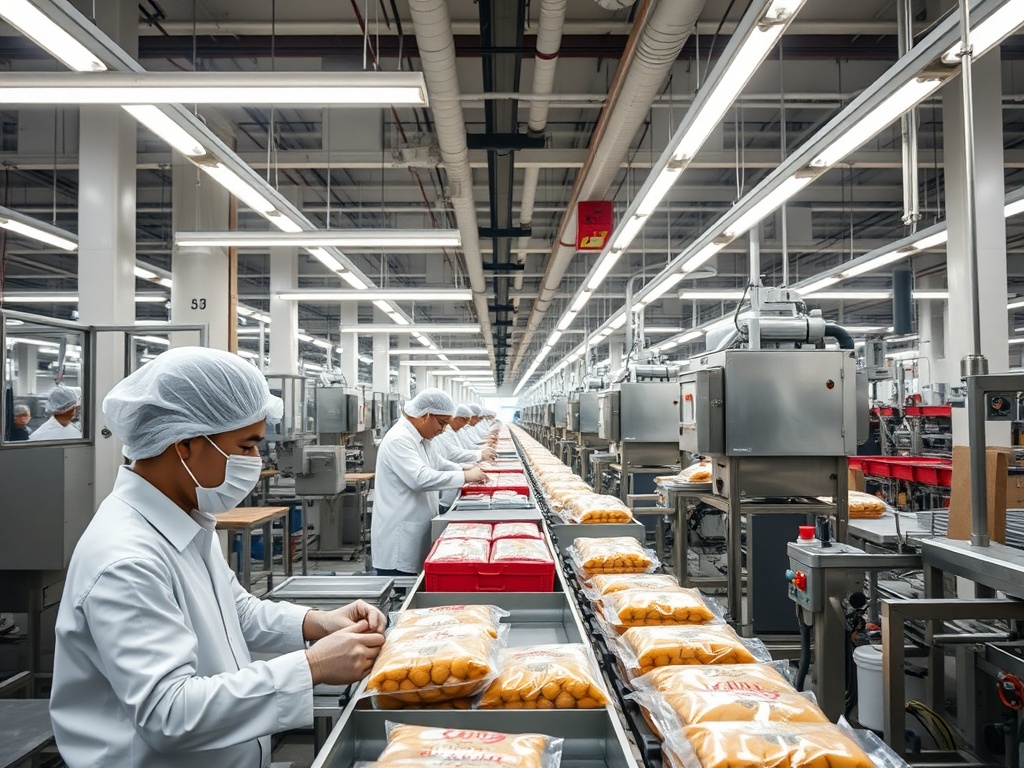
Phichit Mitrawong, the bank's director general, was clear in his reasoning: the three industries that will receive priority are food manufacturing, agro-industrial processing, and health and wellness. All three share a characteristic that is no coincidence: they are sectors where Thailand holds exportable comparative advantages, domestic supply chains with multiple links, and structural demand that does not depend on local consumption cycles. They are, in terms of credit risk, the opposite of financing retail trade in an environment of tight liquidity.
The diagnosis the bank did not say out loud
When a development institution announces that it wants to increase manufacturing and reduce the relative weight of wholesale and retail trade (currently 40% of its portfolio), it is implicitly admitting something uncomfortable: the money that went into trade did not build value chains. It financed inventory, covered liquidity gaps, and in too many cases ended up in the column of non-performing loans.
The bank's non-performing loan ratio closed the first quarter of 2026 at 7.86% on a portfolio of 100 billion baht. That figure improved slightly compared to the 7.9% recorded at the close of 2025, but it still represents approximately 7.86 billion baht in impaired loans. The institution maintains a coverage ratio of 158% over its at-risk assets, which means it is technically well capitalised to absorb losses. But the bank's recent history is a warning no executive can afford to ignore: its non-performing loan rate reached 50% in 2008, forcing it to enter a rehabilitation plan under the State Enterprise Policy Office. Two decades later, no one at that institution wants to revisit that conversation.
The pivot toward manufacturing, then, is not industrial philanthropy or uncritical adherence to government policy. It is a risk management decision disguised as a development strategy. Loans to food manufacturers and agro-industrial processors tend to have physical assets as collateral, more predictable cash flows tied to export contracts, and lower exposure to local consumer volatility. Compared to financing a retail distributor in a year when drought or conflict in the Middle East can cut off demand abruptly, export-oriented manufacturing offers a more manageable risk architecture.
What the non-performing portfolio reveals about the bank's value proposition
This is where the analysis becomes genuinely interesting for any leader building a financial institution, a credit fund, or simply a company that sells to SMEs. SME D Bank has a problem that goes beyond the numbers: its own description of its borrowers' behaviour exposes a flaw in the structure of its offering.
Mitrawong stated that borrowers are using the credits "mainly to support business liquidity rather than to invest in expansion." That phrase is the corporate equivalent of an intensive care diagnosis. When the money you extend as a development loan ends up being operational working capital, it means the client you are receiving does not have the minimum conditions to grow — only barely enough to survive. The loan is not financing a desired outcome; it is postponing a structural problem.
From the angle of commercial viability, this creates a specific trap: the bank reaches its disbursement targets (and in fact marginally surpasses them), but the real impact on manufacturing productivity is marginal. The money enters through one door and exits through the same door disguised as operating expenses. The perceived certainty of the client regarding whether that credit will take them somewhere different in 24 months is, at best, low. And when the perceived certainty of the outcome is low, the willingness to formalise, to document, to grow within the financial system also falls. That, accumulated over years, is what builds non-performing loan portfolios of 50%.
The shift toward manufacturing with a focus on integrated supply chains is, in this context, an attempt to change the borrower profile before changing the product. The three prioritised industries have something that wholesale trade does not have to the same degree: contractual demand derived from third parties. A food manufacturer that exports to Japan or Europe has buyers who pay in hard currency and with agreed timelines. That contract is the true collateral that transforms a survival loan into a scale loan.
The risk that 2026 has yet to resolve
The bank's bet faces two threats that Mitrawong named without equivocation: drought, flooding, and the prolonged conflict in the Middle East. These are not rhetorical risks. Thailand depends on its agro-industrial chains for a significant portion of its exports, and both variables — climatic and geopolitical — can cut demand or destroy production before the credit has generated the expected return.
The conflict in the Middle East has one direct and one indirect transmission channel toward Thai manufacturing SMEs. The direct one is the rise in energy costs, which pressures the production costs of any factory that is intensive in electricity or fuel. The indirect one is the disruption of maritime transport routes that affects delivery times and logistics costs to export markets in Europe, North Africa, and the Persian Gulf. For a manufacturing SME operating on thin margins that has just taken out a loan to expand capacity, that double impact can quickly convert a productive loan into an unproductive one.
The acceleration of government budget disbursement that Mitrawong mentioned as a stabilising factor for domestic liquidity is real, but it has a limited effect on exporters. The 327 billion baht allocated by the Thai government to support SMEs in 2026 creates a floor of domestic demand, but it does not resolve the vulnerability of a manufacturing portfolio that, by definition, needs external markets to justify its scale.
What the bank is building, with its strengths and its open risks, is a model where sectoral selection does the work that product structure cannot do alone. Choosing borrowers with export contracts, physical collateral, and verifiable supply chains reduces the friction of the collection process before a problem even arises. That does not eliminate climate or geopolitical risk, but it radically changes the probability that a loan placed in the right sector will end up in the column of impaired assets. The lesson for any institution that lends money or sells high-value services to SMEs is the same: the client profile you choose before closing the deal determines 80% of your outcome. The remaining 20% is management. And no percentage of provisions can save a portfolio that was built on the wrong profile from the very beginning.