
IFF's AI Knows How to Generate Concepts, but Someone Has to Know How to Use It
There is a moment in product development that nobody wants to say out loud: the moment when the innovation team stares at a blank page and does not know where to begin. It is not a lack of talent. It is that the early ideation process — that period when everything is possible and nothing is validated — remains, in most organizations, a mixture of intuition, experience bias, and the speed of the budgetary clock. IFF has just bet that this moment has a technological solution. The question is not whether the launch of CONCEPT MUSE is smart. It is. The more interesting question is what it reveals about how innovation systems are — or are not — built to function without depending on a brilliant person being in the room.
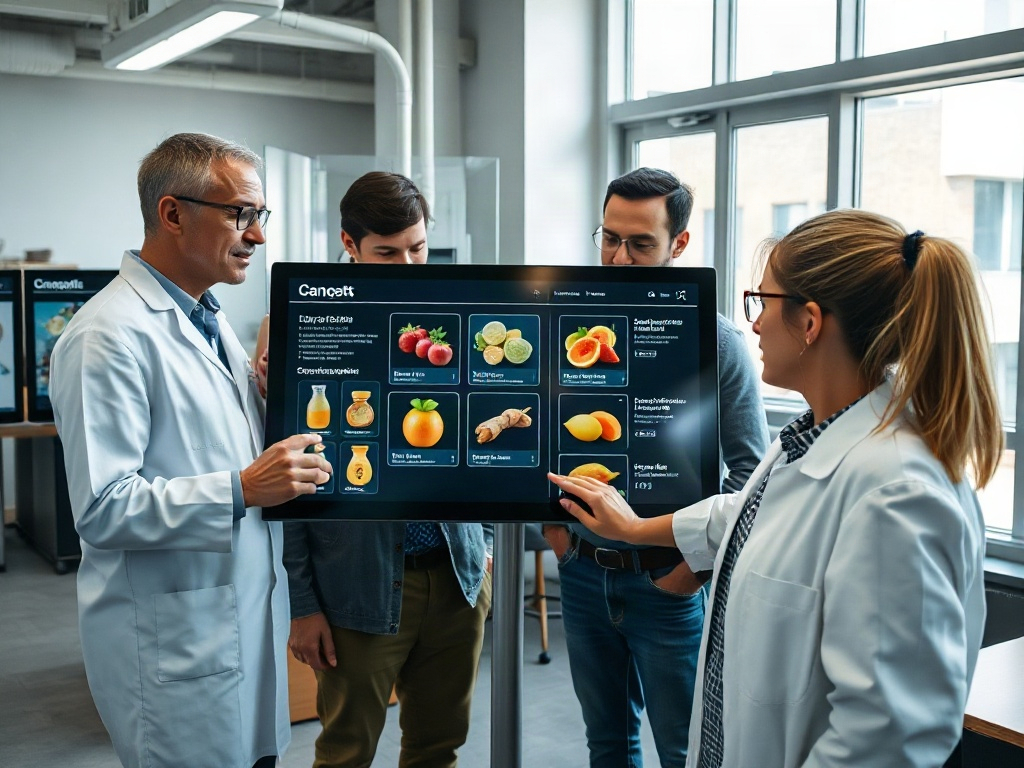
CONCEPT MUSE is a generative artificial intelligence platform developed internally by IFF, the flavors, fragrances, and biosciences giant listed on the New York Stock Exchange. The system takes simple text instructions and produces product concepts for food and beverages: written narratives, visual representations, and suggestions for applicable technologies. Behind each result is not a general-purpose model connected to the internet, but rather a combination of IFF's proprietary data: market intelligence, consumer trend knowledge, flavor expertise, and decades of formulation experience. The company presented the tool at its FirsTaste client event, where IFF experts used it in live demonstrations to co-create concepts with clients and adapt ideas to specific brands and markets.
Benjamin Mattei, Vice President of Intelligence and Digital Transformation for IFF Taste, was direct in his description: "Innovation in food and beverages has always been a balance between art and science. Digital transformation now adds a new dimension to that equation." What he did not say explicitly, but what can be read clearly in the product's architecture, is that this new equilibrium carries an important structural consequence for any company that adopts it.
The Problem CONCEPT MUSE Did Not Invent
The food and beverage industry operates under pressure that has intensified over the last five years: more SKUs, more speed, more segmentation by consumer profile, more sustainability and functionality demands. Product development cycles that previously lasted 18 to 24 months are today considered too slow for many segments. And the most persistent bottleneck is not in technical formulation or ingredient sourcing. It is in the prior stage: ideation.
Early ideation depends on people who know how to ask the right questions. Which consumer trends are signal and which are noise. Which market spaces are underserved. Which combination of attributes — flavor, texture, format, functional positioning — has a real probability of standing out on the shelf. That work demands synthesis between quantitative data, qualitative interpretation, and technical judgment. And in most organizations, that judgment lives in the heads of two or three people. When those people are busy, the organization waits. When they leave, the organization loses.
CONCEPT MUSE attacks that problem from a specific angle: if part of the knowledge currently concentrated in human experts can be encoded in a system, then the system can work in parallel, can scale, and can reduce dependence on the right people being available at the right moment. That is not a minor promise. The company did not publish time-saving metrics, but the qualitative description — moving from weeks to minutes in the conceptualization stage — suggests they are talking about an order-of-magnitude change in ideation productivity.
What makes this bet strategically interesting is not that IFF used artificial intelligence. It is that they chose to build it on their own proprietary knowledge corpus rather than exposing their clients to a generic model. That decision has direct economic implications: a model fed by IFF's data will naturally produce concepts that gravitate toward technical solutions where IFF has execution capacity. This is not manipulation; it is design. The system does not only generate ideas; it generates ideas for which IFF can provide the technical answers. That transforms CONCEPT MUSE into something more than a productivity tool: it is a commercial positioning mechanism at the earliest stage of a client's innovation funnel.
What the Press Release Does Not Say and the Market Should Read
Mimi Sherlock, Vice President of Global Human Futures for IFF Taste, made a statement that deserves more attention than it probably received in the immediate coverage of the launch: "The value of CONCEPT MUSE doesn't come from simply pressing 'generate.' It comes from the expertise behind it — how IFF experts frame the challenge, select the right inputs, critically evaluate the results, and continuously refine. It is human-guided, not on autopilot."
That statement is simultaneously an honest description of the product and a structural warning that organizations adopting the tool should take seriously. Because what Sherlock is describing is not an autonomous solution. It is a system whose output quality depends directly on the quality of the human judgment operating it. Artificial intelligence amplifies the capacity of the operator. If the operator knows how to frame an innovation challenge well, the system produces more relevant concepts. If the operator does not know what they are looking for, the system produces volume without direction.
This has an organizational consequence that few companies are willing to articulate openly: adopting CONCEPT MUSE does not eliminate the need for people who deeply understand the consumer market, category dynamics, and the technical viability of a concept. What it does is reveal, more quickly and more expensively, whether those people exist within the organization, or whether the innovation team was relying on inherited heuristics that were never codified anywhere.
The silent trap of AI-assisted ideation tools is that they can create the illusion of a mature innovation system in organizations that, in reality, have a weak knowledge infrastructure. If a company generates one hundred concepts in a day and does not have the analytical capacity to distinguish which ones have technical viability, consumer relevance, and sound product economics, the result is not more innovation. It is more noise. The volume of possibilities does not replace the capacity for selection.
The Strategic Move Nobody Is Naming
IFF operates in a market where its historical competitive advantage lies in the depth of its technical knowledge and in the quality of its relationships with clients' development teams. The traditional model for a supplier of ingredients of this type is reactive by design: the client defines a brief, the supplier responds with formulations, prototypes are iterated, and eventually a product is reached. In that model, IFF enters when a direction already exists. CONCEPT MUSE shifts that point of entry.
If a food manufacturer's innovation team starts using CONCEPT MUSE in the exploration stage — before even a defined category exists — then IFF is present in the conversation while it is still being decided which problem is worth solving. That is a qualitatively different place in the value chain. It is not the supplier that responds; it is the system that helps formulate the question. The distance between those two positions, in terms of influence over subsequent purchasing decisions, is considerable.
The announcement also mentions KALEIDO Immersive Spaces, IFF's immersive collaboration environment that combines visual storytelling, flavor, aroma, and other sensory dimensions. The coexistence of CONCEPT MUSE and KALEIDO in IFF's digital tools portfolio suggests a coherent strategy: to digitize the co-development experience with the client from start to finish, from conceptual ideation to sensory evaluation. That is not an addition of tools; it is a redesign of the collaboration model.
What IFF is building — if CONCEPT MUSE works as promised and achieves real adoption — is a layer of technical dependency prior to any formulation contract. Clients who integrate the system into their innovation workflows will not only be buying ingredients; they will be buying access to an ideation infrastructure that lives within the IFF ecosystem. That has implications for the power dynamics of the commercial relationship that the launch press release does not mention, but that any procurement director should consider.
The Organizational Maturity the System Cannot Buy
There is something that the adoption of CONCEPT MUSE cannot resolve and that, paradoxically, becomes more visible when the tool is implemented. The underlying question in any AI-assisted innovation system is not technological. It is structural: does the organization have the capacity to act on what the system generates.
A concept produced by CONCEPT MUSE — a product narrative, a visual mockup, a technology suggestion — still needs to be evaluated in terms of commercial viability, fit with brand strategy, regulatory feasibility, supply chain, and product economics. None of those judgments can be delegated to an AI system in the current state of the technology. All of them require people with judgment, authority to decide, and willingness to commit resources to exploration.
What happens in organizations that adopt ideation tools without having resolved that decision-making architecture is well known: the system generates, teams get excited about the speed, more concepts are produced than the process can absorb, and eventually the selection funnel — which remains human and remains understructured — becomes the new bottleneck. The tool did not fail. The organization was not ready to use it.
Sherlock's statement about the role of IFF's experts in the process is, in that sense, a competitive advantage that IFF holds over its own clients: they do have the people who know how to operate the system with judgment. For a food manufacturer that adopts CONCEPT MUSE as an external tool, the most important operational question is not whether the AI generates good concepts. It is whether they have the internal team with the capacity to evaluate those concepts with sufficient rigor to turn them into justifiable investment bets.
The maturity of an innovation system is measured less by the sophistication of its tools and more by the clarity of its selection criteria and by the speed at which it can move from a promising idea to a market test at a controlled cost. CONCEPT MUSE can accelerate entry into the process. It cannot, by itself, build the process.
IFF knows this. That is why it is not selling a tool; it is selling access to its experts working with the tool. The difference between those two value propositions is precisely the distance between a promise of automation and a collaboration architecture with real substance.