Oracle Spends $2.8 Billion to Reinvent Itself: This Is What the Real Cost of the AI Transition Looks Like
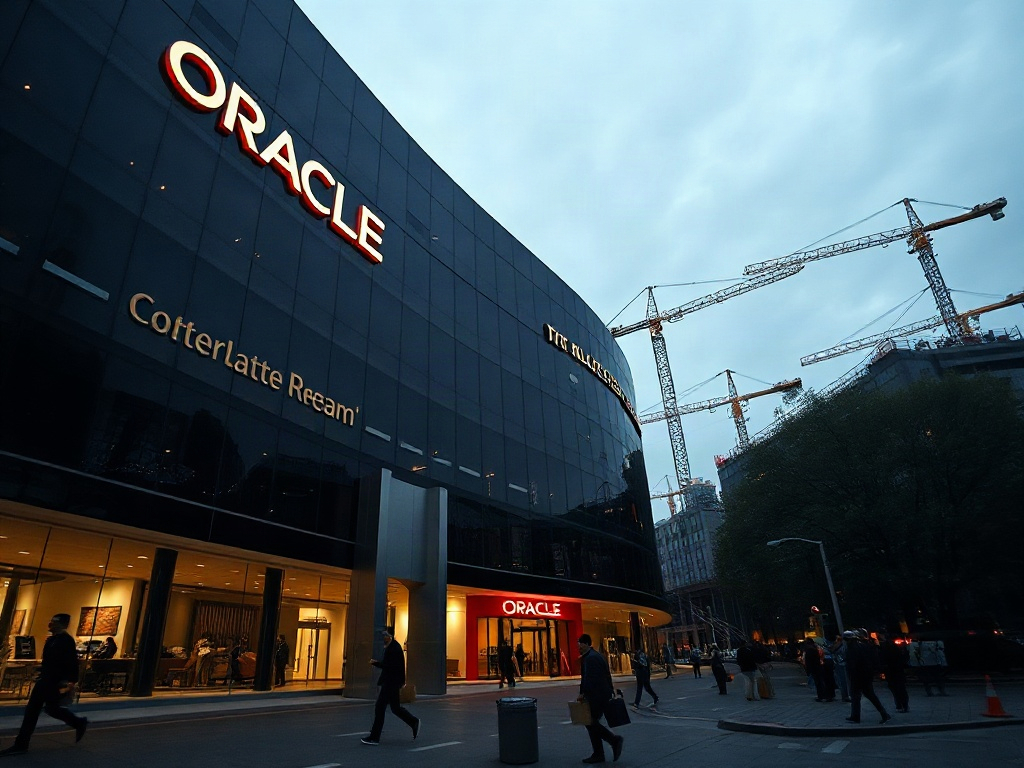
Larry Ellison cancelled in September 2026 a plan to sell up to 50 million Oracle shares, equivalent to roughly $7.5 billion at that Friday's closing price. No official explanation was given. What did appear in a regulatory filing submitted that same week was another figure: Oracle expanded its fiscal 2026 restructuring plan by an additional $700 million, bringing the total expected cost of the programme to approximately $2.8 billion. Both pieces of news arrived almost simultaneously, and together they reveal something harder to name than a number: the moment at which a corporate structure can no longer sustain itself on the logic that built it.
Oracle is not a young company betting on growth from scratch. It is one of the most established software corporations on the planet, with decades of infrastructure, enterprise contracts and customers that have built their operations on its databases. For a company like that to decide to absorb nearly three billion dollars in reorganisation costs — severance payments, contract terminations, operational exits — while simultaneously planning to spend more than $70 billion on artificial intelligence infrastructure during the current fiscal year, is not a signal of expansive strength. It is the signal that something in the internal architecture no longer adds up, and that the cost of acknowledging that fact has arrived before the revenues that are supposed to justify the change.
The Number That Matters Is Not the AI One, But the Layoffs One
The restructuring programme that Oracle expanded includes, according to the regulatory filing itself, severance costs for separated employees, early contract terminations and other exit costs. The company was explicit in linking part of these actions to the adoption and integration of artificial intelligence technologies into certain functions. That deliberately technical language describes, in accounting terms, something with concrete labour consequences: approximately 21,000 positions eliminated over the preceding year, around 13% of the total workforce.
The affected areas cover almost the entire structure of the company. Research and development lost around 7,000 employees. Sales and marketing, roughly 6,000. The cloud and services divisions, approximately 3,000 each. The hardware division lost close to a third of its workforce. Administrative functions also contracted. There is not a single part of Oracle that has been left out of the adjustment.
What makes this case analytically distinct from other rounds of mass layoffs in technology is the nature of the justification. Oracle does not say it is cutting because business is going badly. It says it is cutting because AI is changing the way certain functions operate internally. That turns the adjustment into something more structural than cyclical: it is not a defensive contraction in response to a revenue decline, but an offensive reorganisation that shifts the weight of human labour toward automated systems while redirecting capital toward the infrastructure that supports them.
The problem with that logic is not that it is false. It is that it carries a very high present cost and a still-uncertain future benefit. The $2.8 billion in restructuring charges are recorded now. The savings they are supposed to produce, and the AI revenues that are supposed to justify the investment in data centres, still have no precise arrival date.
A $664 Billion Order Backlog That Is Not Yet Cash
Oracle reported at the close of its most recent quarter a cumulative order backlog of $664 billion, with an increase of $26 billion during the period. The company estimates that approximately half of that backlog will convert into sales within the next 36 months. Presented that way, it sounds like a figure of solidity. But context changes its texture considerably.
Free cash flow was negative at $5.4 billion during the period, though better than analysts had anticipated. Oracle plans to raise $40 billion through debt and equity issuance during the current fiscal year, including a $20 billion placement completed in the first quarter. The stock has fallen close to 23% year to date, while the S&P 500 index advanced nearly 12% over the same period.
What is being described is a company that has signed commitments but negative cash, that is issuing debt and equity to finance infrastructure, and that is simultaneously absorbing billions in exit costs from its previous workforce. The $664 billion backlog is not revenue; it is a contractual promise distributed across time. And part of the infrastructure that Oracle needs to build to honour those contracts will depend, according to its own statements, on customer prepayments and, in some cases, chips supplied by the customers themselves. In other words, Oracle is shifting part of the capital cost onto its buyers. That works if buyers trust the platform sufficiently. If that trust erodes, the mechanics become fragile.
Investors know it. The reaction to the quarterly report was illustrative: shares rose as much as 7.8% in the hours immediately after results were published and then closed the day down 2%. The market processed the numbers, found the friction the headlines did not show, and adjusted. That dynamic — a reflexive rally, followed by a correction when analysis arrives — is the signal of an asset that the market still does not know how to value with precision.
What Oracle Is Revealing About the Systemic Cost of the Transition
The Oracle case is not the case of a company that lost its way. It is the case of a company that found a new direction and is discovering in real time how much it costs to dismantle the previous one. That difference matters for reading correctly what is happening across the large-scale technology sector.
For decades, large enterprise software companies built their advantage on layers of integration, specialised human capital and long-term contracts. That architecture produced high margins because switching costs for customers were enormous. Oracle was, in many respects, the archetype of that model. Its databases, its ERP systems, its support contracts: everything was designed to create structural dependency that would protect recurring revenues.
AI does not destroy that logic overnight. But it does begin to alter a specific part of it: the ratio between human labour and processing capacity within the provider's own operations. If a function that required 500 people can be executed with 50 plus a well-configured natural-language system, the provider's cost structure changes. And with it, the justification for the organisational structure that supported it also changes.
What Oracle is doing — expensively, with visible friction and an income statement that shows the weight of the adjustment — is bringing that recognition forward. The problem is that bringing that recognition forward requires financing, and financing requires market confidence, and market confidence requires that future AI revenues be sufficiently predictable to justify the present. That cycle is not yet closed.
The cancellation of Ellison's share-sale plan adds an additional layer of interpretation. When the majority shareholder of a company decides not to sell shares at a moment when the price has already fallen more than 18% from the level at which he adopted the sale plan, several readings are possible. One of the simplest is that selling at that point would send a signal of lack of conviction in the asset he himself leads. In that context, not selling is not necessarily optimism: it may be perception management at a moment when the company's narrative needs stability more than personal liquidity.
What the Oracle case puts on the table, with its $2.8 billion in restructuring costs and its record order backlog that still does not generate positive cash flow, is an uncomfortable truth about large-scale technological transition: the cost of exiting a structure is not paid by the future; it is paid by the present. And in companies of Oracle's size and complexity, that present has faces, contracts and entire divisions that disappear before the language models replacing them have demonstrated that they can sustain what they promised.