
$67 for Life: The Financial Bet Few Calculate Correctly
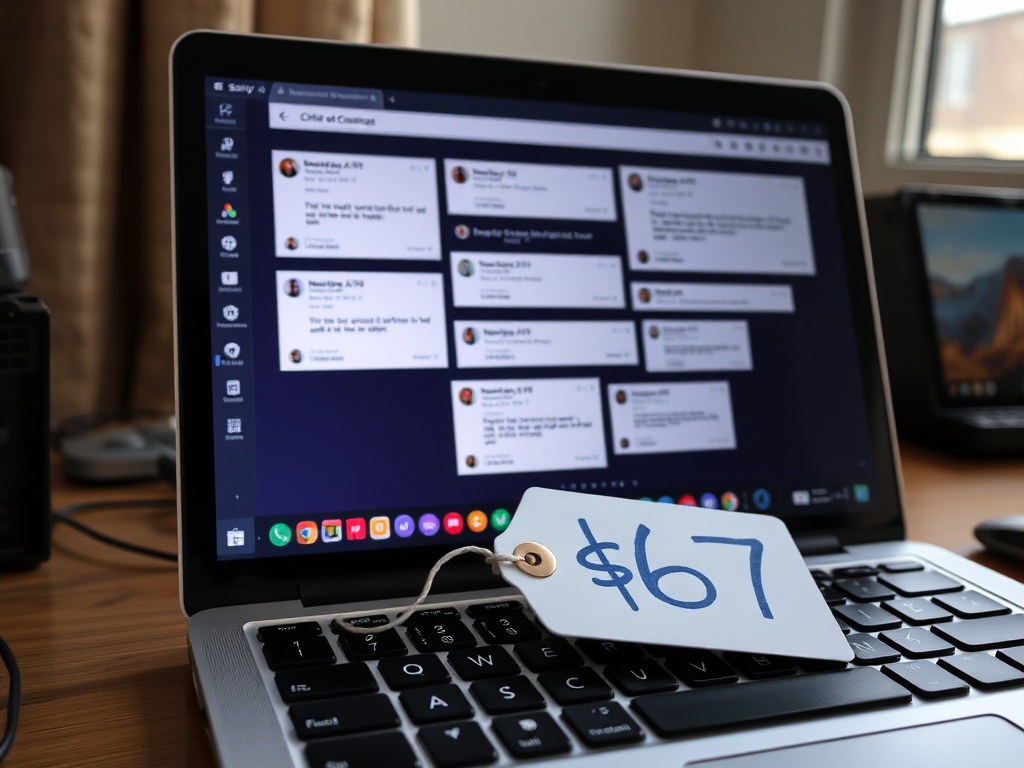
A compelling offer is circulating in tech circles that deserves more scrutiny than it receives: ChatPlayground AI, a platform that consolidates over 20 artificial intelligence models into a single interface, is offering unlimited lifetime access for a one-time payment of $67.15. Its listed price is $619, making the advertised discount exceed 89%.
Most readers who see this figure react in one of two ways: they either buy without thinking, or assume there is a catch. Both reactions miss the more useful exercise of auditing the financial logic of the model the company is using to support that promise.
This isn’t an article about whether the offer is good or bad for consumers. It’s an analysis of what that price reveals about how the business is constructed internally, and what signals it sends to any leader evaluating similar structures in their own company.
The Problem of Selling "Forever" with a One-Time Payment
A one-time payment for perpetual unlimited access has a very specific and demanding financial mechanic. For it to be viable, the company needs the cost of serving that user over time to be less than the income received on the day of sale. With software based on third-party APIs—which is precisely the case for a platform that aggregates models like GPT-4, Claude, Gemini, and similar—this equation is structurally difficult.
Here’s the concrete problem: every time a user sends a prompt through ChatPlayground, the platform consumes API tokens that OpenAI, Anthropic, Google, or other providers charge for usage. This cost does not disappear because the customer has already paid. On the contrary, the service cost accumulates over time while the income remains fixed at $67 from day one.
If an active user conservatively generates $3 to $5 in API consumption each month, the margin from that one-time payment runs out somewhere between month 14 and month 22. From there on, every session with that user costs money that the company does not recoup from that account. The "unlimited" plan amplifies the risk because it removes the natural brake that a monthly message plan would have.
The only way this works financially in the long term is if the company assumes that most users buying lifetime deals do not use them intensively. It’s a statistical bet on human behavior, not on software economics.
Distribution Platform Matters as Much as the Product
The offer is not sold on ChatPlayground’s own site. It is sold through StackSocial, a platform specialized in distributing software with aggressive, time-limited discounts. This distinction is not a minor detail; it lies at the core of the acquisition strategy.
StackSocial charges a commission on each sale, typically between 30% and 50% of the transaction price in these kinds of markets. If we apply a conservative percentage of 35% on the $67.15, the company receives approximately $43.65 net per license sold, before any operational costs.
That number completely changes the analysis. The company is not charging $67 per customer; it’s charging less than $44, and against that net revenue, it needs to sustain infrastructure, API costs, support, updates, and the cost of acquiring new accounts to maintain cash flow while existing customers consume the accumulated margin.
Any CFO should ask themselves when evaluating a similar model, not whether the price is attractive to the market, but the correct question: how many new accounts need to be sold each month for incoming revenues to cover the service cost of accounts sold in previous months? If that curve grows faster than the active user base, the model is sustainable. If it reverses, the company enters a cycle where past customers consume more than new ones generate.
When the 89% Discount is Strategy, Not Error
The list price of $619 primarily exists to make the $67 discount seem extraordinary. This price anchoring mechanism is a well-documented marketing tactic, and there’s nothing inherently wrong with using it. But for the financial analyst, the relevant number is not the discount but the actual gross margin per unit.
If the API cost per user in the first year hovers around $30 to $40 in a moderate usage profile, and the net income after commissions is $43.65, the gross margin for the first year might range between $3 and $13 per customer. That’s between 7% and 30% gross unit margin, figures that in any conventional software company would raise immediate red flags.
Well-structured SaaS companies operate with gross margins between 70% and 85% precisely because their service costs are low and scalable. A model that depends on third-party API consumption breaks that logic because the variable cost does not disappear with volume; it grows with it.
What makes this operation sustainable, at least in the short term, is the speed of sales. As long as the flow of new licenses exceeds the rate of consumption of old licenses, the cash flow works. It’s a model financed by new customers to cover commitments to previous customers, a structure that demands constant sales growth to maintain balance. When that growth halts, the numbers adjust in ways that lifetime license holders generally find out too late.
The Lesson for Those Building Their Pricing Models
Beyond this specific offer, the pattern it reveals is instructive for any company designing its pricing architecture. The temptation to capture customers with attractive one-time payments is real, especially when competing against platforms with visible monthly subscriptions. However, a one-time payment shifts all the risk of future usage to the seller, without an adjustment mechanism.
Companies that have built robust revenue models in software tend to do the opposite: they convert as much of their variable costs as possible into predictable recurring revenue. A monthly subscription of $15 with usage limits is not less competitive than a lifetime deal of $67; it is a structure where income per customer grows in proportion to the value that customer extracts, and where the company retains the ability to adjust prices if API costs rise, if a provider changes its terms, or if demand skyrockets.
That alignment between service cost and recurring income differentiates a financial architecture that can withstand adverse cycles from one that relies on the market never stopping. Today’s $67 finances today’s service. Next month, that user continues to consume, and the only source of income is another new customer buying another lifetime deal.
Businesses that last and provide real control to their founders are those that charge for the value they deliver continuously, month after month, with each active customer. This is not an opinion on pricing models; it’s the only mechanic that ensures the business’s cash flow does not depend on more buyers arriving tomorrow than yesterday.