
The Self-Updating Car Redefines Automotive Margin Calculus
For over a century, the automotive industry has operated under an unchanging financial premise: the manufacturer produces, the dealer sells, the customer pays, and the relationship ends. Each transaction was a unique event, an exchange of asset for capital that closed the revenue cycle at the moment of signing. What is happening today with internet-connected vehicles—capable of downloading software updates on their own, weeks or years after leaving the dealership—is not merely a technological curiosity. It's the demolition of that premise and the construction of a radically different financial model, where revenue doesn't end with the sale; it begins there.
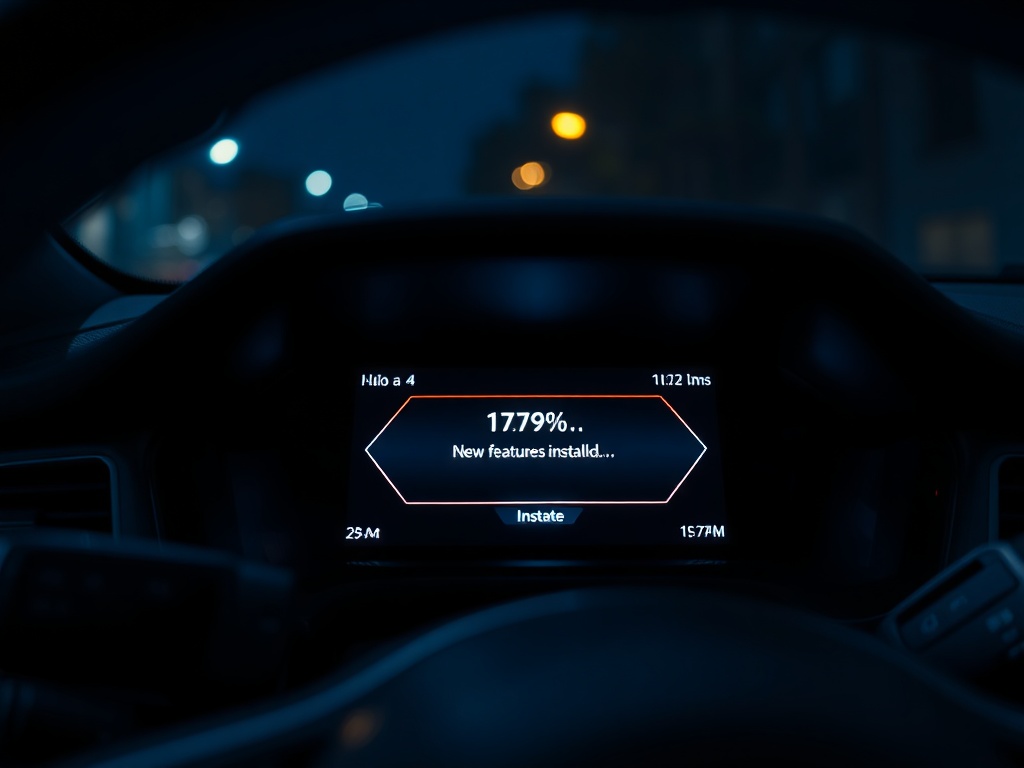
Modern automakers maintain active connections with sold vehicles and use this infrastructure to add new functionalities, correct performance issues, or unlock capabilities that the hardware already had but were dormant. The car a customer purchased last year can have more features today than it did when it was delivered. For buyers, this appears to be a free benefit. For manufacturers, it opens a second revenue stream on an asset that has already been monetized once.
Hardware as a Fixed Cost Generating Variable Revenue
Here's the mechanics I'm interested in breaking down. In the traditional model, manufacturing a car involves absorbing huge fixed costs—materials, manufacturing, engineering, distribution—and recovering it in a single sales event. The gross margin of a volume automaker rarely exceeds 15-18% of the sales price, and within that margin, the costs of warranties, aftermarket service, and recalls still weigh heavily. The net profitability of the sector historically ranges between 3% and 8%, depending on the economic cycle and segment.
The software update model notably changes the cost structure. The hardware is already paid for and delivered. The connectivity infrastructure—servers, software distribution networks, update engineering—represents a cost spread across millions of units. If a manufacturer has three million connected vehicles in circulation and launches a software upgrade that they charge for as a premium feature, the marginal cost of delivering that update to the three millionth vehicle is nearly zero. The margin on that transaction bears no resemblance to the car sale’s 15%; it can approach 70-80%, comparable to enterprise software.
This explains why the market for subscription features in connected vehicles—from advanced driver-assistance systems to fast charging capabilities or onboard entertainment—begins to receive strategic attention in the financial reports of major manufacturers. The incremental margin per unit already sold is the most interesting asset this sector has generated in decades.
Subscription as a Reconfiguration of Cash Flow
What transforms this into an underlying financial argument is the shift in cash flow. The one-time sale model creates a revenue peak at the time of the transaction and then silence. The updates and activatable features model turns that vehicle into an active commercial contact point throughout its lifespan, which averages over ten years.
If a manufacturer can get 20% of its base of connected vehicles to subscribe to at least one paid feature at an average value of $15 to $20 a month, the annual recurring revenue from that base can represent several hundred million dollars with minimal delivery costs. Over three million connected units, that 20% adoption generates between $108 and $144 million annually in high-margin revenue, without manufacturing a single additional vehicle. The existing customer finances revenue growth without the company needing to expand its production capacity.
That is what makes this model financially robust: it does not depend on selling more cars to grow. It depends on deepening the economic relationship with the cars already sold. The installed base becomes the cash-generating asset, and that asset was paid for by customers when they bought the vehicle.
There is a risk that cannot be ignored. The mass adoption of this model requires customers to perceive enough value to pay for features that in many cases were technically available from the outset. If the dominant perception is that the manufacturer is charging to unlock something that should already be included, the reaction can erode brand loyalty faster than any short-term margin gain. The financial architecture is brilliant; the commercial execution is where it can break down.
A Lesson the Automotive Sector Took a Century to Learn from Software
Software companies have been operating under this logic for decades. They sell access to a platform, maintain the relationship actively, and monetize in successive layers on the same customer base. The acquisition cost is amortized in the first contract; the true margin accumulates in renewals and expansions. The automotive industry, tied for generations to the economy of metal and manufacturing, arrived late to this conversation but comes with an asset that pure software companies do not have: hundreds of millions of physical vehicles in circulation, each capable of running new software.
Manufacturers that understand this transition not as a product strategy but as a reconfiguration of their revenue structure have the potential to transform a narrow-margin business into one with high-margin recurring components. The key does not lie in connectivity technology—that already exists—but in constructing a sufficiently concrete value proposition for customers to choose to pay voluntarily and consistently.
When a customer pays a monthly subscription from a vehicle they already purchased, they provide the manufacturer with something more valuable than the initial transaction: a predictable, high-margin cash flow, financed without debt and validated by a free market decision. That doesn’t require a funding round or optimistic projection. It’s already in the bank.