
60 Billion Reasons Not to Do Everything
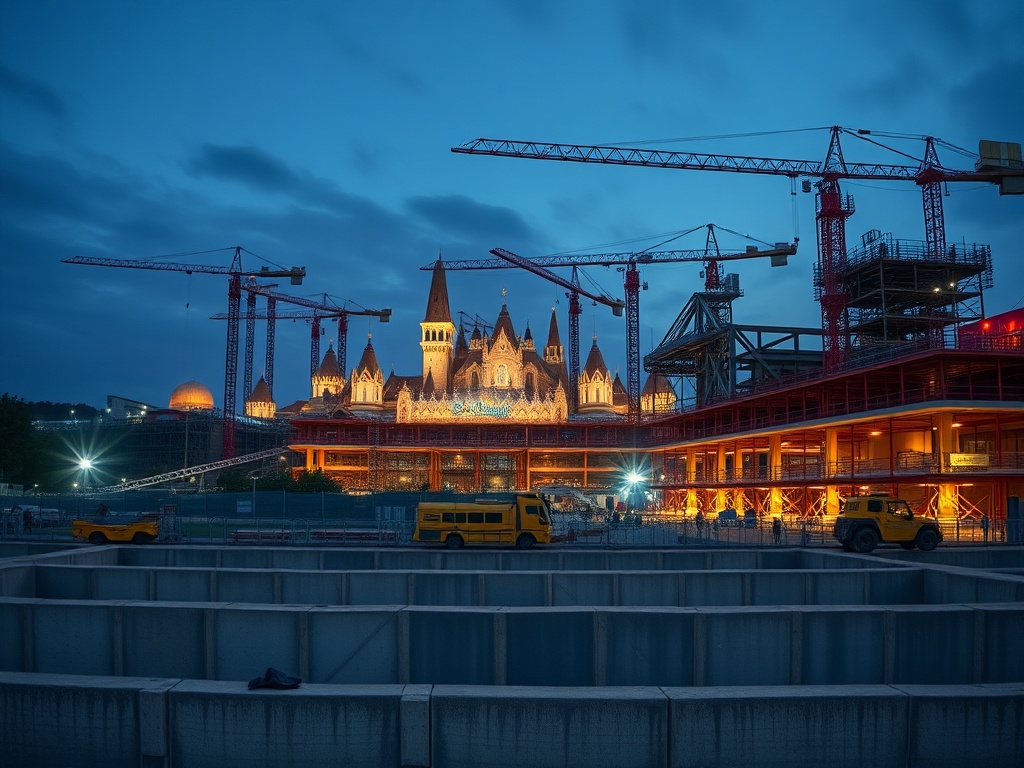
Disney has just cut the ribbon on World of Frozen at Disneyland Paris, crowning the largest expansion in the park's 34-year history. The amount committed to this project: €2.18 billion. A figure that few reports clearly mention: this European expenditure is just a fraction of a global program amounting to $60 billion aimed at parks, resorts, and cruises. This is not a gamble; it's a positioning statement that has been quietly in the making for years.
The new CEO of Disney presided over the inauguration in Paris, and the image carries symbolic weight. It’s not merely a PR stunt, but a clear indication of where the company has chosen to concentrate its executive energy in this cycle. When the head of such a large corporation appears at the opening of a theme park attraction in Europe, the message to the market is precise: this is not a secondary project in the portfolio.
The Bet That Forces Trade-offs
A $60 billion investment in physical experiences comes at a time when the entertainment industry has been migrating toward digital content for nearly a decade, and it deserves cool-headed analysis. Disney could have allocated that vast capital to accelerate its streaming platform, acquire content studios, compete in the digital advertising market, or diversify into interactive entertainment. It has not, or at least not equivalently.
This is not negligence; it’s a decision with direct consequences regarding which resources remain available for the various battles ahead. Committing $60 billion to high fixed-cost physical assets means accepting that there will be other fronts where the company cannot fight with the same intensity. Theme parks are structurally different from streaming: they require land, construction, operation, staff, and maintenance in proportions that no algorithm can compress. Profitability depends on visitor volume, per capita spending, and sustained occupancy, not on the near-zero marginal cost scale that characterizes digital businesses.
The important question isn’t whether World of Frozen is beautiful. It’s whether the financial architecture behind this expansion can absorb tourist contraction cycles without operational debt becoming unmanageable. Disney’s history with its parks during low demand periods—including the pandemic—suggests the company has learned to manage that vulnerability, but not to eliminate it. The fixed costs of a facility of this scale cannot simply be turned off.
Why Paris and Why Now
Historically, Disneyland Paris has been the Disney park with the most turbulent financial trajectory outside North America. Its opening in 1992 was followed by years of losses, debt renegotiations, and model adjustments. That the company has chosen this market for its most significant expansion in recent European history is not nostalgia or inertia; it is a signal that the Paris operation has achieved financial maturity justifying an increase in scale.
The €2.18 billion expansion in Paris serves a dual strategic function. On one hand, it consolidates Disneyland Paris’s position as the most visited tourist destination in Europe, further distancing it from any regional-themed competitors. On the other, it activates the logic of incremental visitor spending: those traveling from Berlin, Madrid, or Warsaw to see World of Frozen are not just visiting for a day; they stay at the resort, spend within the perimeter, and return within a timeframe of two to five years. The model doesn’t sell tickets; it sells moments and spending within a controlled environment.
This explains the coherence among the various nodes of the global investment: parks, resorts, and cruises are different formats of the same operational principle. Visitors don’t escape the Disney consumption ecosystem until they physically leave the facility. It’s a model of intensive monetization per unit of attention, not mass reach at low cost. They are different logics, and conflating them dilutes both.
What the Size of the Number Reveals About the Approach
$60 billion allocated to physical experiences over a set planning period implies a guiding policy that few boards have the courage to uphold in front of shareholders: Disney has bet on irreproducibility as a competitive advantage. A theme park of this scale cannot be replicated in 18 months by a competitor with capital. A streaming catalog, on the other hand, can be matched or surpassed at the speed allowed by a competitor’s checkbook.
That irreproducibility comes at a cost: rigidity. Physical assets cannot be redirected. If European tourism contracts for three consecutive years, Disneyland Paris cannot morph into a data center or a content platform. The investment is geographically, climatically, and operationally anchored. This is the sacrifice embedded in the ticket to this model.
What this expansion also reveals is that Disney has decided to compete in the only terrain where the brand's magic has physical and verifiable expression. A six-year-old does not experience the intellectual property of Frozen in a user interface menu. They experience it by walking through a life-size replica of Arendelle. That experiential gap, between digital and tactile, is the financial argument that supports the $60 billion. Not nostalgia, but the monetization of immersive presence.
The Risk That No Press Release Mentions
An expansion of this magnitude, distributed across parks, resorts, and cruises on a global scale, concentrates Disney's operational risk in assets that are simultaneously its largest income generators and its largest consumers of capital. If global demand for entertainment tourism stabilizes or declines in the next decade due to economic, demographic, or climate pressures, the company will not have the agility to reallocate that capital toward lighter formats.
The true risk isn’t that World of Frozen fails as an attraction. It’s that the concentration of $60 billion in a single business model makes Disney an excellent company at what it already knows how to do, but structurally ill-prepared for what it did not anticipate. That is the trap that awaits any organization that scales with conviction: the very discipline that made it a winner in one cycle can render it fragile in the next.
Ultimately, what separates Disney from a corporation that simply spends capital is that this expansion has a coherent internal logic: each park reinforces the brand, each resort extends the stay, each cruise extends the capture of family spending. The pieces hold together. But maintaining a $60 billion structure requires not only that the pieces fit but that the board has the discipline not to add pieces that do not fit, no matter how attractive they may seem at the moment.
The C-level that learns from this move does not learn to spend more. They learn that the only way to commit capital of this magnitude coherently is to have previously, explicitly, and painfully renounced the other three things that could also have been built with that money.