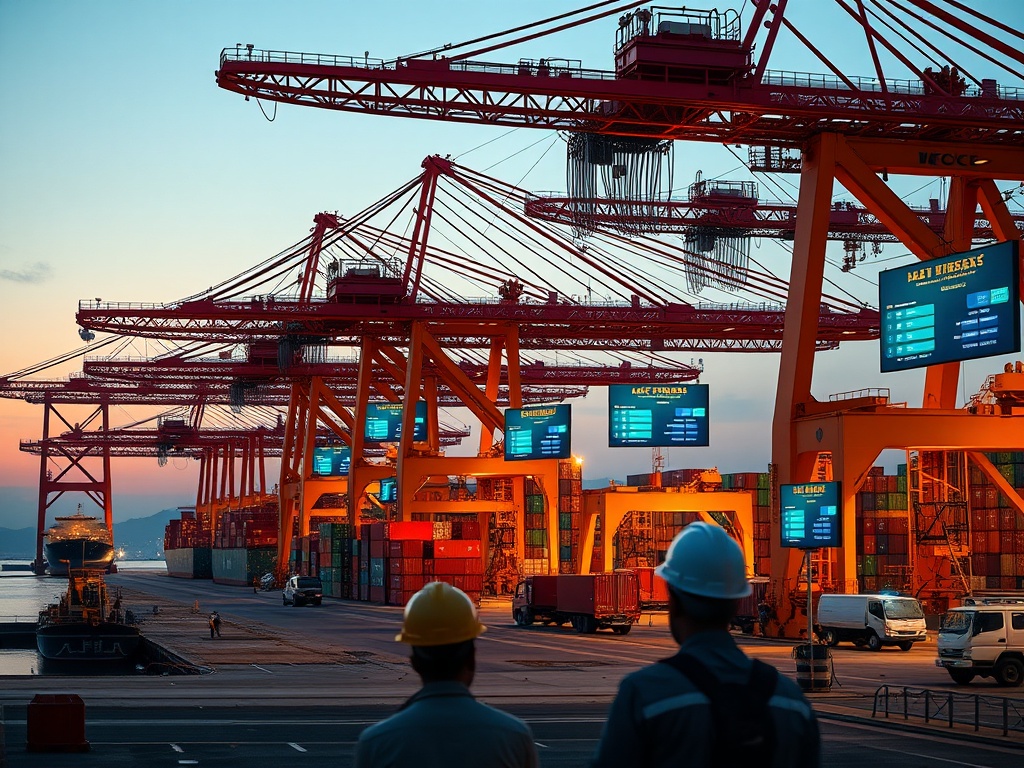

The New Silk Road: No Longer Moving Cement, Now Moving Data
For nearly a decade, the Belt and Road Initiative (BRI) was viewed by Western analysts as a concrete export program: Chinese loans, Chinese construction firms, ports, and roads in countries with limited ability to repay. The narrative of the "debt trap" took hold in think tanks in Washington and Brussels, comfortably settled like dogma. The issue with this diagnosis was that it assumed Beijing would not learn.
It did learn. The tariff pressure applied by the United States and the European Union since 2018 did not weaken China’s foreign strategy; instead, it accelerated its transformation into something qualitatively different and significantly more complex to counter.
From Exporting Infrastructure to Exporting Productive Capacity
What’s happening with the BRI in its current phase is not just a larger-scale expansion of the same concept. It's a shift in logic. China has transitioned from financing infrastructure projects in third countries to selectively and calculatedly transferring complete industrial capacity: factories, supply chains, technical standards, and, above all, technological dependence.
This reconfiguration responds to precise mathematics. When Western tariffs make products manufactured in China more expensive, the response isn’t to absorb the cost or exit the market. It is to relocate manufacturing to countries that do not face those tariff barriers, while still maintaining Chinese control over the production process, critical inputs, and intellectual property. Vietnam, Malaysia, Mexico, Morocco, and Serbia have become nodes in this new architecture. The product leaves with a local origin label, but the value chain remains Chinese.
This transforms the BRI from a lending program with direct financial returns into an industrial policy tool with deferred geopolitical returns. Cement was version 1.0. Version 2.0 is the controlled relocation of Chinese manufacturing, wrapped in bilateral agreements, special economic zones, and proprietary technological standards.
The strategic difference is enormous. A port built on debt can be renegotiated or reverted. A local industry that depends on Chinese-sourced inputs, management software, and technical training creates a structural dependency that is much harder to dismantle without severe economic costs for the host country.
Why This Is Harder to Block Than Previous Tariffs
The Western tariff response was designed to protect domestic industrial sectors from cheap imports. It was effective — at least in part — against BRI 1.0, where the flow to be intercepted was physical and traceable: solar panels, steel, electric vehicles with declared destinations.
BRI 2.0 operates in a different dimension. The flow is no longer a container crossing the Pacific; it is a direct investment in an assembly plant in Tunisia, a technology transfer agreement with a Southeast Asian government, or a digital infrastructure maintenance contract in Sub-Saharan Africa. Taxing these transactions with tariffs requires a level of international regulatory coordination that the West has not demonstrated the capacity to maintain.
This is where the convergence between industrial policy and digitalization becomes analytically relevant. China doesn’t just export factories; it exports the software that manages them, the connectivity protocols that integrate them, and the payment systems that finance transactions between them. Each of these digital components has a near-zero marginal cost of replication once developed, meaning scaling this network does not require capital proportional to its reach. The Chinese digital infrastructure is dematerialized for recipients — it arrives cheaply or for free as part of investment packages — while building an asset of increasing value for Beijing.
This is what makes the strategy difficult to intercept with 20th-century tools: tariffs tax weight, not influence.
The Diagnostic Error the West Cannot Afford to Repeat
For years, the dominant narrative about the BRI was built upon the image of the elephant in the china shop: opaque loans, cost overruns, abandoned projects, countries trapped in unpayable debts. This image had empirical support in specific cases, but generalizing it was a major strategic blunder.
The mistake was in confusing implementation inefficiencies with institutional learning deficits. Organizations that survive are not those that don’t make mistakes; they are those that turn mistakes into actionable data. China took the negative feedback from its first generation of BRI projects — local political resistance, reputation issues, low financial return rates — and adjusted its model. The result is a strategy that is lighter on its own capital, more distributed in risk, and deeper in structural dependency for the host countries.
For business leaders operating in emerging markets, this has direct consequences. Global supply chains are being redesigned not for logistical efficiency but for geopolitical geometry. A company that today manufactures in a BRI 2.0 investment recipient country is operating on an infrastructure whose control architecture is not neutral. That is not a value judgment; it is an operational risk data point that must enter decision models.
The question global sourcing executives should be asking is not whether their suppliers meet quality standards. It’s who controls the technical standards of the platform on which those suppliers operate, and what the costs are of changing platforms if geopolitical conditions change.
The Invisible Infrastructure Already Won the First Round
The West took a decade to understand that the BRI was not a development plan but an extension of China's industrial policy projected abroad. When it finally understood, it responded with tariffs designed to stop a flow of physical goods. In the meantime, the flow that mattered — data, standards, technological dependence, relocated manufacturing capacity — continued to circulate unhindered by significant tariff barriers.
This asymmetry between the response instrument and the real nature of the challenge is the most costly strategic gap of this period. The digitization of geopolitical influence operates exactly like the digitization of any industry: it first becomes invisible because incumbents search for impact in the wrong place, then becomes irreversible because dependency is already established.
The reinvented BRI is a textbook case of how convergence between industrial policy, digitalization, and controlled relocation can build power without conventional measurement instruments recording it in time. For markets still deciding on what digital and productive infrastructure to build for their next decade of growth, that delayed recording has a cost that does not appear in any investment prospectus but determines the margins of autonomy available in the future.