
108,000 Tons Annually: When AI Turns Waste into Strategic Infrastructure
Some assets don’t seem like assets until someone builds a two-decade contract on top of them. This is exactly what has just happened in Portsmouth, Virginia, where AMP Robotics Corporation, through its subsidiary Commonwealth Sortation LLC, has expanded its municipal solid waste processing facility to an annual capacity of 108,000 tons. This milestone is not operational; it is financial and geopolitical on a regional scale.
The counterparty to this agreement is the Southeastern Public Service Authority (SPSA), the waste authority for South Hampton Roads, a region that encompasses several counties and cities with a stable population and tax base. The contractual framework lasts for 20 years, which in terms of infrastructure economics converts a waste flow—one of the few guaranteed outputs of any functioning society—into a financial asset with long-term visibility.
Few analysts question why a robotics and AI company is building public infrastructure contracts instead of selling software licenses.
The Financial Logic Behind the Two-Decade Contract
When a tech company signs a 20-year agreement with a regional public authority, it isn't selling technology; it's converting its technical advantage into a regulatory entry barrier. This strategic move by AMP in Portsmouth deserves precise dissection.
The traditional model for applied robotics companies involves selling equipment or charging for software licenses. While margins may appear attractive on paper, the recurring revenue is fragile: clients can switch providers at contract renewal, and the competitive edge relies on maintaining a permanent technological lead over increasing resources among competitors. AMP chose a different architecture. By structuring its relationship with SPSA not as a sale of equipment but as a long-term operational alliance over proprietary physical facilities, it transformed its technological capacity into a fixed asset backed by institutional support.
The annual capacity of 108,000 tons isn’t an arbitrary figure. It represents sufficient volume to handle the solid waste of a medium metropolitan area, meaning that SPSA cannot simply change providers without facing a considerable logistical challenge. The physical infrastructure in Portsmouth effectively becomes the only viable processing point for the waste flow from various municipalities for two decades. This is not technological dependence; it is infrastructure dependence—far more difficult to replace.
From a unit economy perspective, the completed capacity expansion implies that the fixed costs of the facility—automation, maintenance, specialized personnel—are distributed over a volume guaranteed by contract. Every additional ton processed within that ceiling of 108,000 enhances operational margins without requiring new commercial capture investment. This is the cost structure of an infrastructure business applied to a sector that has historically operated with tight margins and short contracts.
What AI is Doing That Excavators Couldn't
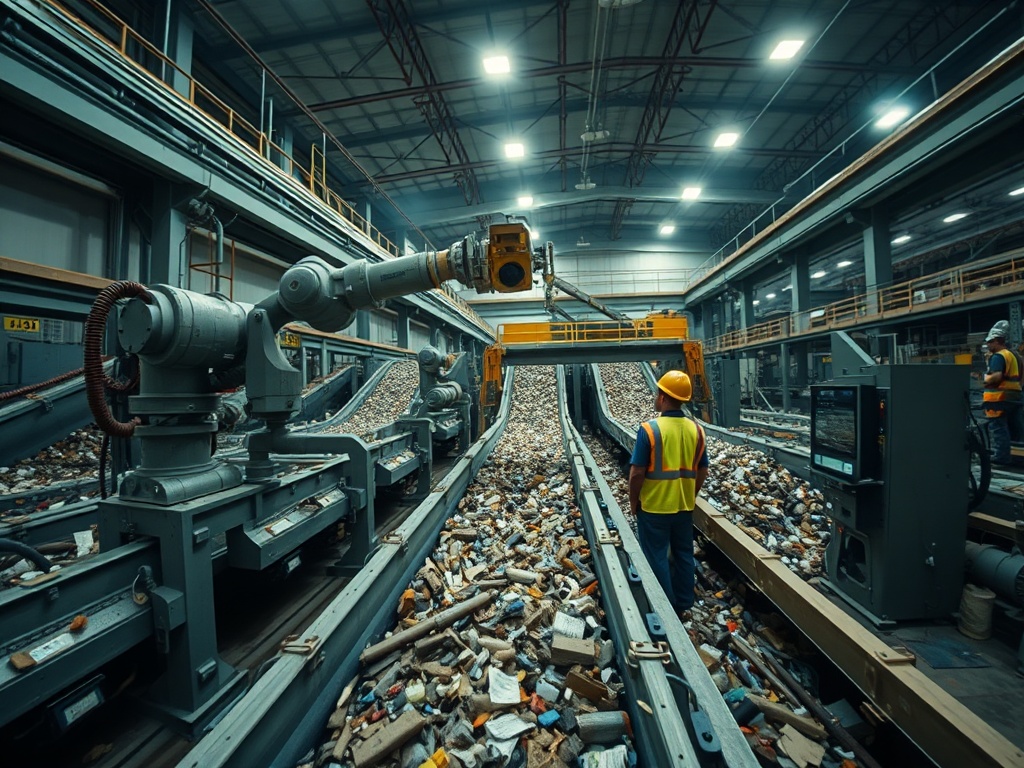
The technological piece of the puzzle is not merely decorative. AMP Robotics has built its market position in waste management based on computer vision systems and robotics capable of identifying and categorizing materials at speeds that far exceed human capability. In a mixed solid waste processing facility, this sorting capability directly affects two variables that determine the financial viability of the entire operation: the material recovery rate and the cost per ton processed.
Sorting mixed waste is more of an information problem than a mechanical one. The input stream contains plastics of various polymers, ferrous and non-ferrous metals, paper, cardboard, organic matter, and a fraction of contaminants that vary by municipality. Accurately separating those streams determines what percentage of the incoming material can be sold as recovered material in secondary markets and what fraction ends up in landfills. A well-trained computer vision system measurably increases the recovery rate, and that improvement translates directly into additional revenue from the sale of recycled materials—a cash flow that complements the guaranteed payments from the public contract.
Here is where artificial intelligence acts as an enhancer of human judgment rather than a substitute. The operators at the Portsmouth facility work on decisions that the system makes at the object classification level: humans manage exceptions, calibrate parameters, make preventive maintenance decisions, and respond to variations in the composition of the input flow. Automation frees cognitive capacity for operational analysis; it does not eliminate the need for knowledgeable personnel. This distinction has concrete operational consequences: a facility that replaces people without building parallel human capabilities accumulates systemic fragility that manifests during technical failures or regulatory changes.
The Pattern the Waste Sector Will Take Time to Replicate
What AMP has built in Portsmouth describes a specific phase within the dynamics of technological transformation in mature markets. Municipal solid waste is a sector that has operated for decades under public concession models, capital-intensive physical assets, and compressed margins. The digitalization of the sorting process has not arrived with the speed characterizing consumer markets precisely because the required capital investment and public contracting cycles act as natural buffers to change.
This means that AMP didn’t compete against equally digitized operators; it competed against an industry standard that had not incorporated computer vision at an industrial scale. The performance gap between its system and the conventional model of manual or semi-automated sorting was significant enough to justify a 20-year contract with a public authority that prioritizes operational certainty above all else.
The pattern will be repeated in other metropolitan regions across the United States and eventually in international markets, but with a crucial structural difference: competitors looking to replicate the Portsmouth model in the next five years will not find the same market void. They will find AMP backed by two decades of real operational data on municipal waste composition, recovery rates by region, and wear curves for equipment under continuous operational conditions. This database is possibly the most valuable asset of the entire operation, yet it appears on no balance sheet.
Waste management is transforming from a low-profile municipal service into material recovery infrastructure with supply chain logic. Those who control sorting at a regional scale control access to secondary material flows in a context where pressure on primary supply chains shows no signs of diminishing. AMP didn’t bet on technology; they bet on data, contracts, and volume, using technology as the instrument to make that bet credible before a public authority. This sequence—technology serving a strategic position rather than as an end in itself—is what transforms a waste sorting facility in Virginia into a benchmark model for the smart infrastructure of the coming century.