
The Skyscraper That Grows Like a Reef of Sponges
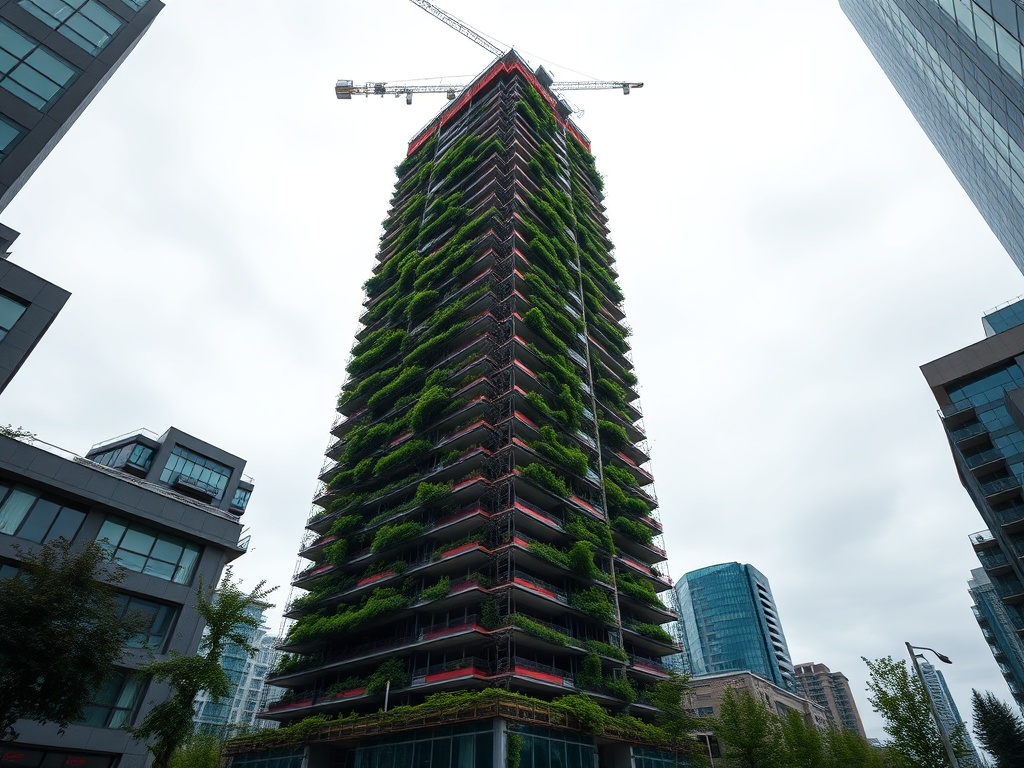
An image has haunted me since I saw the renders of the project: a 315-meter tall tower, adorned with multi-level greenery, rising over the skyline of Vancouver as if it had been designed not by architects but by the very logic that builds the glass sponge reefs on the ocean floor. This is not a decorative metaphor. The studio behind the project explicitly stated that their structural inspiration comes from those marine formations, organisms that have been building silica networks for millions of years without generating net waste and without consuming more than their environment can regenerate.
For a systems analyst, this is not poetry. It is an engineering manifesto with massive economic implications.
The newly unveiled project, slated for Vancouver, proposes Canada’s first supertall tower at 1,033 feet and includes what its designers call a "sky forest": strips of vegetation integrated throughout the facade that are functional within the thermal and air management system of the building, rather than merely ornamental.
When Biology Dictates Financial Structure
What I’m keen to analyze is not whether the building is beautiful, but what it reveals about the changing logic in financing, constructing, and operating infrastructure at this scale. The Lens 3, focusing on Networks and Circularity, applies here with surgical precision, as this project was not born from a conventional real estate urgency. It arose from a systemic pressure that has been building in construction markets for at least a decade.
Tall buildings account for between 28% and 40% of global energy consumption, according to established estimates from the infrastructure sector. That figure is not abstract; it is an operational debt that owners, municipalities, and real estate investment funds pay month by month in energy bills, HVAC system maintenance, and regulatory compliance costs that tighten with each legislative cycle. Vancouver, in particular, has binding commitments to achieve net-zero carbon emissions for its built environment by 2040. It’s not an aspiration. It’s a legal framework with consequences for permits and funding.
In that context, drawing inspiration from glass sponges is not an aesthetic exercise. It is a response to a market constraint. These marine structures lack a central nervous system and design hierarchy, yet they construct geometries capable of withstanding deep ocean currents. The principle engineers extracted from them—distributing load in a reticular fashion rather than concentrating it in rigid columns—allows for a reduction in the volume of structural steel in tall towers, which directly impacts construction costs and the building's embedded carbon footprint before a single glass panel is installed.
The embedded carbon footprint, that carbon emitted during the manufacturing and transportation of materials before the building becomes operational, accounts for between 11% and 15% of global CO₂ emissions from the sector. Reducing it is not a matter of corporate reputation. It’s the difference between gaining access to certain categories of green financing, which currently trade between 30 and 80 basis points below conventional debt in the bond markets. At the scale of a project of this magnitude, that difference is significant.
The Vertical Forest as an Asset, Not an Accessory
Integrated vegetation in supertall facades has a short and somewhat rocky history. Milan's Bosco Verticale, inaugurated in 2014, popularized the idea and triggered a wave of imitations in Asia and the Middle East, many of which ended in operational failure: poorly calibrated irrigation systems, plant mortality exceeding 60% in the first three years, and maintenance costs that doubled initial projections. The difference between a vertical forest functioning as an asset and one serving as a passive feature lies in whether it was designed as an integral system from the structural conception or added as a decorative layer over conventional architecture.
What the Vancouver project describes, in the available information, suggests that the vegetation is part of the bioclimatic design from the structural stage. This fundamentally alters its economic logic. A vegetation system contributing to thermal regulation reduces the demand on the air conditioning system. In a 315-meter mixed-use tower situated in a climate like Vancouver's, with humid winters and increasingly warm summers due to climate change, that reduction can translate to operational savings that accumulate over decades.
The most sophisticated real estate investment funds are already factoring this variable into their valuation models. A building operating with 30% lower energy consumption than the standard for its category doesn’t just save on operational costs; it commands a premium of between 7% and 15% in price per square meter in markets where institutional buyers prioritize assets with lower regulatory risk. Vancouver is precisely that market.
The City as a Laboratory for Circular Infrastructure
What Vancouver is doing by permitting and potentially financing such development is not merely building a striking edifice. It is coding a new urban norm. Cities that manage to ensure that their flagship projects function as demonstrators of technical and financial viability create a ripple effect that is hard to overestimate across the entire real estate market.
Singapore did this with its green facade regulations. Copenhagen achieved it with its living roof requirements. In both cases, what started as a flagship project eventually became the minimum standard that developers had to meet to access building permits. The market, faced with clear rules, adapts. And when it adapts, the costs associated with the technologies involved decline because demand scales up.
This is the pattern I see in motion here. Vancouver’s supertall is not just a building. It establishes a new competitive threshold for any large-scale project in North America seeking access to institutional funding over the next fifteen years. Cities that define the standards for circular infrastructure first will not only capture green capital but also attract technical talent and advanced construction companies that will settle where the rules are clear and stringent.
Leaders managing real estate asset portfolios, overseeing infrastructure capital, or making decisions about their organizations’ built environment should view this project for what it is: the public formalization of a new economy of square footage, where biology is not a metaphor but an operating model, and where the cost of not integrating living systems into infrastructure will, within a decade, be indistinguishable from the cost of building without electricity.