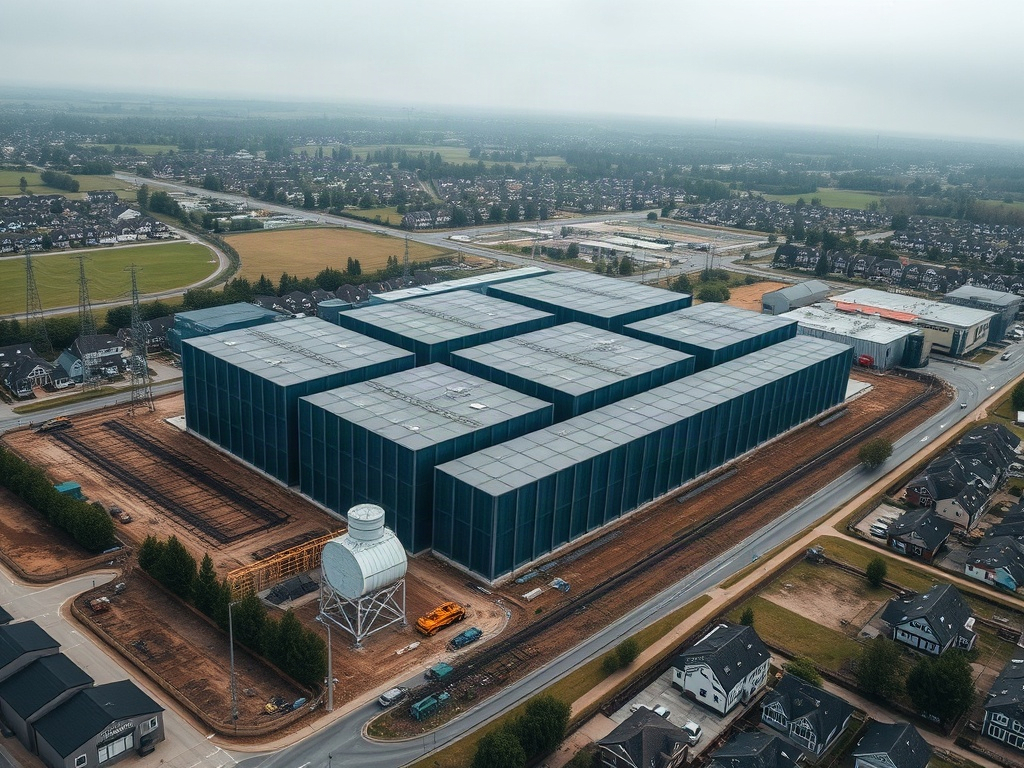

Why AI Data Centers Became the Most Political Asset in the Technology Sector
The week of August 18, 2026, left a signal that was hard for infrastructure investors in artificial intelligence to ignore. GE Vernova fell 9.5% over the course of the week and Eaton lost 6.7%, two names that for months had functioned as safe bets on data center growth. There was no collapse in chip demand, nor was there a budget cut from the major hyperscalers. What there was, was a state governor signing an executive order on a Tuesday afternoon.
Pennsylvania Governor Josh Shapiro published on August 18 the Executive 2026-05, known internally as the GRID requirements. With immediate effect, any data center project with a peak demand exceeding 25 megawatts is excluded from the state's accelerated permitting program. To build in Pennsylvania, developers must obtain local community approval before the state even evaluates the project, assume the full cost of the additional energy they consume, and sign a legally binding consent order. Negotiations with state agencies under confidentiality agreements are prohibited.
This is not a formal veto or a moratorium. Infrastructure development remains possible, but the process is structurally longer, more expensive, and politically dependent on local actors. For Jim Cramer and the CNBC Investing Club team, who hold positions in GE Vernova and Eaton as indirect plays on data center construction, the immediate question was whether this was political noise ahead of the midterm elections or a genuine signal that the sector's regulatory landscape had fundamentally changed.
---
The Capital Structure That Reveals the Fragility Behind the Optimism
While industrials were falling, Broadcom was starring in another story that deserves to be read at the same time. CNBC reported that Broadcom is in negotiations to raise between $70 billion and $80 billion in debt for an artificial intelligence chip financing scheme. Additional reports from Bloomberg place the possible ceiling of the operation near $100 billion, structured in a senior tranche of approximately $60 billion to $70 billion and a subordinate tranche of around $30 billion, channeled through a special purpose vehicle with beneficiaries such as Anthropic.
The operation is neither accidental nor isolated. Oracle and Amazon recently turned to similar debt structures to finance the expansion of AI infrastructure. The pattern is systematic: large chip and services providers are securitizing future AI demand through debt instruments, distributing risk toward private credit managers such as Blackstone and Apollo, and locking in long-term contracts with chip buyers.
What the structure reveals is that the data center growth model in this phase does not sustain itself with immediate operating cash flow. It is financed by anticipations of demand that have not yet materialized into stable revenues. That does not automatically make it a house of cards, but it does make it an architecture built on very specific assumptions about when and at what speed the large customers' language models generate returns that justify servicing that debt. If that speed slows, whether for regulatory, political, or simply slower-than-projected adoption reasons, the financing structure comes under pressure before the assets generate the cash flow they promised.
For Broadcom, the additional context of the week was that Alphabet announced an agreement with Marvell Technology for custom chip design, competing directly with Broadcom in the segment where Broadcom has its greatest concentration of revenues. Alphabet is Broadcom's flagship customer in custom chips. That customer diversifying its supply chain does not eliminate Broadcom, but it does reduce the exclusivity of the relationship and, with it, a portion of the pricing power that justified the previous quarter's valuations. Broadcom closed the week with a 6% decline, despite a 1% rebound on Friday.
---
The Moment When AI Stopped Being Welcome Everywhere
There is something structurally relevant in Shapiro's order that goes beyond Pennsylvania. The state had been considered a serious candidate for infrastructure expansion by major technology operators, including projects linked to Amazon. The Shapiro administration had actively courted that investment with tax incentives and expedited permits. What changed was not the technology but the local political pressure: community opposition to noise levels, water consumption, and energy demand from installations that primarily benefit external corporations.
The order is not just a regulation: it is a negotiation framework. By requiring community benefit agreements that include local hiring, investment in local infrastructure, and transparency regarding environmental impacts, the state administration is redistributing who captures the value from the arrival of a data center. Previously, the value was captured almost entirely by the developer and the hyperscaler. Now, the state demands that part of that value remain in the community where construction takes place.
For the business models of the companies that supply electrical equipment, energy management systems, and generation capacity for these centers, this redistribution has direct consequences. Every new local approval requirement represents an additional month of waiting. Every obligation to assume the cost of energy is an additional negotiation with the electrical grid. The project cycle lengthens and the risk of cancellation increases. In terms of valuation, that compresses the multiples of companies whose prices had already anticipated an aggressive pace of construction.
Cramer raised in the Morning Meeting of August 21 the difficulty of calibrating whether this is pre-electoral rhetoric or policy with lasting consequences. That difficulty is legitimate. But the market does not wait for the doubt to be resolved. The industrials tied to the sector absorbed that uncertainty during the week with a clarity that political commentary does not possess.
---
What the Following Wednesday Will Ask the Market to Decide
The week closes with an additional layer of pressure: the following Wednesday concentrates the earnings results of Nvidia, CrowdStrike, and Salesforce. Nvidia's numbers are anticipated to be solid given the state of chip demand for AI. The Investing Club team pointed out with precision what truly matters: not whether the numbers are good, but whether the market decides that those good numbers were already priced in.
That is the crux of the moment. The expansion of AI infrastructure was one of the most broadly consensual investment narratives of the past eighteen months. The industrials that manufacture the electrical components of data centers, the custom chip designers, and the software platforms that monetize on top of that infrastructure were valued with growth assumptions that required few obstacles. Now the obstacles are appearing simultaneously: state regulation that lengthens development cycles, customer concentration that is diversifying away, and debt structures that depend on a specific pace of adoption to remain sustainable.
Salesforce represents a different but no less relevant angle within this picture. Enterprise software spent much of the first half of 2026 under the shadow of the narrative that language models would displace traditional software-as-a-service licenses. The stock's recent recovery reflects that investors moderated that fear. The coming quarter will determine whether that moderation is grounded in actual customer retention and in the growth of new product lines with embedded AI, or whether it was simply a temporary relief in the absence of bad news.
For CrowdStrike, the Club anticipated solid results supported by increasing demand for cybersecurity solutions as AI models become more advanced and more exposed to attack surfaces. The logic is coherent: a larger attack surface requires more defense. But logical coherence does not guarantee the speed at which that demand converts into signed contracts within the quarter being reported.
---
AI Infrastructure as a Political Business
What the week of August 21 reveals is not a collapse of the sector but the end of its lowest-friction phase. During the period of accelerated expansion, data centers were built with state incentives, fast permits, and little community resistance. Debt was issued with ease because financial actors wanted exposure to the AI growth curve. Industrials rose because the pace of construction appeared to have no visible ceiling.
The friction that appeared this week — regulatory in Pennsylvania, competitive in Alphabet's custom chip segment, and financial in the scale of the debt that Broadcom is negotiating — does not invalidate the underlying thesis about AI infrastructure demand. But it does force a distinction between two very different types of exposure: that of companies which have a direct fit with the end AI customer and the capacity to adjust their proposition when the environment changes, and that of intermediate suppliers whose valuation depended on that environment never changing.
GE Vernova and Eaton are good businesses with real positioning in energy infrastructure. The problem is not their operational quality. The problem is that they were valued with assumptions that Shapiro's order and its possible replications in other states no longer guarantee. When one piece of the business model — in this case, the speed of permitting and the absence of community requirements — is eliminated by decree, the impact is not merely regulatory. It is a recalibration of the revenue timeline that the market discounts immediately, even though the company may take months to confirm it in its reported results.
The Club bought more GE Vernova on the dip. That decision may prove correct if the long-term thesis on energy demand for AI remains intact. What the week also showed is that maintaining that conviction now carries a higher opportunity cost and a longer confirmation horizon than it did three months ago.