
Whoever designs the cash register designs the business
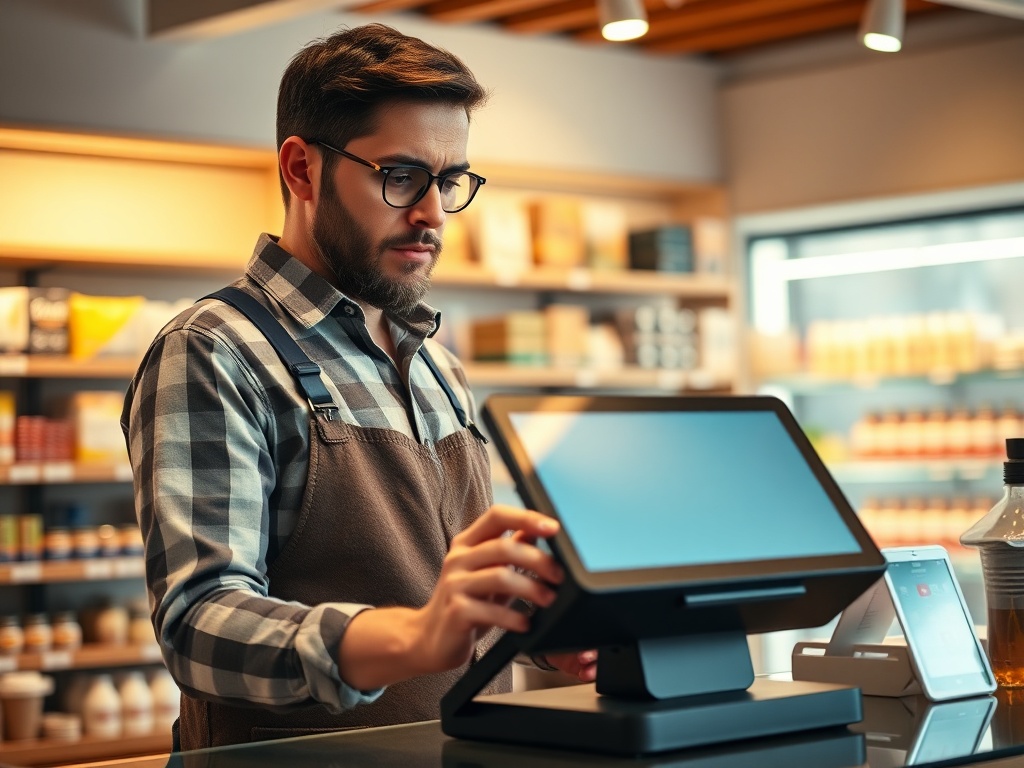
There is an object on the counter of almost any small business that for decades was invisible: the payment terminal. Nobody asked whether it was inclusive, whether it favored one type of customer over another, whether the shop owner chose it or the bank delivered it. It was hardware, full stop. The debate ended there.
In June 2026, Forbes Advisor published its ranking of the ten best credit card terminals for small businesses, and what it describes has very little to do with a terminal. It describes complete operational management platforms, with sales analytics, automated marketing, loyalty programs, inventory control and staff shift administration, all tied to the same box that processes payments. What changed is not the hardware. What changed is who makes the decisions about how the business operates, and from where those decisions are made.
That is the question the ranking does not ask, even though its data answers it by omission.
The point-of-sale system as a silent architecture of power
When Forbes rates Korona POS as the best option for "sales analytics", what it is describing is a system that knows, before the owner himself does, which products are most profitable, at what hours of the day money is being lost, and how much revenue is generated per average customer. The Korona dashboard, according to the published analysis, shows in real time the best-selling items of the day and the week, the number of customers and the average revenue per visit. That information existed before, scattered across notebooks, in the memory of the most senior salesperson, in the accumulated intuition of whoever has been running the business for a decade.
What the system does is not generate new intelligence. What it does is capture intelligence that previously lived at the periphery of the business, in the people who staffed the counter, and centralises it in a control panel that responds to Korona's design criteria, not the store's. That has consequences that go far beyond efficiency.
Clover, which Forbes positions as the option with the greatest hardware variety, offers three portable readers, multiple tablet-style stations, a self-service kiosk and a kitchen display system. The variety is genuine. But the business model ties the merchant to a 36-month cycle or an upfront hardware cost of 349 dollars, with online transaction fees that the ranking itself describes as high. The choice of hardware is not free: the merchant can choose among Clover's formats, but cannot take those terminals to another payment processor without replacing them. Dependence on proprietary hardware is the mechanism by which a short-term purchasing decision becomes a long-term contractual relationship that structurally favours the provider.
What this designs is not just a payment terminal. It designs who holds the data, who interprets the data, and under what conditions the merchant can change their mind without paying an exit cost.
The illusion of the included periphery
The Forbes ranking includes SumUp as the best option for new businesses, with zero monthly fee and low-cost hardware. The narrative that this positioning builds is clear: there is an accessible entry point for those who are just starting out. No costly hardware, no long-term commitments, with money deposited within two business days.
What the Forbes analysis also records, though without emphasising it, is that SumUp's processing fee is among the highest in the evaluated group: 2.6% plus 0.10 dollars per in-person transaction. For a business that processes 5,000 dollars a month in card sales, that represents around 135 dollars per month in processing fees. For a business that processes 50,000 dollars, the same rate implies close to 1,300 dollars. The model that appears most inclusive at the point of entry is the one that becomes most expensive as the business grows.
That pricing structure is not accidental. It is the way in which the payments market captures value from businesses that do not yet have negotiating power. Stax and Payment Depot, two of the featured partners highlighted in the same Forbes article, operate with the inverse logic: a fixed monthly fee plus a minimal per-transaction fee above the interchange cost. At 59 or 99 dollars per month, those models only become cost-effective above a certain sales volume, which generally sits around 10,000 to 15,000 dollars per month in card transactions. Below that threshold, SumUp may be cheaper. Above it, the merchant who remains with SumUp is effectively subsidising those who have already migrated to an interchange-based model.
The periphery gains access to the system, but it gains access under conditions that guarantee that, if it scales, it will need to rebuild its entire technological infrastructure in order not to lose margin. That is not structural inclusion. It is a waiting room with processing fees.
What is not designed when designing for restaurants
A significant portion of the ranking is dedicated to systems specialised in restaurants. Shift4 Dine, formerly known as SkyTab, appears with the highest rating in the group: 4.5 out of 5. Its description is that of a system integrating payment processing, real-time table management, tableside ordering, online orders, reservations and a waitlist. Cake enters the picture as hardware resistant to spills, grease and dirt, designed for real kitchen environments. Rezku adds a loyalty programme, gift cards and coupons connected directly to Mailchimp.
What these systems share is not only vertical specialisation toward restaurants. What they share is that they are designed to capture the relationship between the business and its customer in a format that the provider can read, analyse and monetise. Rezku notes, within the Forbes analysis itself, that gift card users spend on average 22% more than the face value of the card. That piece of data is not advertising. It is the system's sales argument directed at the restaurant owner. But it is also information that describes the behaviour of the end customer, who never consented to being part of Rezku's data model.
The chain of information capture in these systems runs in one direction: from the end customer toward the platform provider, passing through the merchant who acts, in part, as an involuntary intermediary. The restaurant owner obtains operational tools, sales reports and marketing automation. The provider obtains aggregated behavioural data on consumer spending across thousands of restaurants simultaneously. The customer receives a digital receipt and, if they are lucky, a birthday discount.
That asymmetry is not new in technology. But in the case of point-of-sale systems for small businesses, the dimension is especially sharp because the merchant is not a sophisticated user who negotiates data terms with a specialist attorney. They are someone who chose a system because it had good reviews and zero monthly fee.
The cost of having no representation in the design room
Lightspeed appears in the ranking as the best option for marketing, at a monthly price of 109 dollars, with automation tools for emails, SMS, forms, surveys and integration with TikTok, Facebook, Amazon and eBay. The Forbes analysis highlights that the system tracks the customer's purchase history and allows segmentation for targeted promotions. It is, in the language of the industry, a customer data platform disguised as a payment terminal.
The question that no ranking of this kind is designed to answer is who was in the room when these architectural decisions were made. When Lightspeed designed its customer segmentation module, the small merchant was not in that meeting. When Clover decided that its hardware would be proprietary, the shop owner who would later be locked in for 36 months did not participate either. When Cake chose not to publish its transaction fees with transparency, nobody consulted the restaurants operating on margins of 4% to 6%.
This is not an accusation of bad faith. Point-of-sale system providers are solving genuine technical problems with real resources. The problem is structural: the end users of these systems — the owners of small businesses — have zero representation in product design decisions, and that absence translates directly into architectures that favour data capture, hardware dependence and contractual retention over the merchant's operational autonomy.
The Forbes ranking, with its logic of ratings and "best for" categories, reproduces this dynamic involuntarily. By evaluating the systems from the perspective of the merchant as a consumer of technology, rather than from the perspective of the merchant as an agent who should have control over their own data and relationships, the analysis produces recommendations that are useful within a framework that does not question its own limits.
Korona POS scores 4.3 out of 5 for its analytics dashboard. What is not measured is how much of that analytical intelligence remains accessible to the merchant if they decide to migrate to another system. What is not evaluated is whether the historical data on sales, customers and inventory behaviour can be exported in standard formats or remains trapped within the platform. Data portability — which in any analysis of structural capital would be the key indicator of merchant power — does not appear as an evaluation criterion in the ranking.
The terminal you don't see is the one that defines your margin
Payment systems for SMEs ceased to be neutral infrastructure at least a decade ago. What the Forbes 2026 ranking documents, albeit not from that angle, is the current stage of that process: verticalised platforms, with volume-differentiated pricing models, hardware contractual dependencies and data capture structures that asymmetrically benefit the provider.
The merchant who chooses well can effectively improve their operation, reduce inventory errors, automate customer follow-up and make better decisions about what to sell. The benefits are real and documented. But those benefits do not change the fact that the architecture of power in this market places the small merchant in a position of structural dependence with respect to providers who designed the systems without their participation, who capture their operational data as a by-product of the service, and who built pricing models that become more expensive at precisely the moment the business begins to succeed.
The hardware diversity that Clover offers, the durability of Cake's equipment or the analytical depth of Korona are each partial answers to the partial needs of businesses that had no voice in the design of any of those solutions. That absence is not a product detail. It is the condition that determines at which end of the value chain the shop owner ends up sitting when the end-of-month invoice arrives.