
Forty Years of Heavy Machinery, an Industrial Buyer, and 29 Million Dollars on the Table
There are companies built to last and companies built to be desired. The difference between the two is not always visible from the outside, but it becomes legible at the precise moment when someone puts a number on the table and the founders decide that number is worth more than continuing. Davison Earthmovers, a family-owned earthmoving company from South Australia with four decades of operation, has just crossed that threshold: the transaction closed at 29 million Australian dollars, with a buyer described by sources as one of the country's civil construction giants.
The news itself is brief and partially shielded behind a paywall. But what is known is enough to construct a structural analysis worth building with precision, because operations of this kind are neither as frequent nor as simple as they appear from the headline.
What happened here is not merely a family story with a happy ending. It is a story about how four decades of accumulated operational capital are monetised, about what makes a physical-asset business attractive in a market where sector-wide consolidation has been accelerating for years, and about the economic logic that transforms a mid-sized construction firm into a strategic acquisition for a large-scale operator.
What 29 Million Dollars Reveals About the Architecture of the Business
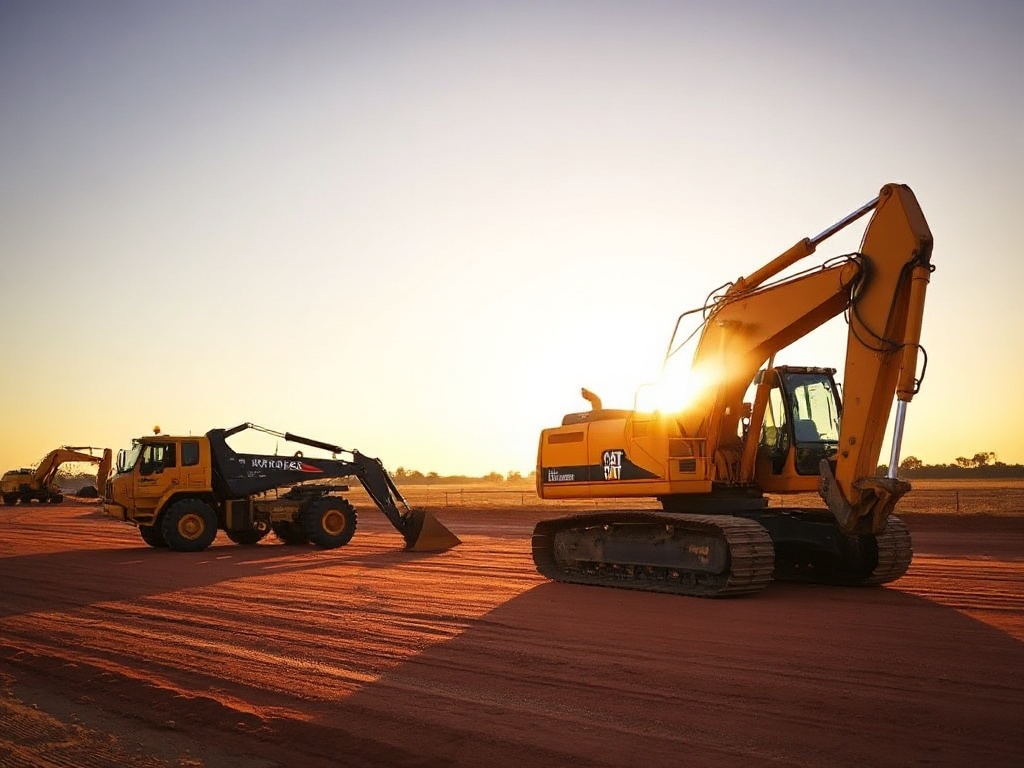
The first piece of data that deserves attention is not the number itself, but what that number implies about the structure of the asset that was sold. An earthmoving company with forty years of history is not, first and foremost, a company of light cash flows. It is a company of heavy assets: excavation machinery, transport vehicles, grading equipment, maintenance contracts, and almost certainly a base of trained operators with experience in infrastructure projects.
In businesses with that asset composition, sale value tends to be built on three simultaneous levers: the replacement value of the equipment fleet, the portfolio of active or relational contracts with public or private clients, and the accumulated operational reputation, which in Australia translates directly into preferential access to infrastructure tenders. None of those levers appears overnight. All three are built over decades of sustained operation, with sufficient positive cash flow to keep the fleet updated and the operational structure functioning.
What that suggests about Davison Earthmovers is that the company arrived at this transaction from a position of strength, not urgency. A company that sells under pressure — depreciated machinery, expired contracts, accumulated debt — rarely achieves a multiple that justifies describing the operation as a "mega deal." The fact that the buyer is described as one of the heavyweights of Australian civil construction reinforces this reading: large-scale buyers do not acquire problems at a premium price. They acquire capabilities that cost them more to build from scratch than to purchase at an embedded price.
Put another way: the 29 million was not paid for the company as it exists today, but for the position that company occupies within a value chain the buyer already operates. The fleet, the operators, the contracts, and the regional reputation are resources the buyer can absorb and integrate immediately, without the waiting time that would be required to build that presence from scratch in the South Australian market.
Sector Consolidation as a Structural Background Force
To understand why this type of operation has structural logic and is not an exception, it is worth examining the broader pattern. Civil construction in Australia has been undergoing an accelerated consolidation process for at least a decade, driven by the scale of public infrastructure contracts. Road, rail, water management, and urban expansion projects tendered by the federal and state governments in recent years have reached a size that makes it practically impossible for a medium-sized company operating independently to compete.
When the minimum size of a viable consortium begins to exceed the operational capacity of a family business, that business faces a structural fork in the road. The first option is to grow independently: invest in new machinery, hire staff, build a tendering structure, and assume the financial risk of scaling up before the contracts arrive. The second option is to become part of something larger that already has the access, the scale, and the financial capacity to compete at that level.
For a company with four decades of history and founders who are likely thinking about a retirement horizon, the second option carries very concrete financial rationality. The value of remaining independent decreases as accessible contracts concentrate in larger-scale operators, and the cost of competing in that segment grows proportionally. In that scenario, selling at the right time — when the company still has full operational capacity, active contracts, and an intact reputation — generates a sale price far superior to what would be achieved in a sale process conducted under competitive or financial pressure.
This also explains why the buyer paid what it paid. It is not philanthropy or sentiment for a family story. It is the cold calculation that acquiring installed capacity in South Australia for 29 million costs less, in time and in risk, than building that capacity from scratch in a market where local reputation carries direct weight over contracts. The price reflects that cost asymmetry, and that asymmetry is precisely the kind of leverage that a well-operated family business accumulates without necessarily knowing it possesses it.
Family Businesses, Time, and the Succession Problem as a Financial Catalyst
There is an element in this story that merits separate analysis because it operates silently but with enormous financial consequences: the internal dynamics of family businesses over time. Four decades of operation imply, almost certainly, that the company went through at least one generational transition or came close to doing so. And it is at that point that many family businesses of this type begin to accumulate tensions that eventually resolve themselves in a sale.
Succession in asset-intensive businesses such as earthmoving is not only a question of willingness or of preparing the successor. It is a problem of capital structure and incentives. When founders age and assets are distributed among multiple family members, the pressure to liquidate grows naturally, even when the business is operating well. The liquidity that a company of this type generates can be excellent in operational terms and yet insufficient to simultaneously satisfy the retirement needs of the founders, the reinvestment in fleet, and the capacity to remain competitive.
A sale of this magnitude resolves that problem cleanly. The 29 million dollars converts four decades of physical assets and relational capital into distributable liquidity, eliminating in a single stroke the tension between reinvestment and retirement, between continuity and succession. It is not the only possible solution, but in an environment where sector-wide competitive pressure pushes toward consolidation, it is probably the solution with the best risk-return equation for the owners.
What this pattern also reveals is that family businesses with long-term physical assets have, in many cases, a latent value that their own owners underestimate because they measure it in everyday operational terms rather than in strategic terms. The value of a company is not only the cash flow it generates this year. It is also the cost of replication for a buyer who needs that installed capacity and does not have four decades available to build it.
The Market Price and What the Buyer Really Acquired
Closing this analysis requires being precise about a distinction that is often lost in coverage of transactions of this kind. What was purchased for 29 million dollars was not a company in the accounting sense of the term. It was a market position with implicit barriers to entry. The machinery fleet has a verifiable replacement value. The contracts have a calculable present value. But the part of the price that is probably most difficult to justify in a standard valuation model — and yet is the part that matters most to the buyer — is relational capital: the years of work with contractors, with municipalities, with site supervisors who know the operators by name.
That capital does not appear on the balance sheet. It has no accounting line. But it directly determines how long it would take a new entrant to build the same network of operational trust in South Australia. And that time carries a concrete financial cost: contracts lost during the reputation-building period, margin sacrificed to gain experience, and execution risk during the initial learning curve.
When a large-scale buyer pays a premium over the book value of assets, they are generally paying to skip that curve. The 29 million is, in part, the price of the strategic impatience of an operator that needs immediate regional capacity and cannot afford to wait. For the founders of Davison Earthmovers, four decades of consistent work converted that buyer's impatience into the most powerful argument in their favour at the negotiating table.
The financial mechanics of this operation confirm a pattern that repeats itself in asset-intensive sectors with high regional fragmentation: the company that operates well for decades, without structural debt pressing down on it and with its reputation intact, achieves in a strategic sale the highest possible return on accumulated capital. Not because the market is generous, but because the cost of replication for the buyer makes paying a high price still, even so, the cheapest available option.