WeRide Enters WeChat, Revealing Who Fuels Whose Growth
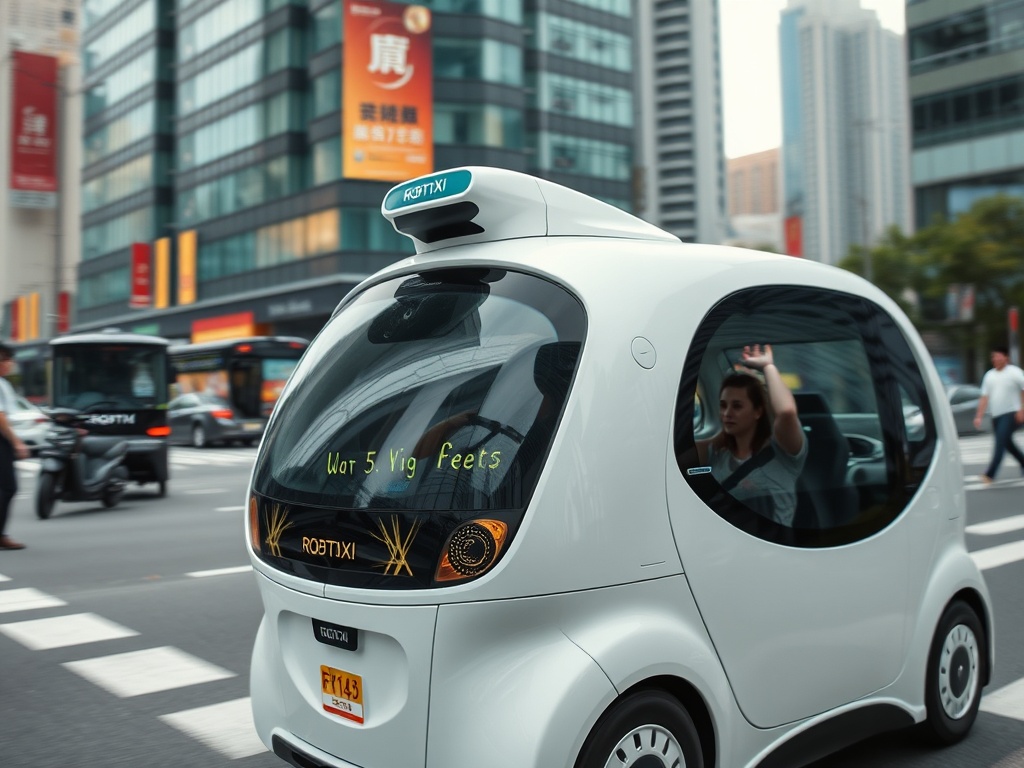
On March 12, 2026, WeRide Inc. announced that its robotaxis can now be booked directly through WeChat, without needing to download additional apps. A user in Guangzhou opens their phone, navigates to "Services," taps "Tencent Mobility Service," and enters an autonomous vehicle in minutes. From the outside, it appears to be a technical integration. From within the value chain, it's a decision that rewrites WeRide’s economics from top to bottom.
The company currently operates over 1,023 global robotaxis and projects to reach 2,600 units by the end of 2026, nearly tripling its fleet in less than twelve months. This pace of physical asset expansion requires a demand justification for every parked vehicle. And therein lies the strategic knot that this alliance attempts to untangle.
The Cost No One Wanted to Mention
So far, WeRide’s distribution model relied on its standalone app "WeRide Go" and a mini-program within WeChat, which served as a secondary channel. The issue with that scheme was not technological; it was the cost of convincing a user to open a new app, create an account, trust a driverless vehicle, and repeat the cycle often enough for the vehicle numbers to close.
Customer acquisition in mobility is one of the most ruthless costs in the sector. Traditional ride-hailing platforms have spent billions of dollars on subsidies to train usage habits. By inserting itself into an environment where hundreds of millions of users already exhibit established behaviors, WeRide structurally eliminates that friction. It is not buying attention; it is leveraging social infrastructure that Tencent has paid for over the years.
This is not an operational detail. It represents a shift in WeRide’s demand cost structure. When Tony Han, founder and CEO of WeRide, talks about “building a next-generation cloud platform that drives every stage of autonomous driving,” he is also describing the other side of the equation: without predictable demand, no technological platform justifies the investment in the infrastructure required for its projected 2,600 vehicles.
A 24-Month Alliance That Is Just Now Showing Its Muscle
What most analyses of this news overlook is that this integration did not arise from a business meeting in March 2026. It was the result of 24 months of deliberate building: an initial agreement in April 2024 focusing on cloud infrastructure, expansion in May 2025 towards level 4 vehicle commercialization, and finally, consumer deployment in 2026.
That sequence matters because it reveals how the dependency is distributed between the parties. Tencent Cloud not only provides visibility within WeChat: it is also the technology infrastructure provider upon which WeRide operates, processes real-time data, and meets local cybersecurity regulations. According to statements from Zhong Xiangping, VP of Tencent and President of Tencent Intelligent Mobility, the goal is to build "an integrated digital auto-cloud foundation for the automotive industry."
This describes a technical and commercial relationship that goes far beyond a button on an interface. WeRide does not just have a distribution partner: it has a critical infrastructure provider that also controls the access channel to the end customer. The concentration of power within Tencent in this structure is considerable, and that is precisely the point of tension that any serious analysis must examine.
Bilateral dependence exists, but it is not symmetrically distributed. For Tencent, WeRide is one of several smart mobility assets in its portfolio. For WeRide, Tencent is the backbone of its marketing strategy in China. This asymmetry does not invalidate the agreement, but it does define who has more leverage if conditions change.
What the Model Reveals About Robotaxi Unit Economics
WeRide explicitly stated that traffic from the WeChat ecosystem "is expected to translate into stable demand, accelerating large-scale commercialization and progress towards profitability per vehicle." That phrase contains the entire economic logic of the agreement.
A robotaxi is a capital-intensive asset. Its financial viability depends on maximizing paid operation hours per vehicle. Every hour a vehicle waits without a passenger is a fixed cost that generates no revenue. Predictable demand is not a luxury; it is the variable that separates a lucrative business from an expensive technological experiment.
By integrating into WeChat, WeRide gains access to demand patterns that Tencent has developed over years in urban transport. The platform already knows when its users are moving, where to, and how often. This enables WeRide to optimize its fleet distribution with data that no competitor lacking that integration can match in the short term.
International expansion adds another layer. The agreement explicitly states that Tencent Cloud will provide localized global infrastructure for the markets where WeRide seeks to operate outside of China. With presence already in over 40 global cities, WeRide needs local regulatory compliance in each jurisdiction. Tencent Cloud, with its distributed infrastructure, offers that without WeRide having to build it from scratch in each market.
This compresses the timelines for international entry and reduces the capital WeRide needs for each expansion. But it also extends dependence into geographies where Tencent operates with varying degrees of presence and where the terms of the agreement could have different regulatory implications.
The Risk That Press Releases Don’t Mention
When a mobility provider builds its demand strategy on the infrastructure of a single platform, it implicitly accepts a concentration risk that becomes more costly as the model scales. WeRide currently maintains alternative channels: its own app and its standalone mini-program. This diversification of access is its best hedge against Tencent's growing negotiating power as dependence deepens.
Scale also changes the dynamics of upcoming renegotiations. With 2,600 vehicles operating and per-unit profitability in the making, WeRide will arrive at the next agreement renewal with more proprietary data, more traction, and more options. That is the scenario where the distribution of value may tilt differently.
What this alliance demonstrates, beyond the announcement, is that the most difficult problem of autonomous transport at scale is not technological. Batteries improve, sensors become cheaper, algorithms mature. What does not scale seamlessly is user trust and frequency of use. Solving that requires embedding into existing habits, not convincing millions to adopt new behaviors.
WeRide is gaining real demand at the price of structural dependence on its main infrastructure and channel provider. Tencent is gaining a differentiated use case in autonomous mobility that strengthens its position in the smart transport services market. The end-user gains convenience and frictionless access. The actor that has yet to show its cards on how much value it will capture is Tencent, and that silence is, strategically, the most relevant information from this entire operation.