
The Balance the AI is Disrupting: The U.S. Buys Hardware and Sells Fewer Hours
The intuitive idea is that artificial intelligence (AI) favors the United States by exporting services: software, consulting, finance, and intellectual property. This narrative has long supported a simple fact: the country has maintained a surplus in services that buffers its chronic trade deficit in goods.
However, The Dallas News raises an alarming counterpoint: AI may threaten this surplus by automating precisely those services where the U.S. has been strong, reducing the demand for expertise imported from abroad to global clients, and consequently, the export value of American professional labor. The opinion piece does not quantify the deterioration of the surplus, but the strategic risk aligns with a basic mechanic: when a service transforms into software, its price tends to compress, and differentiation becomes harder to maintain without defensible intellectual property or a dominant distribution chain.
What changes the game by 2025-2026 is that AI is simultaneously propelling a wave of physical trade. According to economists from the Federal Reserve, global trade in AI-related products surpassed $272 billion in the first half of 2025, a 65% year-over-year increase, with U.S. imports more than doubling since 2024. Concurrently, the WTO attributed 42% of global goods trade growth in 2025 to AI-related investments in hardware, software, and data center equipment. This is the other side of the balance: AI as a boom in goods, not merely in services.
When a country increasingly purchases physical infrastructure while simultaneously finding its capacity to export services becoming more fragile due to automation, the problem shifts from being cyclical to becoming a fundamental economic design.
AI as an Import Shock: The New Gap is Not in Code, but in CapEx
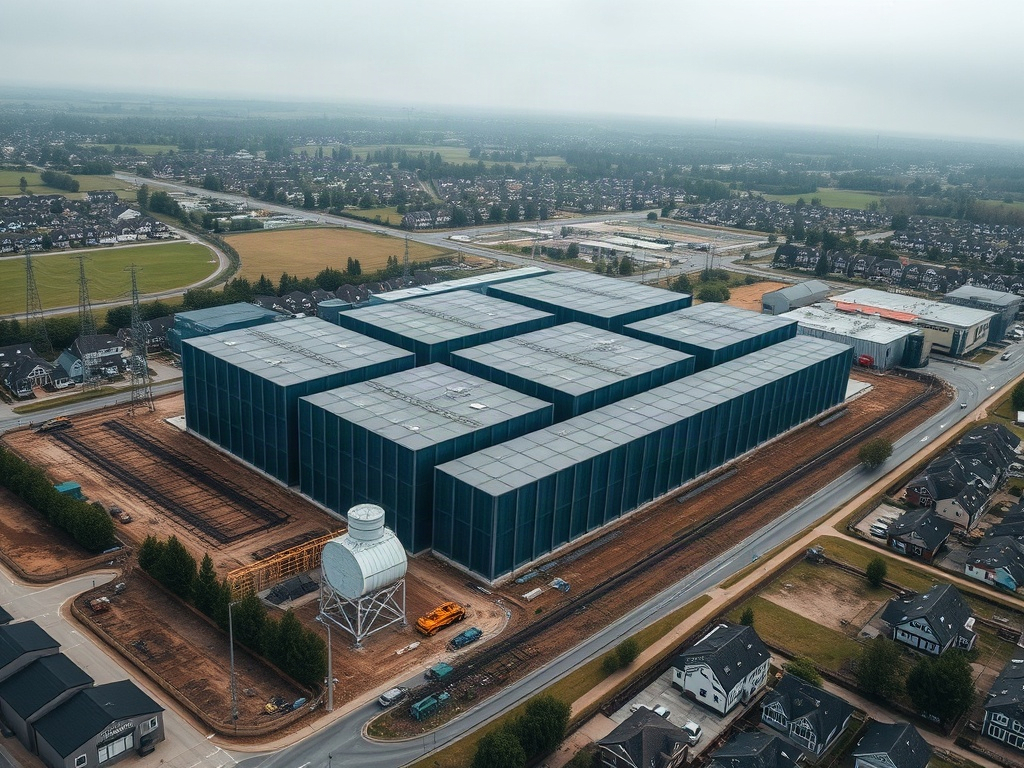
From a financial perspective, the most relevant data is not philosophical but rather accounting: AI is forcing capital expenditures and imports of components. Data centers and semiconductors are not an “idea”; they are purchase orders, logistical contracts, inventory, and depreciation.
The evidence, which is quantified, points to a surge in goods. The Federal Reserve documents that trade in AI products (chips, servers, data center infrastructure) skyrocketed in 2025 and maintained high levels at least until July of that year. The WTO publicly emphasized that AI was driving merchandise trade growth despite tariff frictions.
The accounting effect for the U.S. is direct: if you import more hardware to build domestic computing capacity, your goods deficit widens today even though part of that value may be recovered tomorrow through productivity. The challenge lies in the timing of cash flow and balance: the outlay occurs first and in hard currency; the return relies on that capacity computing manifesting as internationally sellable products and services.
Here lies a crucial asymmetry that many management teams overlook: CapEx is certain, future revenue is conditional. In corporate finance, this is the difference between an investment that strengthens a model and one that stresses it. At the national level, the logic is analogous: infrastructure can enable growth, but along the way, it creates a dependence on imports that someone must finance.
And this dependency is creating visible winners: Taiwan emerges as a key supplier. In the second quarter of 2025, Taiwanese exports related to AI to the U.S. amounted to approximately 14% of Taiwan's GDP, driven by its leadership in advanced semiconductors. This figure does not describe an abstract “boom”; it describes a concentration of power in the supply chain.
Services Under Pressure: When Exportable Value Shifts from “Human Hours” to “Cheap Output”
The threat to the service surplus does not need a confirmed statistical decline to be an operational risk. The mechanics are well-known to any CFO in a professional firm: if the client can achieve a comparable outcome with fewer billable hours, revenue declines unless the provider raises prices through differentiation, sells intellectual property, or captures more volume.
The Dallas News column points out that sectors like software development, legal services, and consulting—traditional strengths—may see reduced demand for exported labor. This fits into a substitution dynamic: AI lowers the marginal cost of producing certain deliverables, and the market rarely allows that gain to be passed on to the provider; it demands it in the form of discounts or expanded scope for the same price.
Financially speaking, the blow does not just hit revenues; it also impacts cost structure. Many service firms operate with high fixed costs (senior staff, offices, sales) and margins dependent on utilization. If AI compresses billable hours and forces repricing, operational margins suffer until the organization turns part of those fixed costs into variable ones or reorients its offering.
At a macro level, the risk is that the U.S. may lose part of its traditional cushion: the services surplus as a counterbalance to the goods deficit. The sources do not quantify erosion in 2025-2026, so there is no place for invented numerical dramatizations here. What can be firmly stated is: if AI accelerates the goods deficit through infrastructure imports and simultaneously reduces the pricing power of exportable services, the balance becomes harder to sustain.
In business models, this translates into a practical rule: when your product is human time, automation tends to commoditize your advantage unless you package the value differently.
The Shift from China to Taiwan is Not Anecdotal: It Represents Concentrated Dependency and Cost Pressure
A detail from December 2025 trade data shows how AI reconfigures flows: U.S. imports from Taiwan reached $24.7 billion, surpassing China ($21.1 billion, with a year-over-year decline of 44%), a shift not seen in decades. Sources attribute this change to demand for AI-related technology and the impact of tariffs that redirect routes.
For a business leader, this reads as a double risk.
First, concentration risk. If the surge in demand for AI drives purchases towards a small set of critical suppliers (advanced semiconductor manufacturing), price elasticity decreases. In simple terms: when there is a bottleneck, the supplier holds power. This pressures input costs for anyone building products or services on computing infrastructure.
Second, regulatory volatility risk. Sources mention that U.S. authorities are considering new chip export rules, linking access to technology with foreign investment in data centers within the U.S. No final decisions have been reported, but the direction is clear: industrial policy is beginning to intertwine with trade negotiations.
In financial architecture, regulatory volatility translates to requiring more liquidity and greater contractual flexibility. If your growth plan relies on imported hardware, and costs or availability shift due to policy, your model isn't under your control. The answer is not rhetorical; it is structural: supply contracts, strategic inventory when it makes sense, and customer offers that allow some cost transfer without destroying demand.
There’s also a less obvious angle: if the U.S. seeks to increase domestic investment in data centers, the goods deficit may partially transform into domestic investment and local jobs. This improves certain economic lines, but does not eliminate the fact that many components will continue coming from abroad. The supply chain is not “repatriated” with a statement; it is redesigned over years of CapEx and know-how.
The Real Adjustment for Companies: Sell Measurable Results and Finance Growth with Contracts, Not Narratives
I find interest at the intersection of geopolitics and management.
If AI is pushing a wave of investment in goods (hardware, data centers) while pressuring services toward lower prices, companies that rely on exporting “premium hours” face a bifurcation.
One route is defensive and usually fails: trying to maintain prices with a narrative of expertise while the client perceives that the output is cheaper to produce. That gap ends in discounts and margin erosion.
The financially robust route is to redesign the business package. AI allows for promising and delivering results with lower internal costs, but the price must be anchored to a verifiable value for the client. In practice, this pushes toward contracts with operational metrics, shared gains when they are auditable, and repeatable products that reduce dependence on utilization.
The reflection for the import boom is equally concrete: if your company is going to engage with AI infrastructure, the direct or indirect CapEx must be recovered with close cash flows, not with a promise of future efficiency. In data center, software, and integration projects, the common mistake is turning a large investment into a “hole” justified only by hypothetical growth.
The signal for 2025-2026 is that spending is already occurring on a global scale. The challenge is who monetizes it. Taiwan appears to be monetizing through massive exports of components; for the U.S. side, monetization depends on turning that infrastructure into real exports of differentiated products and services.
The operational closure is simple and demanding: when costs rise due to critical inputs and prices fall due to automation, the margin only survives if the company charges for impact and sustains its growth financed by actual sales. Client money remains the only validation that ensures survival and control.