
Target Transforms from 'Everything Store' to a Category-Driven Success Machine
Target has openly acknowledged what many retailers try to hide with infinite assortments and aspirational campaigns: the promise of being "a store for everything" becomes structurally fragile when competing against those who were designed for that.
On March 3, 2026, during a meeting with the financial community, the company announced a multi-year recovery plan involving an incremental investment of $2 billion in 2026, which includes more than $1 billion in additional capital expenditures and $1 billion in operational investments. CEO Michael Fiddelke framed it unequivocally: "Target is not a store for everything" and what customers want is a reliable assortment that offers trends, quality, and value.
This shift translates into concrete actions: over 30 new stores in 2026, a complete remodeling of around 130 existing stores, expansion of formats and “shop-in-shops” in specific categories, and $1 billion to enhance operations: transforming stores, staff training, marketing, and technology with a focus on AI-driven personalization. The pertinent marketing question is not whether this “sounds good,” but whether the redesign alleviates internal tensions and makes spending a repeatable cash engine.
The Real Repositioning Isn’t in the Slogan, It’s in the Framework
When a retailer attempts to be "everything for everyone," it accumulates weight where it shouldn’t: scattered inventory, operational complexities, promotions to sustain traffic, and a brand defined by volume, not choice. In architectural terms, this is akin to adding floors without recalculating columns. It supports the structure... until it doesn’t.Target is attempting to recalculate those columns with a marketing decision that is, in reality, a commercial engineering decision: concentrating authority of assortment and experience in a set of categories where it can differentiate itself through design, curation, and in-store execution. In its communication, the plan is built on three axes: leading with authority in merchandising, enhancing the customer experience, and accelerating technology with personalization. Beyond the narrative, the strong signal is the budget and the timeline.
The capital expenditure—which raises total capex to around $5 billion as announced—targets assets that change customer behavior: new stores, remodels, technology, and supply chains. The operational expenditure addresses what is often underrated in presentations: floor hours, training, and execution discipline. In retail, the experience isn’t “declared”; it’s paid in payroll and sustained with processes.
From a marketing perspective, what’s noteworthy is that Target is shifting from selling breadth to selling trust in repetitive purchase moments: providing for a family, equipping a baby, replenishing health and wellness, and addressing beauty and home with recognizable curation. These are categories with high recurrence or decisions of high perceived value. This allows it to replace broad-reaching marketing with precision marketing: less noise, more reasons to return.
The Bet on Baby and Groceries Isn’t Romanticism: It’s Recurrence and Loyalty Levers
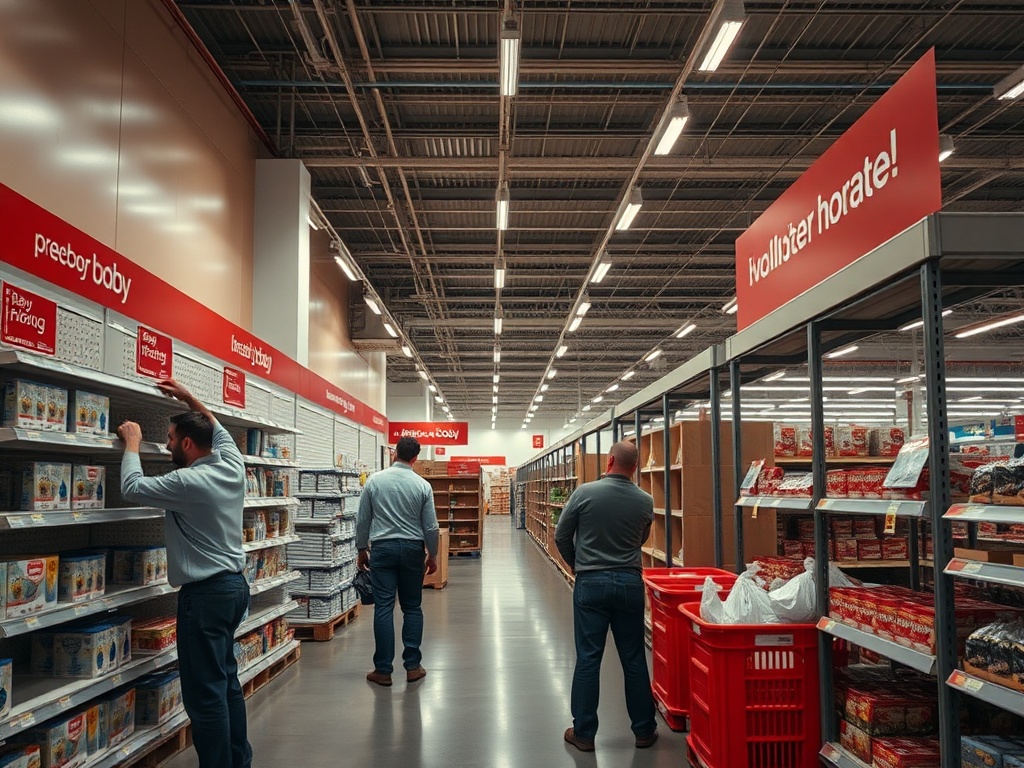
The plan lands on very specific initiatives. In baby products, Target will roll out a “Baby Boutique” in about 200 stores starting March 2026, with premium brands like UPPAbaby, Bugaboo, Doona, and Stokke, in addition to expanding its own brand Cloud Island. For groceries, it announced nearly 50% more “new items” within the assortment, increased space in new or remodeled stores, and a product milestone: in May 2026, it will become the first national retailer to offer certified cereal without synthetic colors.Viewed as a business mechanism, baby serves as an anchoring category: high-ticket, high-demand, and a customer who, once captured, shops routinely. The value isn’t just in selling strollers; it lies in capturing the entire cycle of a busy family, where each visit to the retailer can bring an additional basket. Groceries, in turn, act as the conveyor belt: they may not always maximize unit margin, but they build frequency and justify fast fulfillment services.
The decision to invest in “novelty” in grocery has a very pragmatic marketing reading: combating the perception of predictable shelves and restoring a sense of discovery without expanding the universe to infinity. Target is not saying, “we will have everything,” but rather, “we will have the right and new items with high frequency.” That cadence is an asset: it enables more relevant campaigns, better reasons to visit stores, and a faster learning cycle about what turns.
Simultaneously, the expansion of same-day services—which already accounts for two-thirds of the company's digital sales—and next-day delivery in 20 new metropolitan areas in the spring reinforces the logic: if you increase frequency in groceries and health, the customer demands operational convenience, not just brand relationship.
Remodels, Shop-in-Shops, and Supply Chain: Marketing Financed with Logistics
Target announced its most significant store transformation in a decade, with total remodels of around 130 locations and changes in layout, displays, and assortments across its network. Additionally, it will introduce specialized spaces: the relaunch of Threshold in summer with shop-in-shops in 200 stores; and the Target Beauty Studio in fall within approximately 600 stores, integrating beauty rewards into its loyalty program, in a context where the partnership with Ulta ends in August 2026.This point is often analyzed as “experience” in soft terms. In my view, it’s an investment to reduce friction and boost conversion with physical design. A shop-in-shop is a control device: it limits the perimeter of the assortment, improves navigation, allows for specific training, and creates a consistent visual language. It is, quite literally, a way to prevent the structure from collapsing again under the weight of breadth.
The supply chain receives $1 billion in additional capital investment within the incremental package. This isn’t a technical detail; it’s the hidden engine of the positioning. When same-day and next-day services are part of the promise, every inventory error becomes a reputational cost and a real fulfillment cost. Efficient logistics help maintain a “curated” proposition without sacrificing availability.
AI appears as a layer of personalization. There are no detailed metrics in what was announced, so it should be read as intention rather than outcome. Still, the principle is clear: if Target reduces breadth, it needs to be extremely good at recommending within its new selection and connecting rewards, content, and replenishments. Personalization doesn’t save a weak assortment but amplifies a well-designed one.
The Test of Resilience Will Be Financial and Operational, Not Creative
The market may applaud the strategic clarity and still punish short-term outcomes. An increase of $2 billion in 2026 —with hundreds of millions allocated to payroll and training, in addition to marketing—pressures margins before yielding returns. Target’s thesis hinges on execution: remodels that do not interrupt sales more than necessary, shop-in-shops that genuinely enhance productivity per square foot, and a supply chain that supports fulfillment without degrading costs.There’s a second tension: by explicitly renouncing the “everything” model, Target imposes its own discipline. This is healthy but requires tough internal governance. Every category left outside the focus will attempt to defend itself with arguments of “completeness” or “variety,” and that is a slippery slope back to the past. The plan has an antidote: a timeline with visible deliverables and a concrete budget allocation to categories and stores.
Analysts from TD Cowen, cited in the coverage, pointed out that reinstating merchandising authority in apparel and home—combined, they represent about 30% of the mix—will be essential to returning to positive comps and improving traffic, although they remain cautious. This reading is surgical: the redesign cannot depend solely on baby and grocery. It requires that historical categories, which build brand identity, function again with clear curation, as that’s where Target traditionally thrived on being “affordable with design,” not cheap by volume.
The signal to watch in 2026 will not be the shine of a new boutique, but the consistency: turnover, availability, repeat purchases, and the capacity to maintain rapid services without inflating costs. When a retailer invests in physical assets and payroll, it is betting that traffic and ticket sizes return with enough strength to pay for the concrete.
Target’s Competitive Advantage Will Depend on Fitting Fewer Pieces, but Better
This move is better understood as an intentional reduction of complexity. Target is trying to become a more reliable machine: categories with high recurrence, specialized spaces that improve conversion, and a supply chain funded to uphold promises of convenience.The value of marketing here does not live in clever campaigns. It resides in crafting an experience that makes the customer not compare every purchase as if it were a commodity. A premium stroller, a grocery aisle with visible renewal, an immersive beauty section with integrated rewards, and a relaunch of the proprietary home brand are pieces that, if fitting together, create a routine. And a routine reduces the cost of persuading.
Target is spending to be chosen again, not just visited. If execution maintains availability, training, and in-store navigation, the repositioning will have structure. If the company succumbs to the temptation to regain breadth due to competitive anxiety, it will overload the structure with unnecessary weight.
Companies do not fail due to a lack of ideas; they fail because the pieces of their model can’t fit together to generate measurable value and sustainable cash.