
Golden Goose and the Art of Selling Fear on a Blank Canvas
There is a tension that the luxury industry rarely admits out loud: the customer who pays for exclusivity is paradoxically terrified of making a choice. Buying a pre-made limited edition piece is safe. Expressing oneself in front of a craftsman, using one's own hands, with personal instructions, and the possibility of regretting it in real-time, is another story. Golden Goose has just bet everything that it can resolve that tension better than anyone else.
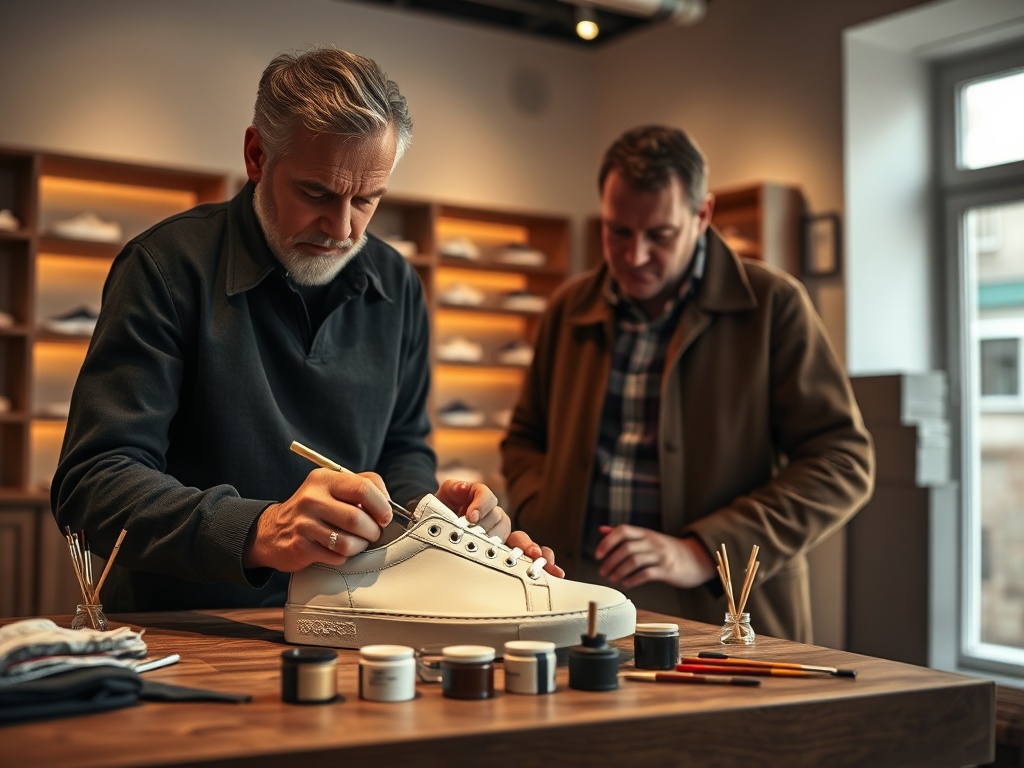
The Italian brand, founded in Venice in 2000 and now one of the most recognizable names in artisanal luxury footwear, announced its Arts and Crafts initiative as an extension of HAUS, its creative incubator. The proposal includes in-store artisans called Dream Makers, repair and customization services in its advanced format stores, a year-long artisanal training course, and the integration of Google’s Gemini AI model to translate customer ideas into visualizations that artisans can execute. Silvio Campara, the company’s CEO, summed it up with a phrase worth dissecting: "our priority is to ensure that everyone has their own blank canvas within each experience."
The blank canvas sounds liberating. From behavioral psychology, it is one of the most terrifying phrases you can say to a consumer.
The Problem No Press Release Mentions
When a luxury brand puts you in front of a craftsman and tells you to "create," it simultaneously activates two forces that go in opposite directions. On one hand, there is a genuine magnetism: the promise of having something that nobody else has, the experience of participating in something that feels meaningful, the pleasure of narrating that process afterward. On the other hand, there is concrete and largely unstudied anxiety on the brands' part: the fear of creative incompetence.
The luxury consumer does not fear spending money. They fear looking foolish. They fear that the product they co-created will reveal that they have poor taste, that their instructions were clumsy, that the final outcome is inferior to what the artisan would have done alone. That fear does not appear in focus groups because nobody admits it, but it does show up in behavior: the customer who observes customization services without activating them, the one who asks questions and ultimately requests "whatever you recommend," or the one who prefers to buy the standard model to avoid taking risks.
What makes Golden Goose's bet structurally interesting is that, at least in part, its architecture seems designed to deactivate exactly that fear, although likely intuitively rather than deliberately. The Dream Makers are neither salespeople nor designers: they are artisans with the explicit role of accompanying, not judging. The integration of Gemini is not a technological whim; it's a tool that turns a vague or verbal idea into an image, eliminating the most costly cognitive friction in the process—the trouble of translating what the customer imagines into something they can communicate without feeling ridiculous. Campara stated directly: the goal of the in-store AI is to "give people confidence in the creative process."
That phrase should be framed in the offices of many marketing directors in the sector.
The Economics Behind Turning a Store into a Workshop
Transforming a luxury outlet into a space for artisanal production is not an aesthetic decision. It has financial implications that are worth naming precisely.
First, the margin per unit. A customized product does not compete on price with any other product on the market. Golden Goose can maintain a premium price over its premium pricing precisely because the customer has participated in the creation: they are not buying an object; they are buying their own materialized judgment. This makes comparisons with any competitor irrelevant the moment the customer touches the finished piece.
Second, the cost structure. The Dream Makers program requires a year-long training course per artisan, which implies an investment in talent that is neither transferable nor scalable at the speed required to open stores. This represents the most serious risk in the model. Unlike chatbots or interactive screens, you cannot duplicate a trained artisan in twelve months. If demand exceeds the training capacity, the model degrades: the Dream Maker stops accompanying and starts to produce en masse, losing the only differentiator that justifies the customer's investment. Available sources do not reveal how many artisans have completed the program or how many stores operate in this format, making it impossible to evaluate whether Golden Goose is already facing this bottleneck or is still operating at a manageable scale.
Third, the extended product lifecycle. The repair service offered by advanced outlets under the name We Repair is neither philanthropy nor green positioning. It is a retention mechanism that keeps the customer connected to the brand after the purchase. Each repair is a touchpoint, a conversation, an opportunity for the artisan to propose additional customization. In terms of customer lifetime value, this transforms a one-time transaction into a relationship with multiple income moments.
The partnership with the WWF in 2024 and ties to the Venice Biennale operate on a different layer, but with the same logic: building symbolic capital that justifies prices that no cost sheet could defend on its own.
What AI Solves for the Artisan and the Customer
The integration of Gemini in-store deserves separate analysis because it touches the most delicate knot of the model. Friction in participatory luxury does not occur between the customer and the artisan. It occurs beforehand: at the moment the customer has to articulate what they want without feeling exposed.
Imagine the scenario without the tool: the customer arrives with a vague idea, tries to describe it in words, the artisan interprets, the customer doesn't know whether what they described sounds coherent or absurd, decides not to risk it, and asks for something standard. The sale of customization is lost. The artisan did nothing wrong. The customer did nothing wrong either. The model failed because no one built a bridge between the idea and execution.
Gemini acts as that bridge. The customer describes, the AI visualizes, the artisan executes. The customer does not have to be a designer to participate. This is not technology for technology's sake; it's a precise behavioral intervention that eliminates friction at the only point where the model was vulnerable. Campara articulated it accurately when he said that technology must "amplify the human hand, not replace it." What he did not say, but what the mechanics reveal, is that the real purpose of AI is not to help the artisan. It is to give the customer permission to dare.
The Blank Canvas Cannot Be Left Empty
Golden Goose's bet operates on a principle that few leaders in the sector are willing to accept: the product is no longer the sneaker. The product is the moment when the customer realizes they have something to say and finds an environment that helps them say it without the fear of making a mistake.
This completely alters the work of strategic design. It’s not about investing in more sophisticated materials or campaigns that make the object shine. It’s about precisely mapping every point where the customer could doubt, retreat, or delegate their judgment to the brand and building a structure there to support them. The Dream Makers are that structure. Gemini is that structure. The year-long training course is that structure.
The mistake most brands make when trying to replicate this model is to invest 90% of their budget in making the product visually stunning and practically nothing in solving the question the customer asks before committing: if I participate in this and it doesn't turn out well, what do I lose? As long as that question lacks an architectural answer, no customization campaign will take off. Leaders who view this initiative as a story of creative marketing are looking at the window display. Those who see it as engineering to deactivate the customer’s fear are looking at the business.