
Tanger Turned the World Cup into a Mass-Scale Loyalty Laboratory
The summer of 2026 was no ordinary season for retail in the United States. The FIFA World Cup, held on North American soil, generated a wave of international tourism that did not reach all retail formats equally. Tanger Inc., the operator of outlet shopping centers, positioned itself at the center of that wave with an advantage that was anything but accidental: the company had a presence in eight of the eleven host cities of the tournament. The result, according to statements made by its chief executive officer Stephen Yalof to CNBC on August 5, 2026, was a sustained increase in foot traffic during June and July, and a sales growth of approximately 5% year-to-date. For a company whose model depends entirely on visitor volume and on the financial health of its tenants, those figures are not a minor detail — they are the most direct indicator of whether the strategic bet of recent years is producing measurable returns.
What is worth examining is not the number itself, but the architecture that made it possible and the questions it leaves open about its durability.
Geography as a Structural Advantage, Not a Coincidence
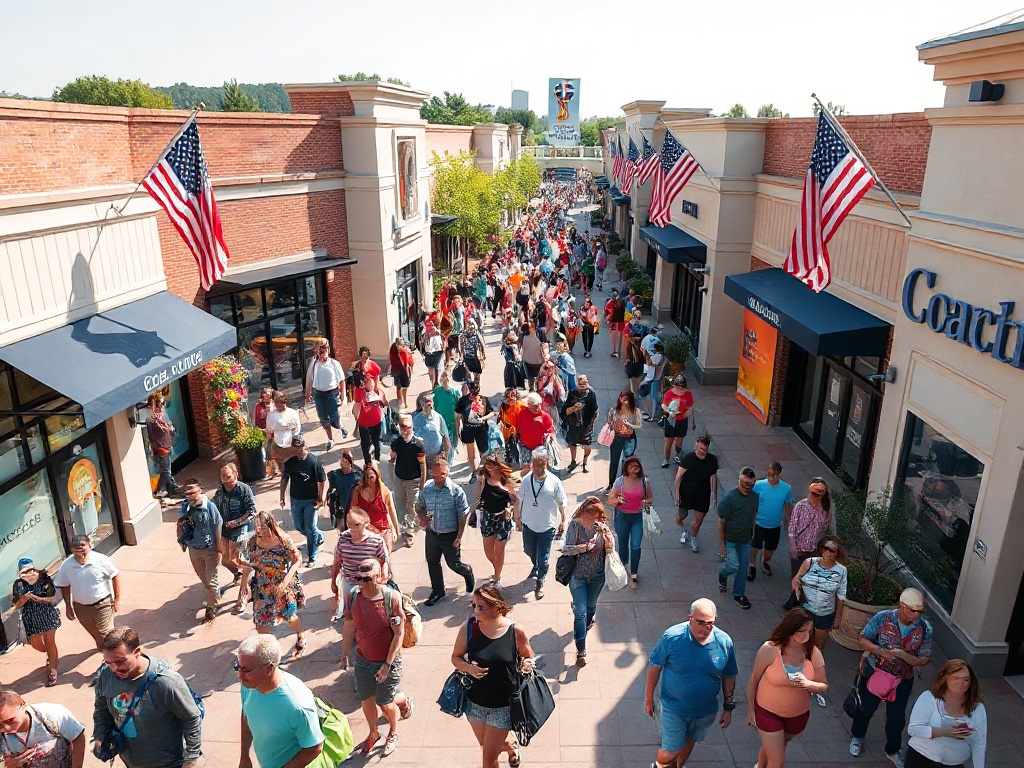
When Tanger points out that it operates in eight of the eleven host cities, it is revealing something beyond a coincidence of timing. That geographic coverage turned the operator into one of the few commercial destinations with sufficient scale to absorb tournament tourism in a systematic, rather than episodic, manner. An international visitor who landed in Dallas, Los Angeles, or New York to watch a match found, within or adjacent to a Tanger center, the opportunity to purchase brands such as Polo, Michael Kors, Kate Spade, Coach, or Nike at outlet prices. Yalof was explicit in describing that appeal: visitors were seeking an "American experience," and Tanger centers offered exactly that, from dining to fashion brands.
This point deserves analytical attention. The outlet format carries a value proposition that works especially well with international tourists: the price gap between the visitor's home country and outlet prices in the United States can be large enough to justify high-volume purchases. That type of buyer does not operate under the same logic as the domestic consumer who compares prices online before visiting a store. The international tourist, especially one coming from markets with high tariffs on accessible luxury brands, perceives the outlet as an opportunity for geographic arbitrage. Tanger did not create that dynamic, but it did build the infrastructure to capture it at the moment when visitor flows concentrated in specific cities.
The question that the CNBC report does not answer is what percentage of the 5% growth corresponds strictly to the World Cup effect and what portion reflects pre-existing trends. The Bloomberg report referenced in the sources notes that Tanger raised its projections for the second time in the year, which suggests that the upward revision is not solely attributable to the tournament. Additional contributing factors include domestic back-to-school traffic, the trend of Americans traveling within the country in response to rising fuel prices, and the effect of cinema on foot traffic at centers that include movie theaters. Isolating the World Cup's contribution within that sum of factors is not possible with the data available to the public.
The Destination Model and the Economics of Dwell Time
Yalof repeatedly described what he calls a "flywheel" of experiences: the visitor arrives for one reason and stays for another. Someone who goes to the movies stops for dinner. Someone who comes in to eat ends up shopping. That mechanic is not new in retail, but its execution in outlet centers — a format historically associated with price-driven purchasing rather than experience — does represent a shift in the format's value proposition.
The sales-per-square-foot figures reported by WWD point in the same direction: $487 per square foot in the twelve months ending June 30, 2026, compared to $465 the previous year. That 4.7% increase in productivity per surface area is not trivial for a REIT that charges rents partially linked to tenant sales volumes. When tenants sell more per square foot, Tanger's ability to negotiate favorable leasing terms increases, and its position as a landlord strengthens against brand turnover.
What Yalof is building, at least in narrative terms, is an outlet shopping center that competes for dwell time, not just for transactions. That distinction matters because it shifts the central performance indicator: moving from measuring average ticket size to measuring how many hours a customer spends in the center and how many touchpoints they activate during that time. If a visitor comes to see a film, eats at the center, shops at two stores, and returns the following month because they remember the experience, the value of that initial visit is far greater than that of a single transaction.
The limit of this logic lies in the costs required to sustain it. Operating restaurants, entertainment venues, and retail under one roof, or in close proximity, demands a more complex curation of tenants and an investment in maintenance and marketing that does not always appear itemized in earnings releases. Tanger cited "enhanced marketing and traffic-generation initiatives across the portfolio" as a factor in its second-quarter results. That phrase covers a great deal of ground without revealing what percentage of the operating margin was allocated to sustaining those initiatives.
What Seasonal Traffic Alone Does Not Guarantee
The structural risk that the World Cup narrative tends to obscure is the difference between event-driven traffic and recurring traffic. Yalof acknowledged this with unusual precision: "We had an opportunity to introduce them to our brand, and we hope they become ambassadors if the experience was good." That formulation is honest about the uncertainty involved. The international visitor who bought Nike at outlet prices in June is not guaranteed to return to a Tanger location the following year, especially if they have since returned to their home country.
The loyalty of that segment depends on variables that Tanger does not directly control: whether the visitor returns to the United States, whether they do so in a city that has a Tanger center, and whether they remember the experience intensely enough to repeat it. The profile of the international tournament tourist is, by definition, episodic. The brands operating within Tanger centers may capture that buyer through their own digital loyalty programs, but loyalty to the center itself as a destination is more diffuse.
Domestic additional traffic, on the other hand, carries a more predictable recurrence profile. Americans who traveled within the country this summer due to the rising cost of international travel represent a segment that can return if the value proposition is maintained. In that case, the World Cup effect served as the catalyst that filled the centers at the moment of greatest concentration of visitors, but the continuity of the business depends on converting domestic visitors into regular customers with higher visit frequency.
The second upward revision of projections reported by Bloomberg suggests that Tanger's leadership has sufficient visibility into the second half of the year to believe that demand did not collapse after the tournament ended. That is a relevant operational signal, although it does not amount to confirming that post-World Cup traffic will sustain the growth rates achieved in the first half of the year.
The Variable the Report Does Not Name but That Determines the Outcome
The indicator missing from Tanger's entire public narrative is the conversion rate of new visitors into recurring buyers. The figures on foot traffic and sales per square foot describe what has already occurred. The long-term commercial architecture of Tanger depends on a metric that does not appear in its communications: how many of the visitors who arrived for the first time this summer — whether due to the World Cup or for any other reason — returned at least once before the quarter ended.
That metric is what differentiates a business that captures events from a business that builds organic demand. Tanger operates as a REIT, meaning its financial health is tied to occupancy rates and tenant rents, not directly to per-transaction sales. But when tenants perform well commercially, lease negotiations become favorable, tenant turnover decreases, and the portfolio becomes more stable overall. The 5% sales growth and the $487 per square foot are symptoms of that chain of cause and effect, not the cause itself.
What Yalof described to CNBC is a model that attempts to resolve a historical tension in the outlet format: how to transition from being a price-driven shopping destination to being an experience destination defined by perceived value. If that transition consolidates, Tanger will have used the World Cup not only as a seasonal sales lever, but as a large-scale experiment to validate whether its new mix of commerce, dining, and entertainment generates the recurrence that the format needs to sustain itself when there is no tournament filling cities with visitors. The results of the third and fourth quarters of 2026 will be the first real test of that hypothesis.