
Staples Reduces Stores to Sell at Higher Prices: The Real Move is to Turn Retail into Value Evidence
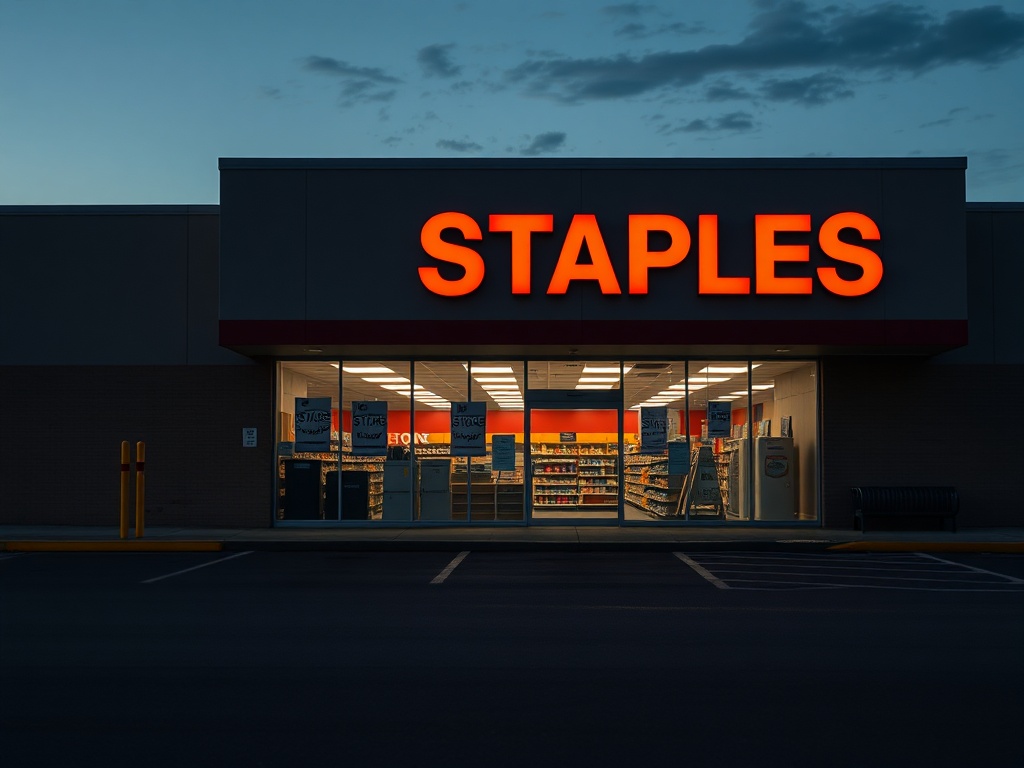
Staples is doing something that, at first glance, seems defensive. Since October 2025, it has closed 13 stores in the United States, reducing its locations from 929 to 916 by January 2026. Specific closures have been reported in states like Maryland, Connecticut, and Maine. In Connecticut, for instance, a planned closure in Norwich is set for May 16, 2026, in addition to another in Newington. The key point that many overlook is there are no signs of bankruptcy in this wave of closures; it’s a deliberate repositioning towards online sales and, above all, towards business-to-business (B2B) transactions. Source: TheStreet.
As a pricing strategist, I don’t see this as “fewer stores.” I see it as “less friction” and “more margin control.” In the office supply retail space, competing for shelf convenience is a losing battle against home delivery and an endless catalog. Staples isn’t trying to win that war. It’s trying to change the game board: using physical presence only where it strengthens conversion and shifting the remaining growth to channels where willingness to pay is supported by contracts, services, and certainty.
Store Closures Are Not Cuts: They Are a Revenue Model Migration
The recent hard data may seem modest in numbers, but it’s a brutal signal: 13 closures in four months. This isn’t a hasty liquidation; it’s a surgical rationalization of the map. This aligns with history: Staples previously announced in 2014 plans to close up to 225 stores (over 10% of its North American base at the time) with an explicit goal of saving $500 million, at a time when almost half of its sales were already going online. That year, moreover, it reported visible financial pressure: declining quarterly revenues and an immediate stock hit following the announcement.
The pattern is consistent: when demand for “core office supplies” weakens and purchases become commoditized, the square footage ceases to be an asset and turns into a burden. The statement attributed to then-CEO Ron Sargent in the 2014 context translates to a boardroom Excel sheet: stores must earn their right to remain open. This isn’t retail romanticism. It’s unit economics.
The acquisition by Sycamore Partners in 2017 for $6.9 billion adds another element of discipline: being a leveraged buyout, the business needs to operate with heightened attention to cash flow and profitability by channel. There’s no need to invent anything here: a structure with more debt tolerates unproductive assets poorly. In that context, closing stores that do not convert with margin isn’t optional; it’s financial hygiene.
Amazon Didn’t Kill the Stores: It Killed Customers’ Tolerance for Effort
The underlying problem isn’t the existence of online alternatives. It’s that customers no longer accept paying with time, distance, and complexity for what they can solve with two clicks. In office supplies, base products tend to seem interchangeable, and at that point, the purchase is decided by friction: immediate availability, automatic replenishment, reliable delivery, simple invoicing, payment terms, integration with procurement.
When a category enters this dynamic, physical retail falls into a trap: attempting to defend itself with promotions, a larger variety, and generic “experience.” Typical result: eroded margins and a race to the bottom.
Staples is pointing in a different direction: online + B2B as the backbone. In B2B, willingness to pay isn’t defended by a product aisle; it’s defended with certainty: compliance, implicit or explicit service-level agreements (SLAs), continuity of supply, fewer billing errors, fewer returns, and less time wasted by the buyer. The corporate buyer doesn’t “buy pens”; they buy the assurance of no complications.
And when the real value is “no complications,” the winning channel is the one that minimizes variability. Well-executed e-commerce and B2B distribution are machines of predictability. Physical stores, by contrast, tend to be machines of fixed costs. That’s why the closures aren’t the headline; the headline is the migration towards a model where value is measured by operational certainty, not foot traffic.
The Surviving Store Stops Being a Store: It Becomes a Conversion Device
TheStreet reports that Staples is trying to maintain the relevance of the physical store through partnerships: vision care centers with Stanton Optical and technology services with Verizon in selected stores. This, strategically, is more interesting than the number of closures.
A traditional office supply store has two simultaneous problems: (1) inventory that customers can compare in seconds, and (2) low-emotion, high-replacement purchases. Introducing optical and tech services changes the nature of the visit motive. It doesn’t guarantee success, but it points to a correct logic: increase the perceived value per visit and reduce direct comparison with Amazon.
From a pricing perspective, the play isn’t “selling glasses” or “selling plans.” The play is using these services to build physical proof of capability: consulting, installation, support, problem resolution. This elevates perceived certainty. And when certainty rises, willingness to pay for higher-priced packages, contracts, scheduled deliveries, and comprehensive solutions increases.
There’s a discipline that many chains don’t execute: if the store exists, it must have a clear job in the funnel. It can be acquisition, demonstration, support, frictionless returns, or consultative upselling. If the store doesn’t perform one of those jobs with hard metrics, it ends up being a museum of costs.
The movement also aligns with trends in the sector: Office Depot, after merging with OfficeMax in 2013, closed over 1,000 stores and prioritized B2B and e-commerce according to the briefing. This isn’t just a Staples anecdote; it’s a reconfiguration of “office retail” as an industry.
The Real Risk: Confusing Footprint Reduction with a Growth Strategy
Closing stores can improve the P&L in the short term simply by trimming costs, but that’s not what separates winners from survivors. The difference lies in whether the company converts that fresh air into a more expensive and defendable B2B offer.
Staples has two visible strategic risks based on the available facts. First, local brand erosion: each closure removes immediate convenience for a segment that still values in-store pickup or resolution. If online doesn’t compensate with an impeccable experience, the customer migrates to whoever makes their life easier.
Second, the hybrid store as a distraction: alliances like Verizon and Stanton Optical can drive traffic, but traffic isn’t margin. If the journey design and proposition don’t convert that traffic into contracts, recurring replenishment, or support services, the store becomes a small shopping mall inside another retail environment, without real value capture.
The scenario that aligns with a robust strategy is another: fewer stores, better located, with defined roles in the funnel; a B2B back-end where execution reduces errors; and pricing that moves from “product list” to “outcomes packaged”: hassle-free sourcing, support, quick replacement, administrative integration.
The news, as reported, doesn’t bring conversion or employment metrics, and Staples didn’t detail labor impacts in previous announcements according to the briefing. This obliges us to read the maneuver by its structural intent: shifting the center of gravity to where margin and recurrence are more defensible.
The Direction That Distinguishes Pruning from Profitable Reinvention
Staples is closing stores without bankruptcy because it’s accepting an uncomfortable truth: physical retail of supplies, on its own, has ceased to be an advantage. The advantage now is operating a system that delivers results with high repeatability and charging for that peace of mind.
The metric that will matter moving forward won’t be how many stores remain, but how much B2B demand they capture with recurring contracts, how much administrative friction they eliminate for customers, and how much margin they sustain without falling into permanent discounts. In-store alliances can work if designed as proof of capability and as accelerators for closure, not as decorations to generate traffic.
Commercial success is determined when the strategy reduces friction, maximizes perceived certainty of results, and elevates willingness to pay with a truly irresistible proposal.