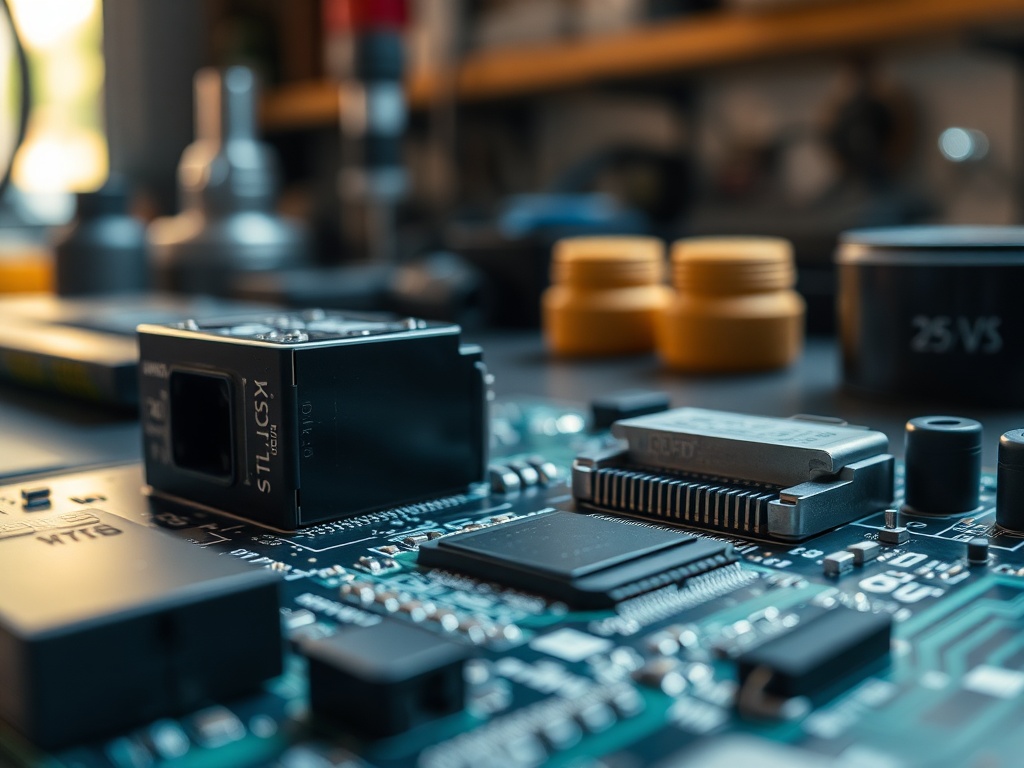

How NASA Transformed the Camera into a Chip
Most disruptions don’t enter the market through a marketing campaign but through a physical constraint. In the 1990s, for space missions and telescopes, digital imaging relied on CCD sensors that provided high quality but came with four significant structural drawbacks: high energy consumption, size, cost, and sensitivity to radiation. When power and mass margins are minimal, these "details" become intolerable.
This is where an internal invention by NASA, developed at the Jet Propulsion Laboratory (JPL), silently changed the economics of imaging. In 1992, Eric Fossum invented the CMOS Active Pixel Sensor (APS) at JPL, with patents held by Caltech (which oversees the lab). The leap was not only technical but architectural: a "camera-in-a-chip" manufacturable through standard CMOS processes, replicable by multiple foundries, integrating control and processing on the same silicon, and boasting an energy and size profile incomparable to that of CCDs.
The result can now be seen in billions of devices, not out of technological nostalgia but due to a compelling financial mechanism: when the sensor becomes small, cheap, and efficient, the camera ceases to be a "premium" hardware component and transforms into an ubiquitous function.
From CCD to CMOS APS: Innovation Was the Cost Architecture
The CMOS APS wasn't just another sensor. Historically, it incorporated within each pixel a single-stage CCD-like mechanism for complete charge transfer, an in-pixel amplifier (source-follower) for gain, low noise operation through correlated double sampling (CDS), and fixed-pattern noise (FPN) reduction in columns. This set allowed high performance without relying on an exotic fabrication platform: it could be made in a standard CMOS process, available across multiple factories.
From a business perspective, that equates to one phrase: industrial standardization. What was once a specialized, costly component with narrower manufacturing and value chains became a scaling component within the global semiconductor infrastructure.
The comparison with CCDs illustrates the era transition: the CMOS APS could require 1% of the power, be less than 10% of the size, cost less to manufacture, and offer greater resistance to radiation damage, making it ideal for space applications. That combination doesn’t merely resolve a mission; it unlocks a market. Because when energy costs drop two orders of magnitude, and volume shrinks, the sensor becomes "portable by design,” and portability is the threshold that separates an accessory from an integrated function.
The “faster, better, cheaper” directive associated with NASA's shift pushed JPL to find alternatives. The pressure was neither aesthetic nor superficial; it was budgetary and operational. When a lab driven to optimize for survival finds an architecture replicable by industry, the knock-on effect inevitably reaches mass consumption.
Technology Transfer: When the Market Validates What the Lab Already Knew
History is rarely linear. In 1995, Eric Fossum and Dr. Sabrina Kemeny licensed the technology from Caltech and founded Photobit to commercialize it; Fossum left JPL in 1996 to lead the company full-time. Photobit refined sensors to align their performance with CCDs by reducing power and costs, and they licensed to companies like Kodak and Intel, though several early efforts did not gain traction.
What’s relevant for C-level executives is not who “won” the first wave, but what pattern tends to repeat: incumbents are typically shielded by three walls.
1) Industrial inertia: product lines and know-how built around CCDs.
2) Internal political economy: jobs, suppliers, and technological reputation.
3) Perception of risk: the market remembers failed past attempts and punishes change.
Fossum expressed it soberly: displacing an incumbent technology is difficult, and the new one must provide compelling advantages. In this case, the advantages were structural rather than incremental.
Another powerful validation route emerged: the case of Schick Technologies in dental imaging. The company (then small) signed a Technology Cooperation Agreement with JPL and later acquired sublicenses and finally a direct exclusive license from Caltech for dental applications. Dentistry is a market where “response time” and reducing operational friction matter as much as quality. Replacing film and chemistry with more efficient digital capture modifies workflow, not just the device.
Here, technology transfer isn’t a “cute spin-off.” It’s a mechanism for capacity allocation: NASA needed robustness and extreme efficiency; the market found a component that could be fabricated like the rest of modern electronics.
The Real Disruption: Imaging Achieved Near-Zero Marginal Cost
When I say the camera ceased to be a product, I’m talking about its economics. The consequence of the CMOS APS is not merely that “there are more cameras.” It’s that image capture became an integrable module with a cost that decreases with every manufacturing cycle and every leap in scale.
The industry immediately translated this into product design: camera phones, webcams, automotive systems, medical devices. The available briefing lacks updated revenue figures or market share, but presents the macro fact: today, billions of CMOS sensors are deployed around the globe. This is sufficient to grasp the dynamic.
The camera as a stand-alone object had a clear margin model. The camera as a chip within another device shifts the gravity center of the value chain:
- The margin shifts from capture hardware to software, services, and experience.
- Competition moves from optical vs. optical to integration: energy, size, processing, and industrial design.
- The “good enough” overtakes the “perfect,” since utility is measured in ubiquity.
This is the type of dematerialization that the corporate world often underestimates. Not because the price of a sensor literally approaches zero, but because it becomes a minor line within the bill of materials, capturing its value in higher layers.
A cultural effect appears with commercial implications: when everyone can capture and share, images cease to be scarce. Scarcity migrates to attention, judgment, and trust. That’s where new dominant positions are played out.
The “Dangerous” Phase for Corporations: Efficiency Without Awareness Amplifies Error
The CMOS APS enabled hardware; digital convergence did the rest. From there, image capture became connected to cheap storage, networks, and embedded computing. The strategic question for a company isn’t whether it integrates cameras, because the market has already done so. The operational question is what to do with that abundance.
Here enters my filter of Augmented Intelligence. Massive image capture enhances medical diagnostics, road safety, industrial inspection, and documentation. But it also opens the most common risk in the corporate world: automating without understanding.
As costs drop, the temptation arises to deploy sensors everywhere, accumulating data and later justifying decisions with opaque models. That’s efficiency without awareness: producing evidence without context. In dental medicine, for example, digitization can accelerate and reduce friction; real value appears when the professional derives better decisions, not when the system merely "processes more." The briefing mentions that adapting the technology for X-rays required intensive exchanges between designers and engineering teams. That detail conveys a lesson: the leap in value isn’t achieved by installing a chip but by adjusting the entire socio-technical system.
In mass consumption, the pattern is similar. Ubiquitous cameras enable new categories, but can also erode trust if used for indiscriminate surveillance or automated decision-making without traceability. Regulation and brand reputation become strategic variables, not mere legal accessories.
For the C-level, the discipline is clear: if the sensor is cheap, the differentiator becomes data governance, explainability of flows, and responsible product design. Competitive advantage is sustained when human judgment maintains control.
The Executive Lesson: The Advantage Was Not the Sensor, But the Dematerialization of the System
The CMOS APS compressed a camera into silicon, and in doing so, changed the game on two levels.
First, it dematerialized components: control, timing, conversion, and parts of processing could be integrated. The camera ceased being a set of pieces and became a building block for any industry.
Second, it democratized access. Adoption in phones pushed mass production and economies of scale that ultimately tipped the balance against CCDs. The briefing also notes early resistances and efforts that did not succeed, reminding us of an uncomfortable truth: technical superiority does not guarantee market presence; that guarantee comes from a volume channel that forces the industrial learning curve.
If I had to transpose this case into corporate strategy, I would phrase it like this: when a technology can be manufactured to a dominant standard, its trajectory relies less on the lab and more on the first market that delivers sustained volume. In this case, mobile consumption served as that engine.
The current phase is no longer about invention or early adoption; it’s the consolidation of an infrastructure where capturing images has become trivial. Value lies in how it’s interpreted, how it’s protected, and how it translates into better decisions.
The market is at an advanced stage of demonetization and democratization of image capture, and the responsible technical direction is to leverage that abundance to empower human judgment and expand access to capabilities, rather than to automate errors at large scale.