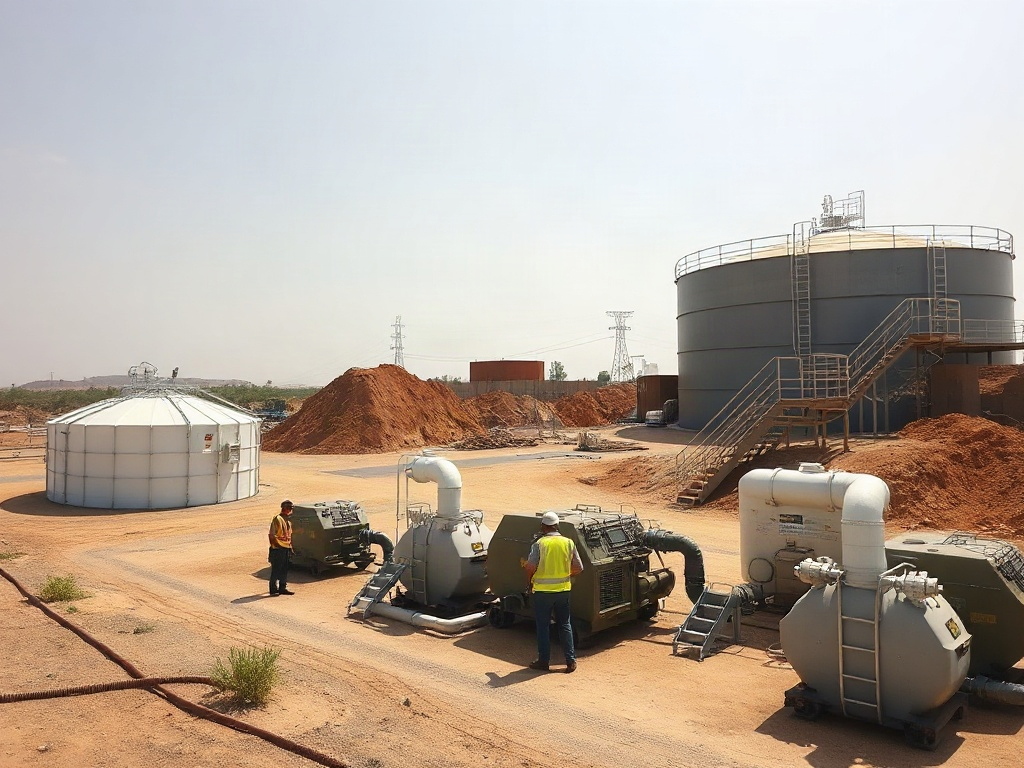

Mining Near Joshua Tree Reveals Who Calls the Shots in Energy Transition
Some corporate decisions, before they become scandals, were simply board meetings. Someone proposed an idea, someone approved it, and no one in the room said: this will cost us more than we will gain. The news that a mining company plans to extract rare earth elements on land adjacent to Joshua Tree National Park in California fits precisely into that category. It is not a geological accident. It is a strategic decision that warrants thorough examination.
According to information published by The Independent, the proposed site is located just outside the formal boundaries of the park, in an area also reported as habitat for the desert tortoise, an endangered species. Activists have responded with outrage. Predictably. What no one is analyzing with the detachment it deserves is the governance architecture that produces these kinds of high-stakes bets.
The Geography of Risk That Wasn't Calculated
Rare earth elements are not a speculative whim. They are the raw materials for batteries, electric motors, defense systems, and communication technology. Global demand is rising, and dependence on supply chains concentrated in a few geographies is a documented political and economic problem. From that perspective, the initial logic of seeking deposits within U.S. territory makes strategic sense.
The issue lies not in the what, but in the where, and in how that where was chosen.
Operating on the fringes of an iconic national park, in a state with some of the strictest environmental regulations in the world, with a protected species as an immediate neighbor, is not a minor variable that can be managed with a good communications team. It is a structural risk of the highest magnitude. The potential costs of environmental litigation, the timelines for regulatory approval in California, the political pressure from conservation groups with real access to legislators, and the reputational impact in a market where ESG investors increasingly weigh these factors create a scenario where projected profitability can erode before the first machine touches the ground.
A mature management team does not shy away from difficult projects. But it builds evaluation systems that differentiate between calculated risk and unnecessary exposure. Here, the available evidence suggests that either that system failed or simply did not exist with the required sophistication.
When Resource Urgency Clouds Context Analysis
There is a recognizable pattern in extractive industries that operate under demand pressure: the urgency of the resource compresses the timelines for context analysis. When the price of a mineral rises or when geopolitics threatens supply, the internal pressure to move quickly on identified deposits becomes very intense. In that environment, voices warning about regulatory complexity, impact on communities, or reputational risk tend to be relegated to the background of the first mover narrative.
This is not a moral judgment on the individuals involved. It is a description of a specific organizational dysfunction: the concentration of decision-making authority in those most exposed to financial upside and least exposed to long-term operational consequences. When the team identifying the opportunity is the same one approving it, without real checks and balances from legal, regulatory affairs, or risk management with effective veto power, the predictable result is exactly this: projects that start with economic logic and end up ensnared in controversies consuming time, capital, and credibility.
Joshua Tree is not a peripheral park. It is one of the most photographed and visited natural spaces in the Southwestern United States, with a cultural and symbolic load that exponentially increases visibility of any conflict nearby. Choosing this neighborhood for a sensitive mining operation is not just an environmental miscalculation. It is a misreading of the competitive environment in which that company operates its reputation.
What the Stakeholder Map Should Have Shown
Before any geologist marked coordinates on a map, information was available about the network of actors capable of blocking, delaying, or increasing the cost of this project. Conservation groups engaged in active litigation in California, federal agencies with jurisdiction over protected species, local governments with electoral sensitivity towards park protection, and investment funds with environmental mandates that might reconsider their exposure to the company were all present before the announcement. They didn’t appear afterward.
The difference between a mature governing organization and one that operates on strategic impulse is its ability to perform that mapping before committing capital and public credibility. It is not about paralysis by analysis. It is about building internal structures where contextual intelligence is weighted equally with geological or financial intelligence.
A team where the director of regulatory affairs, the head of community relations, and the legal department have real access to the project selection process—not just as final validators but as participants from the outset—produces decisions of a different texture. It leads to decisions that survive the first contact with external reality. What the situation surrounding Joshua Tree illustrates is the absence of that architecture, or its presence without effective authority, which is functionally the same thing.
The transition to energy sources with a lower carbon footprint requires minerals. That is a physical fact. But it also requires that the companies extracting those minerals operate with organizational sophistication commensurate with the complexity of the moment. The capital market, regulators, and public opinion no longer separate these two things. Companies that continue treating internal governance as a compliance cost, rather than a competitive advantage, will find that their best deposits become their worst litigations.
Leadership that builds systems where no opportunity, no matter how profitable it seems, can move forward without passing through a real contextual viability filter is what allows the organization to scale without depending on someone at the top to correct last minute what the system should have detected first. That is the standard that a governance structure aims for that doesn’t need heroes to avoid preventable mistakes.