
India Turns Oil Dependency into a Profit-Driven Argument for Renewables
There is a structural difference between a country that adopts clean energy because it is mandated by the Paris Agreement and one that does so because the Strait of Hormuz puts a knife to its throat. India belongs to the latter group, and that distinction changes everything in terms of speed, capital, and sustainability of the model.
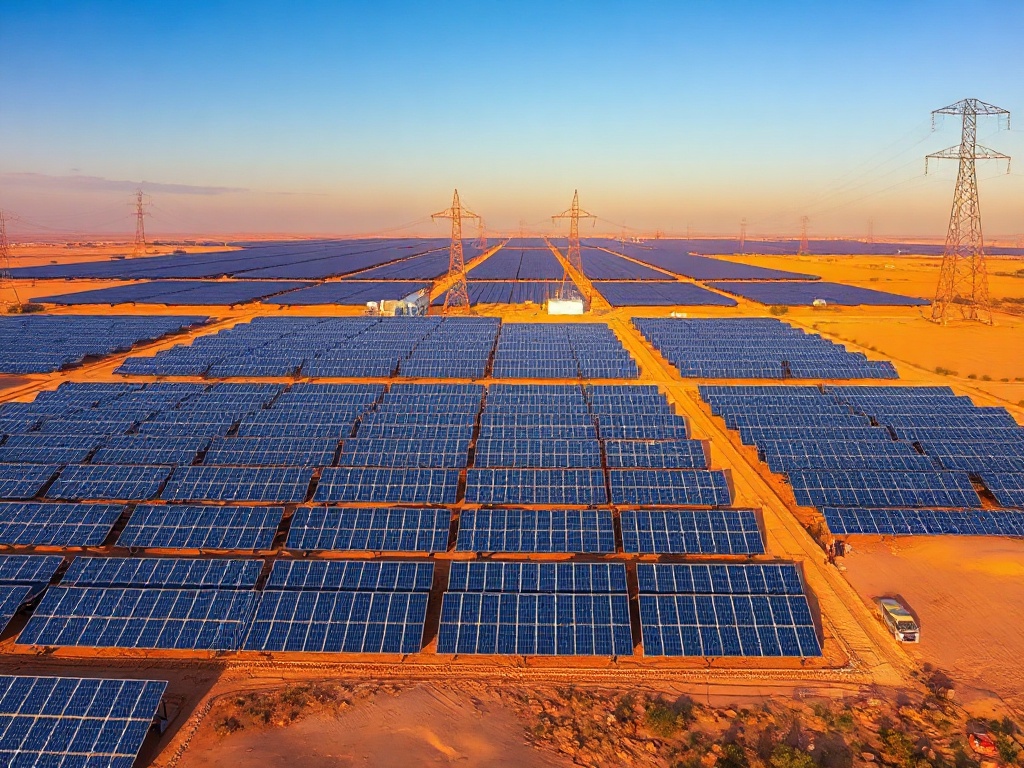
In June 2025, India surpassed the 50% threshold of installed electrical capacity from non-fossil sources, reaching its nationally determined contribution under the Paris Agreement five years ahead of schedule. While the headline sounds like an environmental achievement, the mechanics behind it tell a different story: it is the result of a nation that learned to read its own financial vulnerabilities and concluded that the energy transition was, above all, a macroeconomic shielding operation.
When Geopolitical Risk Becomes the Best Business Argument
Approximately 45% of India's oil imports and 53% of its LNG imports transit through the Strait of Hormuz. This is not merely a foreign policy statistic; it's a direct line to the country's balance sheet. Every escalation of tension in the region translates into pressure on the current account deficit, depreciation of the rupee, and reduced fiscal margin for public investment. The reliance on imported energy acts as a permanent and variable tax on growth.
Madhura Joshi, head of global clean energy diplomacy at E3G, describes it with surgical precision: sustained high oil prices generate current account deficits, currency pressure, and fiscal stress that simultaneously compress growth and public spending. For a government managing a country of over 1.4 billion people with ambitions to triple its economy before 2033, this is a systemic risk that no rational board would tolerate.
The response was not ideological but financial engineering. The ethanol blending program, for instance, has saved approximately $19 billion in foreign exchange since 2014, reduced emissions by 813 lakh metric tons of CO₂, and replaced 270 lakh metric tons of imported crude. In the 2024-25 ethanol harvest year, blending reached 19.05%, nearing the national goal of 20%. This is not environmentalism; it is import substitution with measurable foreign exchange returns.
This is the logic that purely ESG models often fail to capture: when competitive pressure and financial vulnerability align with climate goals, the transition no longer needs subsidies to become self-sustaining. India is not being virtuous; it is being rational.
The $300 Billion Gap and Who Has the Right to Fill It
India's Minister of New and Renewable Energy has estimated that $300 billion in investment will be needed by 2030 to cover renewable generation, storage, hydrogen production, grid infrastructure, and component manufacturing. This figure is not aspirational; it is an estimate of what it costs to structurally reduce exposure to the global fossil fuel market.
Now, here is where financial analysis diverges from political discourse. India needs external capital to close that gap, and to attract it, it competes with developed markets that are also undergoing transitions and offering more predictable regulatory frameworks. The government cites policy stability and transparent markets as its comparative advantages. These claims must be validated in the equation that any infrastructure fund manager runs before committing capital: regulatory predictability, tariff certainty, and exit mechanisms.
The nuclear sector has recently opened up to foreign investment through new legislation, broadening the zero-emission generation spectrum beyond solar and wind. This diversification of sources is smart: it reduces technological risk concentration and opens the door to institutional capital that had previously faced sector-specific restrictions.
But there is one variable that no investment prospectus typically includes with sufficient honesty: the competitive gap with China. While India celebrates achieving 50% of installed non-fossil capacity, China has been years ahead in building low-carbon supply chains for solar, wind, electric vehicles, and strategic minerals. Roshna Nazar, an energy transition analyst at Wood Mackenzie, points out that if India replicates China's strategy post-2010—investing massively in those supply chains—the projected emissions increase for the early 2030s would be temporary, with faster and more enduring decarbonization thereafter. The tipping point does not lie in generation; it lies in manufacturing. A solar panel installed in India that is manufactured in China transfers added value and jobs out of the country. The strategic question is not how many gigawatts India installs but how many it manufactures.
The Architecture of the Model Is More Important than the Ambition of the Goal
A recurring pattern in large national energy transitions deserves attention: failure does not usually stem from a lack of ambition in goals, but from the financial architecture of the execution model. India has the goal (500 GW of non-fossil capacity by 2030), it has the geopolitical urgency, it has investment capital seeking a destination, and it has the scale of demand. What will determine whether this scales sustainably or becomes a subsidized asset accumulation is how the risk is structured between the state, private investors, and end-users.
The Pradhan Mantri Ujjwala Yojana program is an example worth dissecting. It has provided clean cooking energy access to over 104 million households, and the government approved an additional 2.5 million LNG connections for 2025-26. It is a massive and undeniable impact intervention. The question that a sustainable business model must answer is whether that user, once connected, can sustain the cost of supply without permanent public resource transfers. If the answer is yes, the program scales indefinitely. If it relies on annual budget renewal, its continuity is tied to the political cycle.
The gas pipeline network spanning over 25,400 km, covering almost the entire national territory with CNG, is infrastructure that generates user-return. That is the correct model: a fixed asset that generates recurring cash flow financed by the consumer, not by the treasury. Each kilometer of network installed reduces the marginal cost of serving the next user.
India is simultaneously building three distinct things that are often confused under the same headline of "energy transition": reducing exposure to imports (which has a direct, measurable financial return), expanding energy access for underserved populations (which requires smart, targeted subsidies with scalability logic), and developing renewable component manufacturing (which competes in a global industrial race where the winner accumulates cumulative advantages). Each of these three vectors has different financing logics, different return horizons, and different risk profiles. Treating them as a homogeneous block under the umbrella of "green investment" is precisely the kind of inaccuracy that leads to poor capital allocations.
Oil as an Unintentional Catalyst for a Model That No Longer Needs to Justify Itself with Climate
What India is showing, with data and not just statements of intent, is that the most robust energy transition is not built on climate commitments but on concrete national economic interests. Climate commitments can be reversed with a change in government. The arithmetic of the current account deficit cannot.
When 53% of your LNG imports depend on a single shipping route controlled by actors who do not share your interests, accelerating domestic energy generation is not an environmental policy option; it is a necessity for state financial security. That is the narrative that transforms India into a case study that transcends geography and climate.
For any corporation operating with energy supply chains exposed to geopolitical volatility, the Indian model delivers a high-precision operational instruction: the most powerful argument for decarbonizing operations is not the sustainability report but the audit of financial risk concentrated in imported inputs. When reducing carbon footprint and reducing exposure to price volatility yield the same result, the conversation with the CFO ceases to be awkward.
C-Level executives still assessing their company's energy transition as a compliance cost are measuring with the wrong instrument. The mandate is to rigorously audit where in the value chain your model extracts resources from people and territories without providing them resilience, and where the money is building productive capacity that survives cycles. India has just demonstrated that these two things can be exactly the same.