
The Millionaire Tax in Washington Reveals the Hidden Costs of a State Financing Wealth with Regressive Taxes
When a millionaire says they are willing to pay more taxes, the point isn't personal virtue; it's about the arithmetic of who supports the system. Washington seeks to shift part of the tax burden from consumption to extreme income, thus rearranging incentives throughout the economic chain.
Washington built its modern economic power with a particular tax design: no general income tax, relying instead on consumption taxes, property taxes, and business activity taxes. This setup can coexist with growth, but it carries a tension that is hard to conceal when the cost of living rises and the budget tightens: a wide portion of households ends up financing public services through taxes that disproportionately affect middle and low-income earners.
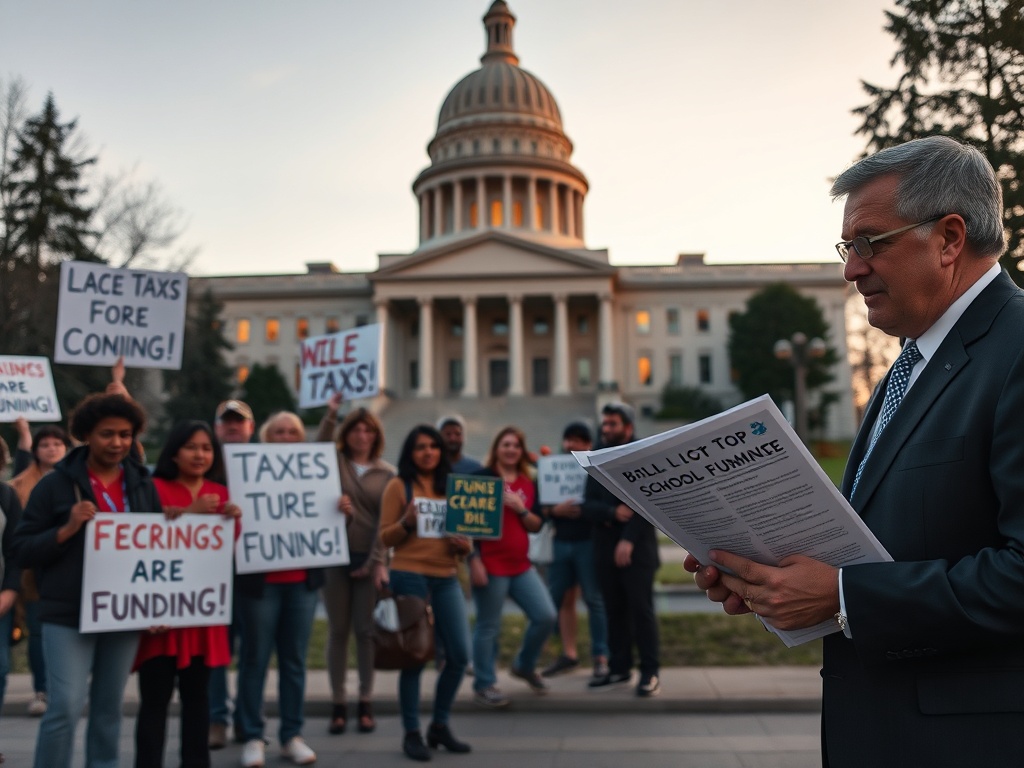
In this context, one voice became a useful symbol. Victoria Hattersley, a millionaire resident of the state, told Business Insider that she is "happy to pay more taxes" because it "helps everyone." Her statement aligns with the political moment surrounding SB 6346, the so-called “Millionaire’s Tax,” which the state Senate approved on February 16, 2026, with a vote of 27-22. The measure imposes a 9.9% tax on household adjusted gross income above $1 million, set to take effect on January 1, 2028, with the first payments occurring in 2029. The most commonly cited political projection estimates over $3.5 billion annually beginning in 2029.
Public discussion often gets trapped between two caricatures: “punishing success” versus “let the rich pay.” For the business world, a more useful analysis is how the distribution of state costs changes, what behaviors it incentivizes in individuals and companies, and how credible it is as a sustainable fiscal strategy for a region competing for talent and capital.
#### A Small Tax in Population, Big in Incentive Design
The bill targets households with the highest payment capacity: according to its proponents, it would affect the 0.5% wealthiest Washington residents. The mechanism is simple in its message but complex in its implementation: it uses the federal adjusted gross income as a base, incorporates state modifications, and applies a standard deduction of $1 million before calculating the 9.9% on the excess.
The fine print matters because it defines the real economic impact and predictable reactions. SB 6346 includes relevant exclusions: real estate sales, qualified pension incomes, and retirement account withdrawals like IRAs. It also includes credits for existing state capital gains taxes of 7% on long-term gains, to avoid double taxation, effectively increasing the marginal burden on certain incomes above high thresholds.
This type of tax isn't merely revenue collection; it is behavioral architecture. A 9.9% marginal tax on income above $1 million encourages tax planning, income re-labeling, profit timing changes, and, in extreme cases, residency decisions. It also forces companies to reassess compensation packages, especially in sectors where income is concentrated through stocks, bonuses, and liquidity events. Washington does not operate in a vacuum: it competes with states that have no income tax and others like California or New York, where high rates are already part of the landscape. The effect isn't automatic or uniform, but the signal is unmistakable: the state wants to capture a fraction of the value realized in its territory when income surges.
#### The Phrase “I’m Happy to Pay More” Works as a Narrative, but the Business is in the Tax Base
Hattersley’s testimony is valuable as a counter-narrative: it challenges the idea that all high-income earners oppose tax increases by default. However, turning this gesture into a central argument is a strategic error. Public finances are not sustained by individual will but by stable tax bases, low escape elasticity, and viable administration.
Here, the focus is on the income composition of the 0.5% and its ease of movement. In Washington, much of high income derives from business activity, executive compensation, and realizations from assets. SB 6346 seeks to close loopholes with rules for residents and non-residents earning income considered sourced in Washington, with prorated deductions. This decision expands its reach but also increases complexity; the line between local and non-local income becomes friction territory, particularly in multi-state operations.
From a distributive logic perspective, the most significant argument for fiscal sustainability is the partial replacement of regressive taxes with a tax on extreme incomes. If the state manages to collect $3 billion to $3.5 billion annually, the point isn’t just to fund programs. It’s about creating space to alleviate other burdens or avoid cuts that indirectly increase operational costs: educational deterioration, pressure on health services, food insecurity in schools, or simply greater budget instability. Democrats have mentioned destinations like education, health, tax relief, public programs, and free school meals. These uses can be productive, but their effectiveness hinges on execution and political discipline to avoid converting volatile income into rigid commitments.
In other words: the “moral narrative” sells; sustainability is defined by the base design and the use of funds when the economic cycle changes.
#### The Business Risk is Not the Tax, But Political and Legal Uncertainty
If the tax takes effect in 2028, the market will start reacting sooner. The reason is simple: estate and corporate planning cycles are long. The briefing itself anticipates legal challenges and even a potential voter repeal initiative in 2026. This combo presents the worst scenario for investment decisions: not because of the tax level, but because it raises compliance costs and necessitates designing strategies that may not materialize.
Governor Bob Ferguson expressed support for a revised version, conditioned on “affordability” amendments, mentioning exemptions for small businesses and working families, and stated he would sign it if changes were incorporated. This stance is politically pragmatic: it seeks to reduce collateral damage and safeguard legitimacy. It also opens the door to what typically happens with complex taxes: more exceptions, more definitions, more arbitration.
For companies with highly paid talent, the typical reaction is twofold. First, the executive renegotiates salary to maintain net income if their negotiating power allows; that cost gets passed on to the company. Second, alternative compensation methods are sought, or functions and residences are relocated if the total costs exceed the value of remaining. None of this is inevitable but is certainly predictable.
The state, for its part, plays a balancing act. If it collects significantly and the productive fabric doesn’t suffer, it gains fiscal margin. If the base erodes due to migration or aggressive planning, actual revenues fall below the promised levels, and political costs increase. In that scenario, the adjustment usually falls where it always does when revenues are lacking: service cuts or indirect increases that ultimately burden those least equipped to absorb them.
#### Where Sustainability is Played: Who Pays, Who Collects, and Who Stays
SB 6346 is not a “tax on the rich” in the abstract; it aims to rebalance who finances public goods in a state that has amassed massive private wealth without a general income tax. The operational fact is that the tax is concentrated at a high threshold and within a small group, with a relevant marginal rate starting from $1 million in household income. If the projection of more than $3.5 billion annually approaches reality, Washington buys fiscal capacity to sustain education, health, and programs that stabilize domestic demand and quality of life, two silent inputs of territorial competitiveness.
But this purchase comes with a condition: the design must minimize leaks and litigation, and the spending must yield measurable social returns, not just new commitments. The exclusion of real estate and retirement incomes, and credits to avoid double taxation with capital gains tax, show an intention to focus revenue collection on extraordinary incomes without punishing transactions deemed sensitive. This targeting reduces friction in some groups but also concentrates the burden on profiles with mobile income.
Hattersley’s phrase helps defuse cynicism, but it doesn’t solve the equation. Sustainability is defined by the preference for permanence: high-income households choose to stay if the additional cost is less than the value of living and operating in the state; the middle class stays if the system stops extracting via regressive taxes and insufficient services. In this decision, value is captured by public services and budget stability when the design manages for the 0.5% to contribute more without unanchoring their economic activity, and it is lost for the whole when promised revenue transforms into volatility and compliance costs that push the most mobile actors to exit.