
The Technology Nobody Expected So Soon
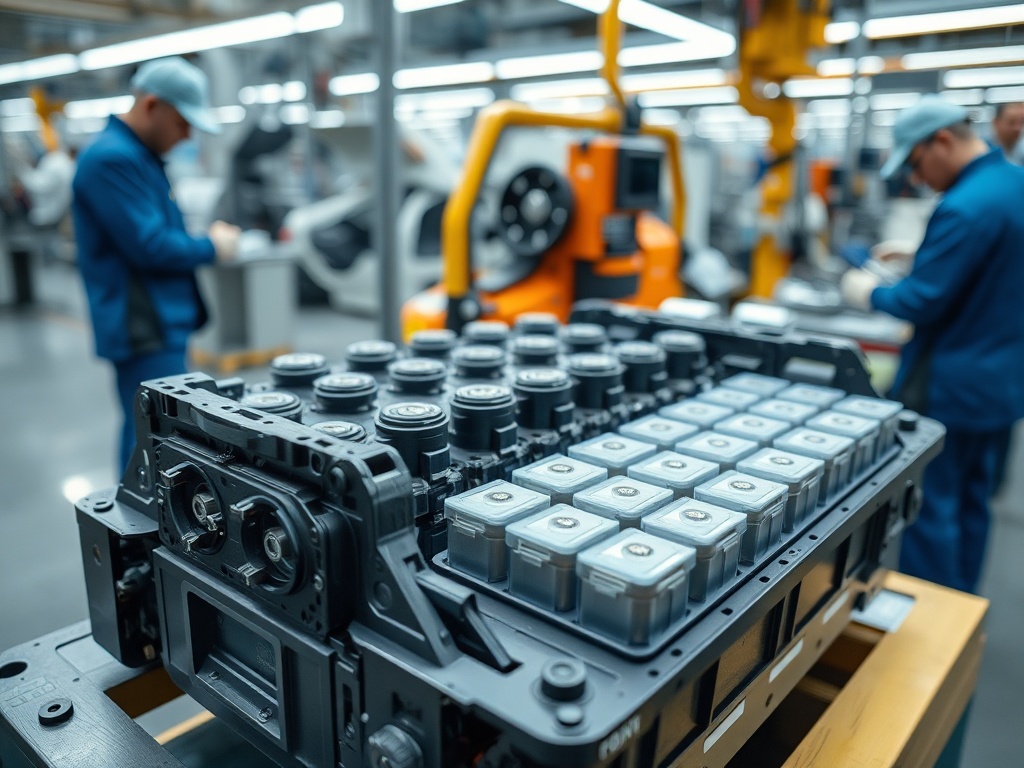
Solid-state batteries have been promised as the great revolution in energy storage for a decade now. Timelines have repeatedly been pushed back: first to 2022, then to 2025, and eventually to the end of the decade. MG, the brand under the Chinese automotive group SAIC, has just broken that paralysis with a pragmatic move: rather than waiting for the perfect version, it’s bringing semi-solid batteries to the European market in 2026. This technology retains a reduced amount of liquid electrolyte but incorporates enough solid-state components to improve both energy density and safety compared to conventional lithium-ion cells.
This advancement is not trivial. Conventional lithium-ion batteries operate with flammable liquid electrolytes, which impose physical limits on energy density due to thermal management concerns. The semi-solid architecture reduces that vulnerability without requiring a complete re-engineering of the manufacturing processes that pure solid-state would demand. The result is a cell with higher energy density, lower ignition risk, and more controllable manufacturing costs than its theoretical successor. MG is not announcing science fiction; it is executing an incremental transition that its Western competitors have postponed for years out of fear of cannibalizing their current lines or betting on a technology that has not yet reached industrial scale.
But the strategic question is not whether the technology works; it’s about who bears the risk of developing it, who captures the margin when it scales, and what happens to the rest of the chain when a vertically integrated manufacturer enters Europe with cost and technological advantages.
Vertical Integration as Economic Advantage, Not Marketing Argument
What structurally sets MG’s move apart is not the battery chemistry itself, but the cost architecture behind it. SAIC, its parent group, has access to supply chains for anode and cathode materials in China where costs for lithium, manganese, and other materials have steadily declined. More importantly, MG does not purchase its batteries from an external supplier who needs to recover its own R&D costs and margin: the integration of cell design, manufacturing, and vehicle assembly allows it to absorb development costs into the final product's cost structure without ceding margin to an intermediary that, in the standard Western model, usually captures between 15 and 25 percentage points of the total battery value.
This has a direct arithmetic consequence on the price for European consumers. A manufacturer like Stellantis or Renault that buys cells from an external supplier must set its sale price by adding the supplier's margin, its own integration costs, and the dealer's commercial margin. MG can compress that equation. Not because its engineers are smarter, but because the design of its value chain has fewer actors with negotiating power capturing profits along the way.
Here is where the analysis becomes uncomfortable for the European industry: MG’s competitive advantage does not stem from a covert subsidy or dumping, as has been the politically convenient argument. It comes from an architectural business decision made two decades ago when SAIC opted for vertical integration rather than outsourcing and quarterly optimization. European manufacturers optimized their balance sheets. The Chinese optimized their supply chain.
The European Consumer as an Unwitting Arbiter of a Positioning War
The arrival of MG’s semi-solid batteries in Europe in 2026 does not happen in a vacuum. It occurs against the backdrop of community tariffs on Chinese electric vehicles that the European Commission raised in 2024, precisely to protect local manufacturers from cost differentials. Tariffs modify the final price to consumers, but they do not alter the underlying value equation: if MG's semi-solid battery offers greater range, less degradation, and a better safety profile at a price equivalent to a conventional European lithium-ion cell, the consumer perceives more value for the same expenditure.
This creates structural pressure on European manufacturers that has no tariff solution. Tariffs buy time, not competitiveness. And the time they purchase comes at a cost: the European consumer pays more for electric vehicles than they would in the absence of barriers, slowing down the adoption rate of the segment and delaying the European Union's own decarbonization goals. Protectionist policies and climate policies are, at this point, in direct contradiction.
For European dealerships and distributors already working with MG, the news has a different reading. A vehicle with a semi-solid battery theoretically has a lower long-term degradation rate, which reduces warranty costs and aftersales conflicts related to the battery's residual capacity. This improves the distributor's net margin over the product's lifecycle, even if the list price is comparable to that of the competition.
The Gamble Western Manufacturers Were Late to Make
The pattern revealed by MG's news is broader than any single company or technology. Over the past fifteen years, Western automakers have outsourced research on battery chemistry to startups and university labs, funded pilot projects, and announced strategic partnerships that rarely made it into mass production. The financial logic was understandable: to keep R&D off the balance sheet, not immobilize capital in technologies with uncertain commercial horizons, and preserve flexibility to switch suppliers if something better emerged.
The problem with that logic is that flexibility and technological depth are mutually exclusive goals in advanced manufacturing. You cannot design the optimal vehicle for a battery that you haven't developed internally, because you don’t know its real degradation parameters, thermal tolerances, or redesign possibilities. A manufacturer that outsources the cell treats the battery as a black box and designs around it. A manufacturer that develops it in-house designs both the vehicle and the battery as a single system. The difference in the final outcome is not marginal.
What MG demonstrates in 2026 is that the bet on integration, with all the capital risk it entails, produces a competitive position that cannot be quickly replicated with a supply contract or the acquisition of a startup. European manufacturers can purchase technology. They cannot purchase the ten years of operational learning behind it.
In the electric vehicle industry, value is not captured by those with the most recognizable logo or those who publish the most ambitious sustainability objectives. It is captured by those who controlled the cost architecture of their most strategic component when it was still possible to do so. By 2026, that moment has passed for most Western manufacturers, and distributors, consumers, and European taxpayers will bear the cost of that decision for at least a decade.