
The Chinese Electromagnetic Pistol that Fires Faster than an AK-47 Without Gunpowder
There’s a number worth pausing to absorb before we continue: 3,000 shots per minute. The AK-47, the most produced rifle in history, fires at 600 rounds per minute. The most advanced commercial model available in the West, the American GR-1, reaches 100. The prototype recently unveiled by China — a battery-powered electromagnetic pistol, devoid of gunpowder, flash, or capacitors — quintupled the rate of the Kalashnikov.
This device was developed by the University of Engineering of the People's Liberation Army, under the guidance of Professor Xiang Hongjun, and publicly presented by the China South Industries Group (CSGC), one of the largest state-owned arms manufacturers in the country. The demonstration included videos of the pistol shattering windows and car panels. CCTV News aired on April 4, 2026, showcased a next-generation model with a 30-centimeter barrel, one-handed operation, and an electronic display showing battery charge, ammunition available, and firing modes.
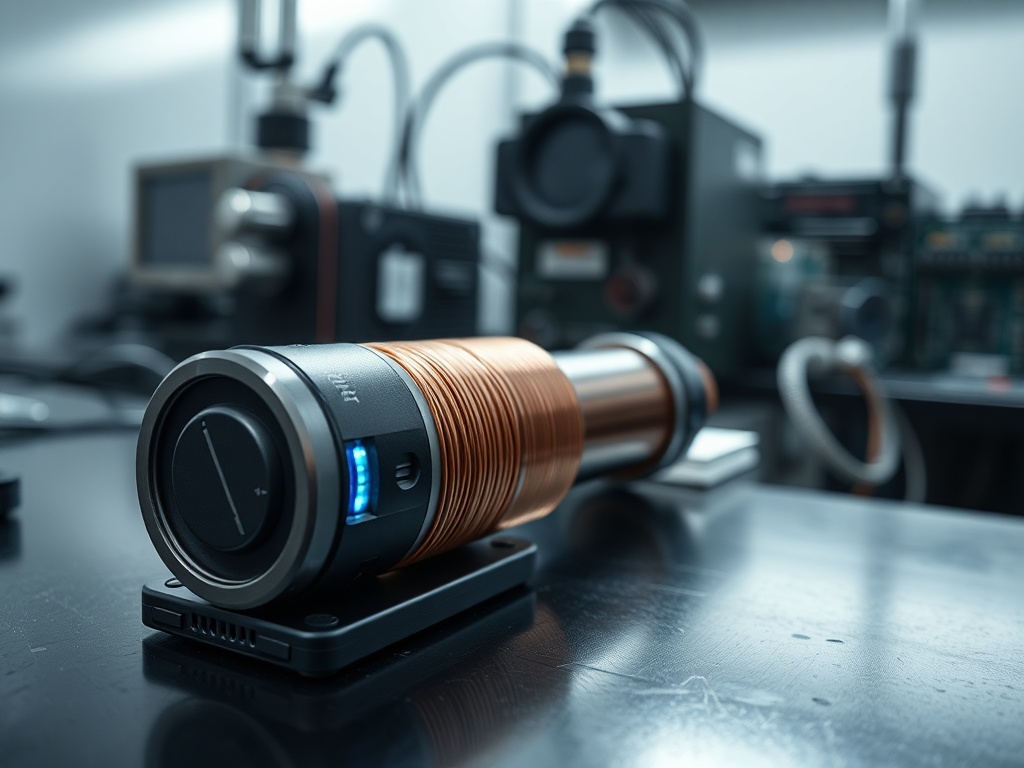
The mechanism enabling this firing rate is, technically, a chain of 20 sequential copper coils, each about 20 millimeters in size, that accelerate the projectile through precisely-timed electromagnetic pulses delivered in nanoseconds. Lithium batteries — not capacitors — provide current peaks of up to 750 amps. The resulting projectile speed is 86 meters per second, adequate for riot control and non-lethal applications. What distinguishes it from previous systems is not the speed of the projectile itself; it’s the ability to continuously fire without the lag of reloading that has always hindered older systems.
Why Eliminating the Capacitor Changes the Weapon's Entire Economics
For decades, the capacitor has been the bottleneck for portable electromagnetic weapons. It accumulates energy, discharges it in bursts, then requires recharging. This cycle limits firing rates, increases weight, and makes the system vulnerable to thermal degradation. Professor Xiang’s team published their findings in the Journal of Gun Launch & Control in China, documenting how direct powering from lithium batteries, combined with nanosecond semiconductor switches and timing algorithms to minimize energy loss, completely eliminates that cycle.
This is not just a component improvement; it’s a fundamental change in the financial and logistical architecture of the weapon. A gunpowder-based system has predictable variable costs — ammunition, barrel maintenance, waste management — but also complex supply chain dependencies. An electromagnetic system powered by batteries turns some of those variable costs into rechargeable energy infrastructure. Military expert Song Zhongping articulated this well when speaking with Global Times: the trend is toward the "individualization of high-energy weapons," with lower ammunition costs and individual deployment capabilities.
The comparison to the electric mobility sector is not forced: the same argument Tesla used to challenge the combustion engine — fewer moving parts, less dependency on fuels, greater energy efficiency — operates here in miniature. China has already solved the abrasion problem in its naval electromagnetic railguns, a challenge that halted the U.S. Navy's comparable program. Now, it’s transferring that learning to a device that fits in one hand.
What the Non-Lethal Model Reveals about Market Entry Strategy
The decision to present this prototype first as a riot control tool — not as a conventional combat weapon — is a market entry move more sophisticated than it appears at first glance. Professor Xiang expressed this clearly: "silent operation, no flash from the muzzle, and adjustable lethality for undercover missions." These attributes do not describe a battlefield; rather, they describe a market of law enforcement, private security, and urban operations where demand for non-lethal alternatives has been growing for years without a technically satisfactory solution.
Norinco, another Chinese state-owned arms giant, already paved this path in 2023 with the CS/LW21, a non-lethal, nine-stage device for riot control. CSGC is scaling that bet with a higher cadence and modular versatility platform. The modular structure that minimizes the use of shells, flash, and noise is precisely the type of proposal that security bodies in emerging markets — and many developed countries — have been seeking for years without finding in the Western catalog.
There is an implicit expansion mechanic: if the system functions at 86 m/s for non-lethal applications, the same architecture of coils and battery can scale in velocity and kinetic energy by adjusting the staging configuration. Military commentator Zhang Xuefeng pointed out that the ability to "precisely control projectile speed" enables reducing lethality while still being able to neutralize targets. This is product modularity, not just technical modularity. A single platform framework serving multiple market segments with software adjustments and hardware configuration.
The Work that Armies and Security Forces Have Been Contracting for Decades Without Resolution
The analysis cycle on electromagnetic weaponry tends to focus on technical capability — projectile velocity, cadence, range — as if the market buys specifications. It does not. Security bodies, armies, and defense operators are contracting for a solution to a specific operational problem: neutralizing a threat with the least possible collateral damage, in environments where noise or flash compromise the mission or the political legitimacy of the use of force.
Conventional firearms do not resolve this task. They are cheap and reliable, but noisy, lethal by default, and dependent on a gunpowder supply chain that can be disrupted. Current non-lethal alternatives — gases, impact devices — have limited range and low cadence. CSGC’s prototype directly targets that space: high cadence, controllable range, operational silence, adjustable lethality.
The relevant question for the global defense industry isn’t whether China has “won” the tech race. It’s more specific: while Western railgun programs halted due to abrasion and energy management issues, China accumulated experience in naval electromagnetic systems — including a 32-megajoule railgun installed on the Type 055 destroyer capable of hitting targets 270 kilometers away — and is systematically transferring that learning to handheld devices. This transfer of institutional knowledge from naval scale to individual scale is the least visible asset and likely the most difficult to replicate.
The failure of the U.S. electromagnetic program demonstrated that the speed of a projectile without solving the system's durability is an incomplete solution. The success of this Chinese model, if sustained through extensive testing, will demonstrate that the work users and operators have been contracting for decades is not just raw firepower, but precise control over the outcome of a shot without the logistical and political constraints of gunpowder.