
Crewless Sonars and the New Geometry of Naval Power
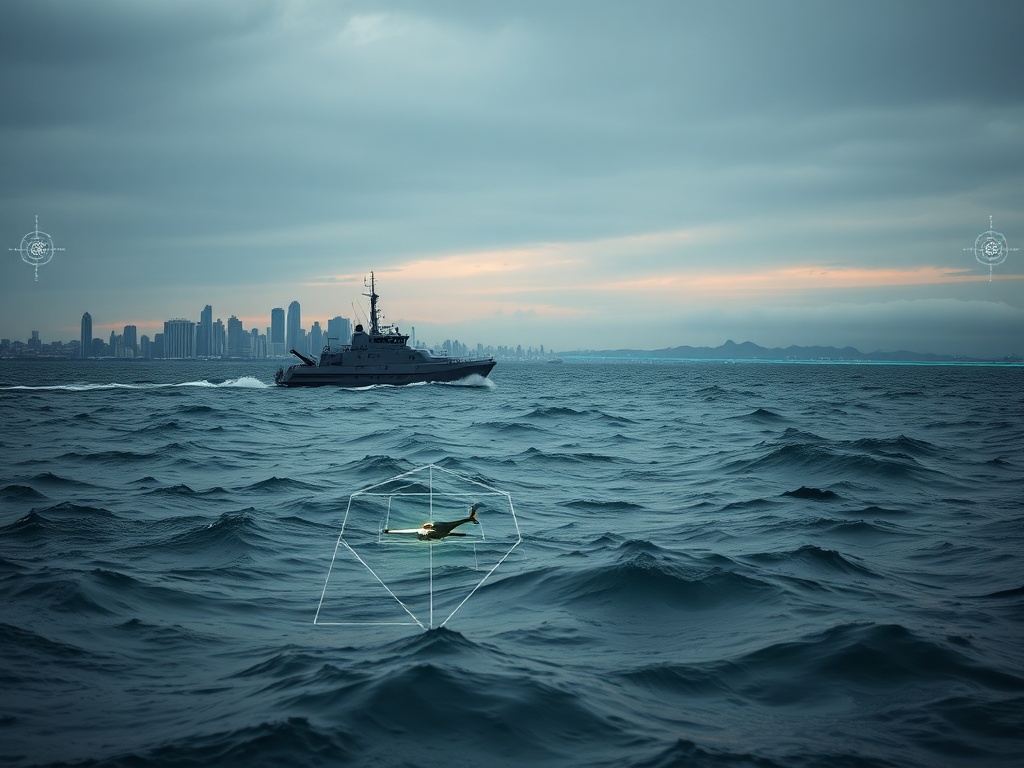
In April 2026, off the coast of Istanbul, several navies and governmental organizations watched in real-time as an unmanned surface vehicle towed a synthetic aperture sonar, detecting mine-like objects at 200 meters on either side and transmitting images of 3 centimeters by 3 centimeters to a command center on land. There was no sailor exposed on the water. No $80 million mine countermeasure ship mobilizing a crew of 45.
Kraken Robotics, a Canadian company listed on the TSX-V under the symbol PNG, executed this demonstration alongside SEFINE SISAM, the Turkish research center for unmanned systems, using the unmanned vessel RD-22. The integration included the KATFISH sonar and the autonomous launch and recovery system that Kraken had tested just five months prior from a ship of the British Royal Navy. The same hardware, two distinct platforms, and two different geopolitical contexts: this is not a product accident; it is a deliberate architectural decision.
The question this event raises for any investment director or naval acquisitions chief is not whether the technology works. It has worked. The question is, what happens to the distribution of value in the maritime defense chain when hardware becomes modular and the classification software travels with it?
The Economy Changing When Crewed Ships Disappear
A conventional mine countermeasure ship mobilizes physical capital, human capital, and operational capital simultaneously and inseparably. The cost is not only in the hull of the vessel: it encompasses the training of divers, port logistics, maintenance cycles, and the actuarial risks of operating near explosive threats. When a navy replaces that chain with an unmanned vehicle towing a sonar, it is not buying a cheaper product; it is rewriting its fixed cost structure.
This has a direct distributive consequence. If operational costs fall significantly, the system provider has room to capture a larger piece of the value without the customer perceiving they are paying more in relative terms. Kraken has not released contract figures associated with this demonstration, but its history of similar events —including trials in Halifax in October 2024 with over 40 naval partners— suggests that the demonstration is not the final product: it is the sales process.
The architecture of that sales process deserves attention. Each multi-client demonstration reduces the marginal acquisition cost per navy. The 3 cm x 3 cm resolution data at 200 meters lateral range does not require a technical document; it is validated live, in front of purchasing authority representatives. The cost of convincing becomes the cost of the demonstration operation itself, which simultaneously generates market intelligence, geopolitical visibility, and platform validation.
For SEFINE, the logic is symmetrically attractive. The RD-22 leaves Istanbul with a documented use case observed by multiple NATO navies. Its willingness to sell that vessel—or to license its design—increases because now there is operational evidence that the integrated system works in real-world conditions. No actor in the chain is subsidizing the other: incentives align because the demonstration generates signaling value for both.
Modularity as Structural Advantage, Not as Product Feature
The most significant decision Kraken made was not technical but architectural: to design KATFISH and the launch and recovery system to function from third-party platforms without deep structural modifications. In November 2025, they operated from an 11-meter British vessel. In April 2026, from the Turkish RD-22. The same technology stack, radically different platform configurations.
This decision carries an implicit cost that few notes have pointed out: Kraken is deliberately relinquishing control of the surface platform to avoid being trapped in a single naval distribution channel. It is a bet against vertical integration and in favor of horizontal integration. In terms of value capture, this means that Kraken focuses its position on the sensor and processing layer—where differentiation is harder to replicate—and leaves the physical platform to regional partners who bring institutional relationships and local manufacturing capacity.
The risk of that model is known: if the sensor layer becomes an open standard or if a competitor achieves comparable 3 cm resolution with a cheaper system, Kraken's position erodes quickly. But as long as that technological parity does not exist, modularity serves as a disguised entry barrier of openness. The more partners integrate KATFISH into their platforms, the harder it is for a navy to justify adopting an alternative system that would require reinventing those integrations.
Bernard Mills, Executive Vice President of Defense at Kraken, articulated this with surgical precision when stating that the combination of SEFINE's vehicle with Kraken's technology allows navies to deploy advanced capabilities more quickly and efficiently. The speed of deployment is not just an operational advantage: it is a negotiation lever. A navy that can certify and integrate a system in weeks instead of years is willing to pay a premium for that agility, and that premium is exactly where Kraken's margin is concentrated.
The Value That is Distributed and the Value That is Retained
The demonstration in Istanbul is, in its naked mechanics, an event of value distribution among four actors: Kraken as the sensor and launch system provider, SEFINE as the platform operator and host, the attending navies as potential buyers, and the states that finance those navies as final beneficiaries of operational capability.
Analyzing who captures which part of that value requires observing the incentives at each node. Kraken retains the intellectual value of the sensor and the ownership of the classification algorithm. SEFINE captures the reputational value and access to export markets that would otherwise be difficult for a Turkish manufacturer to penetrate. Attending navies receive operational data without compromising their procurement budget yet. The states gain intelligence on the technological maturity of systems that could replace much more costly assets.
What no actor is doing in this transaction is extracting value from the others. There are no suppliers being squeezed on their margins to fund the growth of another. The model works because each participant leaves the event with an asset they did not have before: Kraken with multi-platform validation, SEFINE with an exportable case of use, and the navies with real-time classification data. That structure, where the incentive to participate is greater than the cost of doing so for all actors, determines whether a network of partners expands or contracts over time.
Navies operating with mine countermeasure vessels from previous generations now face a tangible, not theoretical, comparison. The system demonstrated in Istanbul does not ask them to adopt a vision of the future: it shows them verified resolution data, obtained without exposed crew, transmitted in real-time to shore. In the gap between what they have and what they saw operating resides the entirety of Kraken’s business argument.
The only advantage that is not exhausted is the one that makes every node in the chain prefer to stay within rather than exit: Kraken is building it sonar by sonar, port by port, navy by navy.