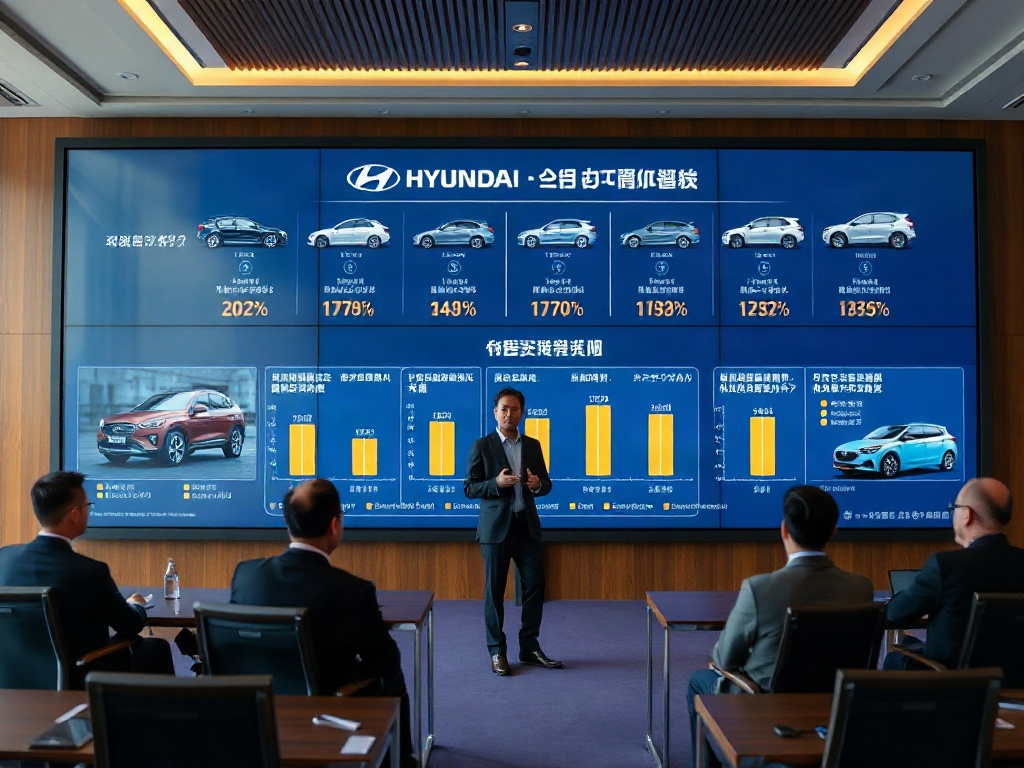

Hyundai Bets on More Than 100 Models Before 2030 and Raises Its Margin Target
On August 26, 2026, in Seoul, Hyundai Motor presented to investors the most ambitious roadmap in its recent history: more than 100 vehicle launches and renewals by 2030, an operating margin target raised above 9%, and a capacity expansion plan of 1.27 million additional units. The backdrop is uncomfortable: in the second quarter of 2026, the company reported an operating margin of just 5.8%, compared to 7.5% in the same period of the previous year. The distance between those two numbers and the stated ambition is not rhetorical. It is the central problem this plan attempts to solve.
The structural question is not whether Hyundai can launch 100 vehicles. It almost certainly can. The question is whether that critical mass of product translates into improved margins, or whether it simply distributes fixed costs across more references without resolving the mechanics that are compressing them today.
The Hybrid as the Backbone of a Margin Plan
Hyundai is not betting on total electrification. It is betting on hybrids as a lever for profitability in the short and medium term, and that is probably the most solid decision in the plan presented at the Investor Day.
The contextual figures are compelling: hybrid vehicle sales in the United States grew 19% in the first half of 2026, while Hyundai's hybrid sales specifically grew 71% in the second quarter. Cox Automotive reported that 56% of car buyers in the US market stated that rising gasoline prices had increased their willingness to purchase a hybrid. That is not a niche trend. It is a structural shift in preference that Hyundai is positioning itself to capture before its competitors consolidate their positions.
The concrete bet is 58 launches in North America before 2030, including 10 hybrid models, with the expectation that hybrids will represent half of the brand's regional sales within that horizon. If that is achieved, and if hybrids carry the margin profile they typically generate for manufacturers producing them at sufficient volume, the arithmetic begins to approach the stated objective.
But there is one condition this plan does not fully control: that gasoline prices remain high enough to sustain that demand. Hyundai is building its growth argument on a macroeconomic variable that has historically been volatile. That does not invalidate the bet, but it does establish a ceiling on the level of certainty that can be attributed to the sales mix projections for 2030.
Localization in the United States as a Hedge Against Tariffs, Not Just as a Strategy
CEO José Muñoz stated publicly that tariffs are accelerating the company's localization plan in the United States. Under the trade agreement currently in force between Washington and Seoul, Hyundai faces a tariff of 15% on imported automobiles. The logical response is to manufacture more on American soil, and that is precisely what the company is doing: 500,000 of the 1.27 million additional units of capacity are planned for North America.
The Alabama plant will manufacture the Santa Fe EREV, the brand's first extended-range vehicle, expected in the first half of 2027 with a target range of more than 600 miles. That is not a minor announcement. EREVs are an architecture that resolves one of the most persistent frictions American buyers have with electrification: range anxiety. And Hyundai is producing them on local soil, which mitigates tariff exposure.
Muñoz also noted that the company had an advantage because its productive expansion in the United States had begun before the tariffs were announced. That is important because it indicates that localization is not a reactive emergency response, but a strategy that already had critical mass when the regulatory environment changed. The difference between late adaptation and prior positioning has direct consequences on implementation costs and execution timelines.
What does merit scrutiny is the ambition to raise the localization of parts and components above 80% in the region. That level of local integration is not built quickly. It requires supplier development, long-term agreements, and in many cases, direct investment in the supply chain. If the local component targets are delayed, the tariff benefits of local assembly are reduced. It is a complex execution with multiple friction points that the plan announces but does not detail.
The Jump from 5.8% to 9% Requires More Than Volume
The investor presentation raised the operating margin target for 2030 to above 9%, up from the previous range of 8% to 9%. At the same time, the guidance for 2026 was maintained at 6.3% to 7.3%. The gap between the most recent quarter (5.8%) and the end-of-decade target (above 9%) is just over 300 basis points. That is not achieved through volume alone.
The margin improvement mechanics that Hyundai is implicitly building rest on three simultaneous pillars: improving the product mix toward higher-value segments — Genesis is targeting 350,000 annual units across more than 40 markets with its first hybrid and its first EREV —, reducing dependence on tariff-exposed exports through local production, and third, absorbing the expanded fixed cost base with sufficient volume so that unit costs decline.
The problem with all three pillars is that they are all sensitive to conditions Hyundai does not control. The mix depends on consumers actually migrating toward hybrids and premium vehicles. Local production depends on the supplier chain responding on time. And the absorption of fixed costs depends on the projected 5.55 million units for 2030 materializing in a competitive environment where Toyota, Ford, and Honda already have consolidated hybrid positions.
The company also announced that IONIQ 5 units destined for Waymo's robotaxi fleet will begin arriving in the fourth quarter of 2026, with robot production in the United States planned for 2028 at an annual capacity of 30,000 units. That is a segment that could generate differential value if scaled, but which for now represents a bet with a broad monetization horizon and a business model that still depends on the end client, Waymo, executing its own expansion plan.
Product as a Structure of Confidence, Not as a Catalog
There is something the Investor Day communicated that goes beyond the numbers: Hyundai is attempting to reposition itself as a company with execution credibility before investors who, over the past two years, watched margins deteriorate. The commitment of seven new vehicles in the next eight months functions as a signal of pace. Not as advertising.
The opposite risk to excessive ambition is not caution. It is an excess of references without a margin hierarchy. More than 100 launches and renewals in four years, distributed across Korea, Europe, India, China, and North America, imply a pressure of operational coordination, marketing, and distribution that can dilute resources if the company does not maintain severe discipline over which models prioritize profitability and which prioritize volume.
Hyundai now has a plan that, if executed well, has the architecture to work. Its tariff exposure is being mitigated by real localization, not merely declared localization. Its bet on hybrids is backed by current demand data, not by pure electrification projections that the US market is still not absorbing at the speed many expected. And its margin target, while ambitious, has a mix and efficiency logic that can be tracked through concrete quarterly metrics.
What makes this plan something more than an Investor Day presentation is that the entry conditions for executing it are already partially in place. The question is not whether the roadmap is credible on paper. It is whether the company can maintain the discipline of resource allocation for four years, in a market where competitors are also accelerating and where the conditions that today favor hybrids may change before the installed capacity is fully amortized.
The 5.8% margin from the second quarter is not an argument against ambition. It is the starting point from which execution is measured as real or not.