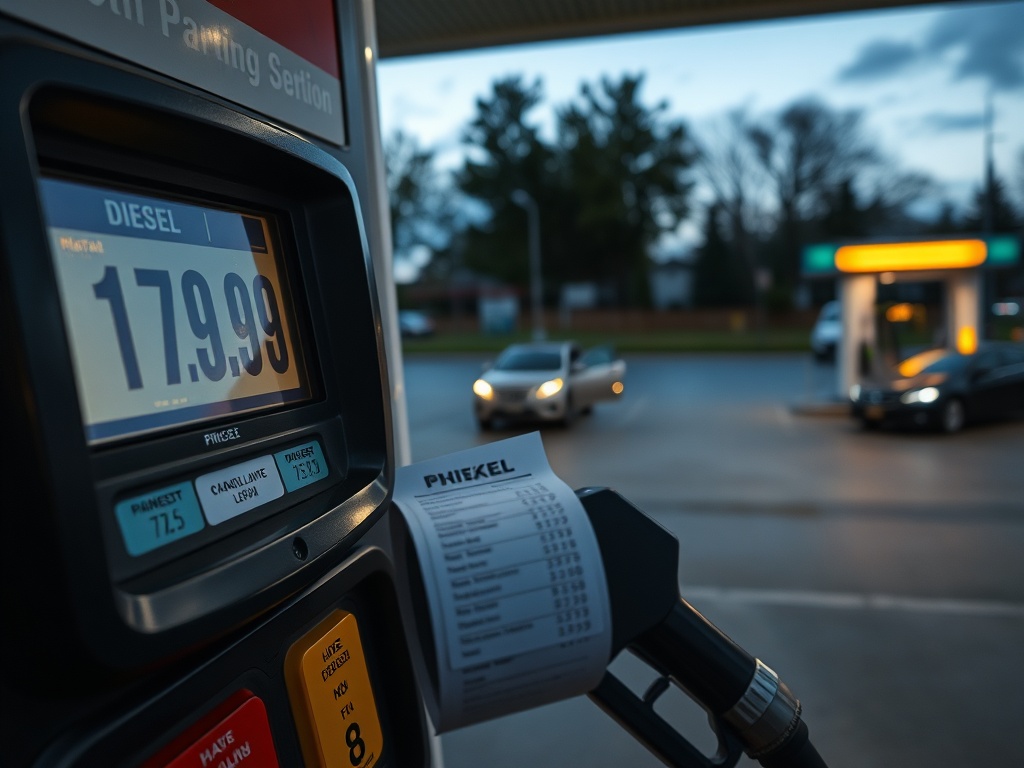

The average price of regular gasoline in the United States reached $3.41 per gallon on Saturday, March 7, 2026. This is no marginal movement: it represents 43 cents more since President Donald Trump initiated military actions against Iran, alongside a 36% spike in oil prices in just one week. Diesel, a crucial indicator of the real economy, climbed to $4.51 per gallon, approximately 75 cents more than the previous week. These figures, reported by Fortune, encapsulate an uncomfortable reality for any corporate board: energy remains the input that seeps into all profit and loss statements, and its geopolitical volatility disregards both annual plans and narratives of control.
What’s significant is not only the level but the underlying mechanism. A conflict in the Persian Gulf does not impact “one country” or “one region”; it affects a logistical and financial system that operates on risk premiums. Briefings highlight scenarios from the CSIS where impacts could range from disruptions in Iranian exports (with price increases of $10–12 per barrel) to escalations that push Brent oil above $90, $100, or even $130 per barrel if infrastructures or large-scale regional flows are compromised. In that range, the price at the pump ceases to be a number and transforms into a signal of cascading stress: inflation, compressed margins, demand re-adjustments, and an immediate revaluation of any alternative that reduces exposure.
Risk Premiums Now a Financial Product for Households and Businesses
The market is not just reacting to the absence of barrels; it is responding to the probability of their absence, the costs of moving them, and the costs of insuring them. This is the aspect often omitted in presentations: oil is traded as a fungible commodity, yet enters the economy as a package of logistics, insurance, and expectations.The briefing notes that, following the conclusion of indirect talks without an agreement on February 17, 2026, military rhetoric and deployment heightened the perceived risks. For the final price, the key data point is not whether an incident is confirmed in real-time; rather, it is that the market adds a premium because it cannot afford to be wrong. When state-affiliated media in Iran reported an attack on a U.S. tanker and verification was pending, that “pending” does not neutralize the impact: it fuels uncertainty, and uncertainty carries a price.
In businesses, this translates into three simultaneous frictions. First: direct costs in transportation, thermal generation, and petrochemical derivatives. Second: indirect costs from inflation that erodes consumption and necessitates renegotiation of wages, rates, and contracts. Third: capital costs when energy shocks contaminate interest rate expectations. The briefing cites a rule of thumb from Citi: a sustained 10% increase in energy costs over three months could add 35 basis points to inflation in the Eurozone. There is no need to extrapolate further to understand why the diesel shock hurts: diesel is the fuel powering moving inventory.
There’s a power dynamic here that many boards underestimate. When risk concentrates at a chokepoint—the Gulf—the control does not belong to those who can refine best, but to those who can operate with less dependency. In that sense, volatility acts as a regressive tax for households, but also a competitive tax for energy-intensive industries.
From Barrel to Balance Sheet: Why Diesel at $4.51 Accelerates Decisions Planned for 2030
The jump in diesel prices to $4.51 per gallon is a clearer signal than gasoline. Gasoline punishes the consumer; diesel punishes the economy's capability to move goods. In logistics and transportation, the difference between a “normal” week and a week with +75 cents translates into decisions about surcharges, routes, cargo consolidation, and, in extreme cases, service.In my work analyzing technology adoption patterns, such episodes act as catalysts. The energy transition is often framed as a conversation about sustainability and reputation. In reality, moments like these transform it into a conversation of risk management and operational continuity. Suddenly, technologies that seemed “more expensive” begin to be compared against a new benchmark: the cost of uncertainty.
This doesn’t mean that electrification or renewables become trivial overnight. It means something more practical: the shock redefines the order of operations. Investments that reduce fuel exposure are prioritized, such as route and load optimization, fleet efficiency, intelligent energy purchasing, and gradual replacements where returns become justifiable under scenarios of $90–100 per barrel. The briefing details how disruptions can reversible in some cases but also warns that damage to terminals or platforms extends the issue. For the CFO, that changes the calculation: tail risk enters the model.
Another layer emerges: China's response. The briefing indicates that China is conserving fuel and that the loss of Iranian barrels would force it to bid for global supplies. That’s where the national narrative loses its sense. Even if the United States does not buy certain crude oil, the price is dictated by a global market where a large buyer adjusts the demand. The consequence is straightforward: the conflict reorganizes flows, and everyone pays the re-adjustment.
The Real Disruption: More Digital Energy, More Measurable, Less Dependent on a Single Point of Failure
When oil surges 36% in a week, public conversations remain stuck in “high prices.” The useful executive discussion is about “architecture”: how much of my energy is exposed to exogenous shocks, and how much is managed as a measurable and flexible system.This is where digital convergence stops being a slogan and becomes competitive infrastructure. 20th-century energy was managed as an input that arrived and was paid for. 21st-century energy is managed as an optimizable flow: sensors, telemetry, planning algorithms, predictive maintenance, digital twins in industrial operations, and purchasing with market intelligence. It’s not tech glamour: it’s converting uncertainty into controllable variables.
Simultaneously, energy decentralization gains value. Not from ideology, but from risk topology. When a chokepoint concentrates a significant portion of global flows—the briefing cites 18 million barrels per day of non-Iranian exports from the Gulf as part of the risk in extreme scenarios—any solution that reduces dependence on those flows has a “hidden benefit”: it minimizes vulnerability to events that management cannot control.
This episode also exposes a frequent trap: automating to cut costs rather than implementing to improve judgment. In energy crises, errors amplify. An AI used as a decision-making co-pilot—to simulate price, availability, and logistics scenarios and prioritize measures with real impact—is augmented intelligence. An AI used to impose rigid savings rules or shred capacity without understanding the system is efficiency without awareness. The market punishes the latter with internal shortages, service degradation, and customer attrition.
What Leaders Must Do: Turning Volatility into an Operational Options Portfolio
The news doesn’t present a list of corporate “winners,” and that’s for the best: it avoids false security. What it does present is a scenario map. The CSIS details disruptions from Iranian exports to attacks on infrastructures or facilities in other Gulf countries. In terms of direction, this calls for layered responses, not a single bet.First layer: financial discipline. Separate exposure into two categories: unavoidable short-term consumption and medium-term substitutable consumption. Cover the former with prudent contracts and hedges; design the latter as a measurable substitution program.
Second layer: operations. In transportation and logistics, high diesel costs force a review of planning and asset utilization. Load optimization, reduction of empty miles, condition-based maintenance, and route redesign offer immediate returns when fuel prices surge. In industry, thermal efficiency and heat recovery transition from “engineering projects” to “margin projects.”
Third layer: energy as infrastructure, not as a bill. Accelerate electrification where the case is justifiable, and sign electricity purchases with structures that minimize volatility. In some sectors, value lies not just in the price per kWh, but in the predictability of costs and the ability to operate during disruptions.
Fourth layer: risk governance. Energy volatility is not an isolated procurement issue. It must be integrated into the risk committee, with explicit scenarios and triggers for action. The briefing mentions windows of 3 to 8 weeks related to insurance and normalization in certain media comments; even if these timelines are not taken as promises, they serve as a reminder that administrative time is also a bottleneck.
Counterintuitively, these shocks, while damaging, often accelerate modernization. They raise the cost of inaction and make the benefits of measuring, purposefully automating, and decentralizing visible. In that sense, the price of $3.41 not only hurts: it also reallocates capital toward solutions that reduce exposure.
Energy Enters a Phase of Forced Digitalization and Gradual Democratization
The spike to $3.41 per gallon and diesel at $4.51 following the escalation between the U.S. and Iran reveals a reality: oil remains vulnerable to concentrated events, and for this very reason, it drives businesses and households to seek more controllable alternatives. The market is transitioning from a dependence based on centralized supply to management based on measurement, optimization, and gradual fuel substitution.This is a phase where the digitalization of energy becomes non-optional, and where the democratization of energy resilience begins to take shape through technologies that reduce dependence on single points of failure. Technology should empower human judgment and broaden access to more stable energy systems.