
China Installed More Robots Than the Rest of the World Combined, and It's Just Getting Started
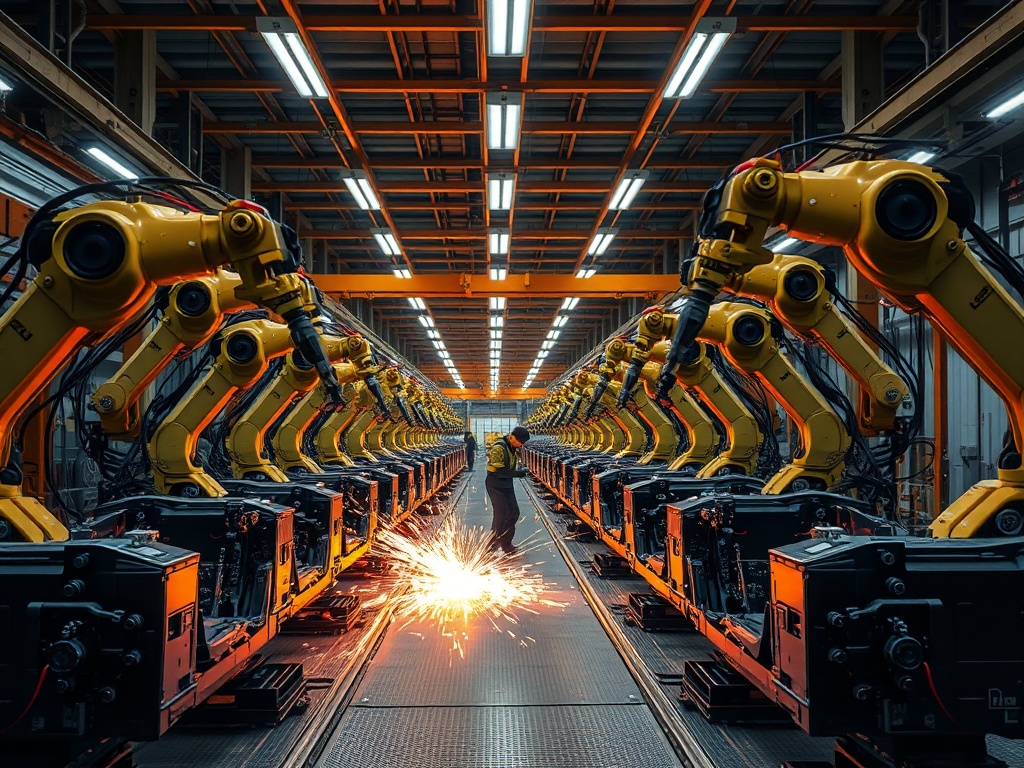
By 2024, Chinese factories surpassed the milestone of 2 million operational industrial robots. This accounts for more than half of the global total stock. To put this into perspective, during the same year, the rest of the world installed just 247,000 units, while China added 295,000, representing 54% of the 542,000 installations reported by the International Federation of Robotics. This isn't a marginal advantage; it's a structural divide.
The robotics market in China closed 2024 at approximately $47 billion, with projections to grow at 23% annually through 2028. The sector's revenue reached nearly 240 billion yuan (around $35 billion), and in the first half of 2025, it was already growing at a year-on-year rate of 27.8%. The robotic density reached 470 units per 10,000 workers, trailing only behind South Korea and Singapore. These numbers are not the result of a government marketing gamble; they are the outcome of over a decade of consistent industrial decisions.
From Importing 75% to Manufacturing 57% in a Decade
Ten years ago, China relied on imports for nearly three-quarters of its robotic demand. By 2024, domestic production covered 57% of the internal market. This shift wasn’t accidental; it was a direct result of the "Made in China 2025" policy, which identified motors, reducers, and actuators as strategic components and directed investment towards their local development.
What makes this case particularly interesting regarding how bets on industrial scale are validated is that the Chinese government didn't gamble on a single model or wait until having the finished product before hitting the market. They subsidized both demand and supply simultaneously, creating a real feedback loop: more installations generated more operational data, which in turn accelerated the development of local software and hardware. This local, cheaper hardware allowed for more installations. The market became the laboratory.
The Ministry of Industry and Information Technology reported that industrial robot production in the first half of 2025 reached 370,000 units, with a year-on-year growth of 28%. This isn't inertia; it's a curve that’s trending upward while other markets continue debating roadmaps.
The scale also enabled something that few industries achieve: turning fixed costs into variable ones. Chinese companies integrating robotics no longer solely depend on external suppliers with prices in dollars or euros. They have domestic supply chains that can scale up or down depending on the economic cycle. This reduces exposure to external disruptions in ways that no five-year financial projection could have guaranteed.
The 80% That Is Still Not Automated
Among the emerging profiles in this sector is Guchi Robotics, founded in 2019 in Shanghai by a mid-career engineer who identified a specific blind spot in electric vehicle factories: final assembly. Tasks like mounting wheels, dashboards, and windows may seem simple but have historically required manual precision and contextual coordination that previous generations of robots could not replicate cost-effectively.
Guchi works directly with manufacturers like BYD and Nio. According to a report by The Guardian, its founder estimates that 80% of final assembly in automotive plants is still not automated. That figure is their market thesis, not a presentation for investors or a pitch at a conference. It comes from touring factories and mapping what tasks humans can do that robots still can’t perform well.
This logic, while it may sound obvious, is exactly what differentiates companies scaling in this sector from those that remain perpetually in prototype mode. Guchi didn't attempt to build a universal robot; it developed a specific robot for an identified bottleneck in real customers. The difference between both paths isn’t philosophical; it's financial. The universal robot takes years of R&D with no revenue. The robot for final assembly in a Nio plant generates contracts.
This fits into a broader pattern exhibited by the sector: Chinese robotics companies gaining ground are doing so by attacking specific vertical inefficiencies rather than building generic horizontal platforms. Alibaba deployed fleets of autonomous mobile robots for e-commerce. Meituan integrated them into last-mile logistics. JD.com and CATL developed in-house projects because they had the scale to amortize development costs. None of these cases began with an abstract vision of the future; they started with a measurable operational issue.
The $137 Billion Fund and What It Reveals About the Next Phase
In March 2025, the National Development and Reform Commission announced a government-guided investment fund of $137 billion aimed at startups in artificial intelligence and robotics, with a 20-year horizon. Coupled with more than $20 billion in subsidies, loans, tax credits, and venture capital injected between late 2024 and early 2025, the industrial policy message is clear: Beijing isn't just managing this sector; it is actively building it as national infrastructure.
However, there is a limit that sector players themselves acknowledge. An expert cited by china.org.cn described current humanoid robots as still being "a little dumb" when it comes to urban navigation, handling complex objects, and contextual interaction with humans. This intelligence gap is the next battleground, and the 27 training centers in Beijing, Wuhan, and Shanghai, where robots collect real data in environments like commerce, elderly care, and smart homes, serve as the operational response to this limit. It isn’t lab research; it is data collection in real market conditions.
At CES 2026, 38 Chinese humanoid robotics companies showcased their developments. This number, when compared to the global presence of Western competitors at the same event, illustrates the speed at which China is compressing the cycle between prototype and marketable product. The speed doesn't come from having more talented engineers; it originates from having more real-use contexts where they can test, fail, and correct at industrial scale.
The pattern that China is executing in robotics mirrors the one applied in electric vehicles and, earlier, in textile manufacturing: first mastering domestic volume, then compressing costs until export becomes inevitable. The 38 companies at CES did not go to showcase technology; they went to open business conversations.
The lesson for any manufacturer, logistics operator, or manufacturing company outside of China does not lie in headlines about humanoids playing soccer. It resides in the operational margin lost each quarter that delays the decision to automate processes where proven technology is already accessible and increasingly affordable. Leaders who continue to wait for the perfect moment to integrate automation are, unknowingly, financing their competitors' advantage through inaction—those who have already validated, adjusted, and scaled. Sustainable growth isn't generated by the most elaborate plan; it's achieved by the decision to subject that plan to market reality as soon as possible.