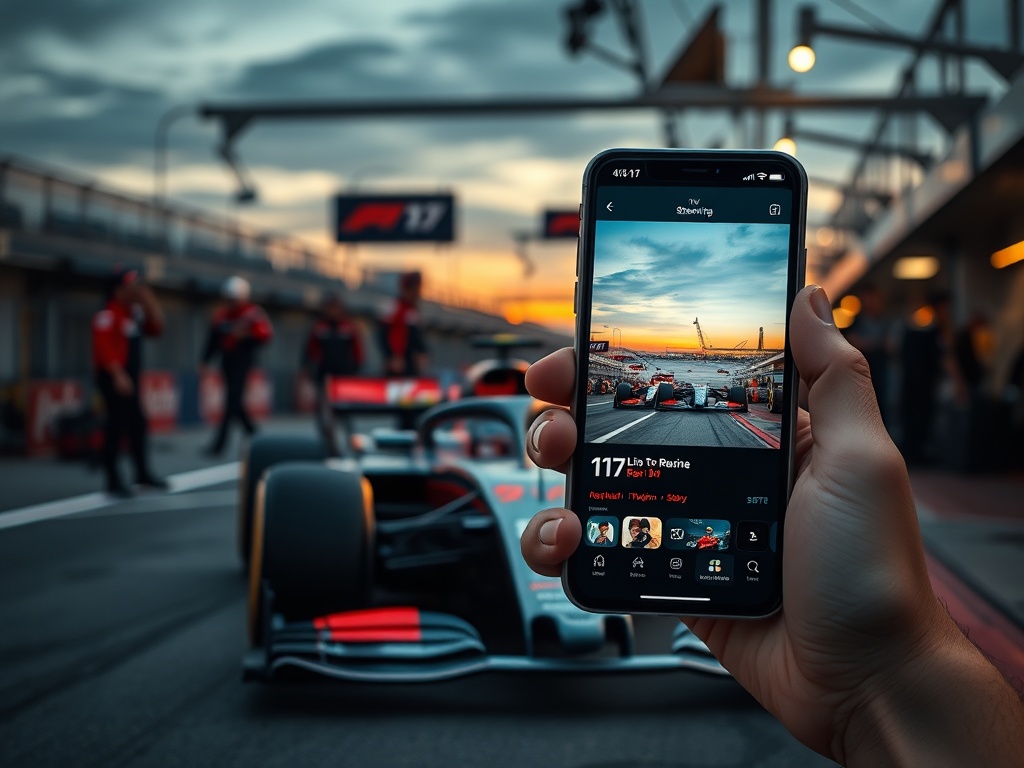

Apple Acquires Formula 1 in the U.S.: A Focus on Retention Rather Than Mass Audience
The shift is unmistakable: starting in 2026 and extending until 2030, Apple TV will have exclusive broadcasting rights for Formula 1 in the United States, displacing ESPN. The deal, reported at an average of $150 million annually (around $750 million over five years), positions Apple TV as the one-stop shop for practices, standings, sprints, and races—available live and on-demand for subscribers in the U.S. At the same time, Apple plans to provide a window of free access: four or five races per season, along with all practice sessions, will be available without a subscription through the Apple TV app.
The market will interpret this as "more streaming." The useful reading for a C-Level executive is more uncomfortable and specific: Apple is acquiring a live programming asset to reduce cancellations and increase retention; Formula 1 acknowledges that its growth in the U.S. is entering a phase where the financial value of broadcasting rights weighs as much as—if not more than—mass distribution.
This decision arrives on the brink of a transformative 2026 for F1, driven by new regulations, vehicles, and teams. Apple adds another layer: an ecosystem capable of enveloping fans beyond broadcasting, from Apple Sports to widgets and Live Activities. The core goal of this acquisition is not the races themselves but the overarching model.
The Transaction Signals the New Value of Live Attention
The jump from $90 million annually paid by ESPN to $150 million per year on average from Apple is not a "premium" for editorial quality. It reflects the updated price of two concurrent tensions: the value of live sports as a remedy against subscription churn, and the urgency of sports properties to convert popularity into revenue before the platform cycles reorganize again.
The U.S. exclusivity from 2026 to 2030 narrows geographic ambition, but crucially makes the experience controllable. For Apple, live broadcasting ceases to be an isolated content piece and becomes a trigger for recurring activity within its app and devices. The announced coverage includes the entire race weekend—not as an add-on for additional payment. This reduces friction and concentrates consumption.
For F1, the increase in revenue from rights in the U.S. seems like a clear short-term win. However, the contract also codifies a concession: the comfort of linear distribution through a mass footprint is given up in favor of a service that, by design, selects fans willing to pay. Apple’s promise to enable some races for free acts as a pressure valve, but it does not replace what cable historically provided as the cultural default.
The most intriguing signal lies in what isn’t publicly discussed: these types of agreements are not won by promising "more cameras." They are won by promising fewer cancellations and more aggregated consumption within a service portfolio.
Apple Isn’t After Sports Prestige, It’s After Customer Retention
For Apple, $150 million per year is manageable against the scale of its services business; what is relevant is the surrounding design. F1 offers high-frequency content (many sessions each weekend), with a weekly ritual and social conversation. This is precisely what a general streaming service needs to avoid users entering, watching a series, and then leaving.
The announced integration of F1 with Apple Sports (live scores, standings, Live Activities, and widgets) is a product decision, not a marketing one. Traditional streaming suffers when content is consumed in disconnected capsules. Live sports, when well-instrumented, create loops: notification, opening, following, and re-watching. Apple does not need every subscriber to watch all races; it needs a sufficient percentage to feel that "if I cancel, I'm missing something happening in real time."
The film aspect also serves as narrative fuel. Apple capitalized on F1 The Movie, which became a reported box office success at $630 million, using that traction to justify the investment and, above all, convert a sports property into a brand asset within its offer. This is not a creative whim; it’s a way to lower subscriber acquisition costs and increase recall of Apple TV as a destination.
There is another silent choice: Apple isn’t buying “sports” in general. It is purchasing a league with a premium identity and growth in the U.S. This reduces dilution. The risk shifts to execution: the product must feel superior in stability, latency, storytelling, and cross-platform accessibility (Apple TV app on iPhone, Android, consoles, and web, as reported). In streaming, audiences do not forgive failures; in live sports, even less so.
Formula 1 Converts Its U.S. Surge into Revenue, with an Accepted Concession
For F1, the equation seems straightforward: more money from rights and a platform that promises improved distribution using its own tools. F1 CEO Stefano Domenicali highlighted the potential of the U.S. market and Apple’s ability to be “very persistent” with its promotional tools. Eddy Cue from Apple spoke of “innovative” coverage and a “fan-first” approach. This rhetoric aligns with what both parties are expected to say. What matters is the actual architecture.
The decision to move all coverage to Apple TV in the U.S. shifts priorities. F1 chooses to maximize contractual revenue, even if it narrows the funnel of casual exposure. In the expansion phase, sports benefit from wide accessibility. In the monetization phase, they benefit from a partner willing to pay more, promote more, and package better.
The balancing act appears in two specific mechanisms of the agreement: (1) a limited number of free races per season, and (2) open practices. This helps sustain discovery and prevents the asset from becoming invisible to non-paying fans. But it does not eliminate the underlying shift: full consumption becomes a subscription privilege.
The issue of continuity of direct-to-consumer product also remains. According to the briefing, F1 TV Premium will still be available in the U.S., but integrated as part of the Apple TV subscription. This decision reduces cannibalization and avoids the chaos of multiple paywalls competing for the same fan. It is orderly but comes at a cost: F1 relinquishes part of its control over the direct relationship with the end-user in the U.S. market. In the short term, revenue certainty compensates. In the long term, it becomes a dependency.
A Distribution Pact in a Fragmented Market and an Uncommon Collaboration with Netflix
Apple’s move occurs on a board where platforms are consuming premium programming, and fragmentation punishes consumers. The most striking aspect of the briefing is the cross-collaboration with Netflix: Netflix will air the eighth season of Drive to Survive “exclusively for Apple TV subscribers in the U.S.,” while Apple TV customers will have access to the live broadcast of the Canadian Grand Prix in May 2026, which Netflix will produce, as part of the reported arrangement.
This is not a romantic alliance. It is a commercial truce to expand reach without ceding the core asset. Apple needs cultural conversation, and Drive to Survive has been a catalyst for interest in F1. F1 needs to remain ubiquitous in feeds, even when primary broadcasting is locked into Apple TV. Netflix, for its part, gains circulation in the league circuit without purchasing the complete package.
This also reduces the risk of a common mistake: thinking that a single rights deal resolves growth. Rights monetize; sustained growth requires entry channels. Opening some races and leveraging the documentary are ways to maintain the top of the funnel.
There’s another layer: the agreement is announced ahead of the Australian GP, the season opener, and in a year of technical changes and new teams. That timing is tactical. F1 is selling a “new cycle,” and Apple is buying the entry point to that cycle.
The fragility of the model appears where almost no one wants to look: if distribution narrows too much, the base of casual fans decreases, along with part of the value for sponsors and promoters. There is no need to dramatize: it is a mechanical risk of the paywall. The answer lies not in speeches but in designing free access and providing a superior experience.
What C-Level Executives Should Learn from This Move
Apple and Formula 1 are demonstrating discipline in something many companies avoid: designing a coherent action system around a clear bet. Apple is not buying “content”; it is buying recurrence and a living ritual connected to its product layer. F1 is not buying “exposure”; it is buying guaranteed income and a partner that can push the product within its own network.
The uncomfortable part is the concession. ESPN drops out because it cannot match the price and because its model—including the reported commercial limitation around the absence of ads during races—affects its ability to pay. Apple enters, accepting the fixed cost of the rights, assuming it will recoup it in subscription retention and portfolio value. F1 charges more while accepting that a portion of its U.S. audience will see less, unless carefully designed free access and integration with its other content is achieved.
The pattern replicates beyond sports: when a company tries to grow and monetize simultaneously without an explicit sacrifice, it often ends up without either. Here, however, each player chose an axis and paid the cost. This is the type of decision that separates strategy from enthusiasm.
The challenge for any C-Level executive is to maintain that discipline when the temptation arises to “capture everyone” in a single move. Success doesn’t come from piling on initiatives; it comes from rigorously choosing what to leave out and executing a set of actions that reinforce one another, even when it hurts to relinquish part of the market in the short term.