
AMD Acquires Fei-Fei Li's Startup for $8.2 Billion and Reshapes Its Bet on Physics and Artificial Intelligence
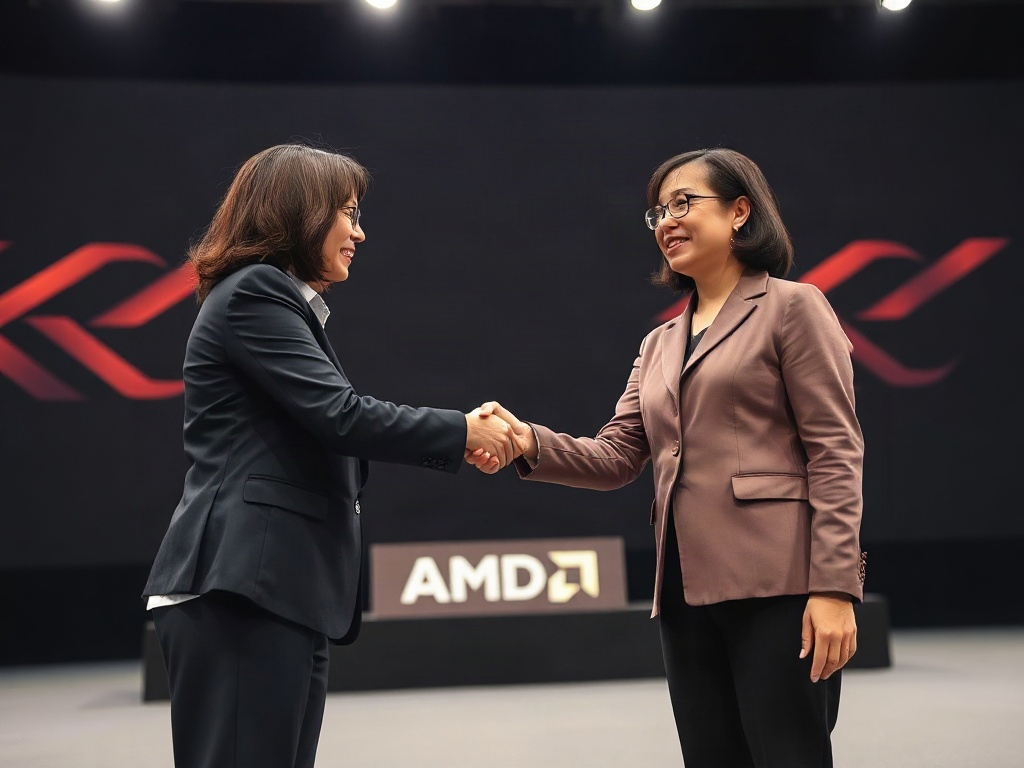
On September 28, 2026, AMD announced the acquisition of World Labs in an all-stock transaction valued at approximately $8.2 billion. The stated goal: to move decisively into the branch of artificial intelligence that does not process text but instead models the physical world. The deal was signed by AMD chief executive Lisa Su and Fei-Fei Li, co-founder and chief executive of World Labs—a researcher who has spent two decades as a reference point in computer vision and whom parts of the industry call the "godmother of AI" for her work on ImageNet, the visual database that helped make deep learning at scale possible.
World Labs is barely two years old. It had raised around $1 billion in funding before the deal. The transaction values it at approximately eight times that accumulated capital, which is not a measure of financial performance but rather a signal of the price AMD was willing to pay for a strategic bet that still has few certainties available publicly.
Fei-Fei Li will become AMD's Executive Vice President and Chief Scientist, reporting directly to Lisa Su. The entire World Labs team will be integrated into AMD. Closing is expected before the end of 2026, subject to regulatory approvals.
---
What AMD Is Buying and What Does Not Yet Have a List Price
To understand the structural magnitude of this deal, it is necessary to separate two things that are often confused when reading an eight-figure number: what is being acquired and what AMD is betting that asset will be worth.
World Labs works on world models, a category of artificial intelligence systems trained on data representing three-dimensional environments—primarily video—rather than the text corpora that feed the language models of OpenAI, Anthropic, or Google. The premise is that a machine that wants to understand and predict physical behavior, such as the trajectory of a bouncing object or the dynamics of a robot navigating a space, needs to have processed the world as it occurs, not as it is described. Fei-Fei Li put it precisely in her statement: "The universe is not made of words, it is made of things."
That is not product philosophy—it is an architectural decision that separates World Labs from the dominant current. Language models are probabilistic systems trained on sequences of text. World models require representing space, time, and physical causality. These are two distinct computational problems and, consequently, have distinct hardware demand profiles.
There lies the root of AMD's move. A chip manufacturer that deeply understands what a world model demands—what type of memory it needs, what latencies it can tolerate, how workloads are distributed during inference—can design processor architectures with a specificity that its competitors do not have. AMD is not buying revenue. It is buying advance design knowledge for the next generation of workloads.
The problem is that this market is neither consolidated nor publicly dimensioned with reliable data. World models as a commercial category are still a promise with embryonic implementations. AMD is paying $8.2 billion for a bet on the order in which market demands will arrive, not for a customer portfolio that already generates predictable cash flow.
---
The Concession That Reveals the Structure
There is an implicit decision in this transaction that deserves more attention than the price: AMD chose to commit to a physically situated approach to artificial intelligence rather than pursue the path of language models, where massive chip demand already exists and where Nvidia dominates with a consolidated position.
That choice is not neutral. It signals where AMD believes the next contest over the architecture of computing demand will take place. Nvidia already has its own internal world models and has forged alliances with startups such as Wayve, which builds autonomous driving systems based on that approach. Yann LeCun, former head of AI at Meta, launched AMI Labs in March 2026 with a similar orientation. AMD's bet is not conceptual originality: it is an attempt to place its hardware at the center of that new cycle before the rules of the market are written.
What AMD is implicitly giving up by making this acquisition is the posture of a pure silicon manufacturer serving all model developers equally. By bringing one of the most prominent research teams in this category inside its own structure, AMD begins to have its own interests in how model architectures evolve. That can be a competitive design advantage or an organizational burden, depending on how the integration is managed.
The structure of the transaction also says something. Paying in stock, not cash, preserves AMD's liquidity but ties the effective value of the deal to the company's stock performance until closing. If the market penalizes AMD during that interval, the real purchasing power of the transaction contracts even though the announced number remains the same. AMD did not disclose the share exchange ratio or the exact number of shares issued, which makes it impossible to calculate dilution for existing shareholders with the available data.
---
How Solid Is the Mechanics Behind the Price
It is necessary to state honestly what analysis still cannot assert: there is no public information about World Labs' revenues, its commercial customer base, its operating losses, or the degree of maturity of its products deployed at scale. The startup is two years old. Its capital raised—around $1 billion—establishes that it had considerable financial backing, but says nothing about whether that investment translated into measurable commercial traction.
The $8.2 billion as a multiple of capital raised is striking, but that calculation mixes magnitudes that are not equivalent. Accumulated funding is neither the pre-acquisition market value nor a conventional valuation basis. What it does reveal is the price AMD considered reasonable to pay for access to a research team, an undisclosed intellectual property portfolio, and the positioning signal that comes from bringing Fei-Fei Li's laboratory inside its structure.
That signaling component should not be underestimated. AMD competes in a market where the perception of technical leadership influences purchasing decisions at large data centers and affects the ability to retain research talent. Having the chief scientist who built ImageNet as an executive vice president is a recruitment argument and a positioning argument in front of customers who, before this deal, may have had reasons to look to Nvidia first.
What can be sustained with the available information is that AMD assembled, over the prior year, a deep technical collaboration with World Labs oriented toward optimizing training and inference on its GPUs. The fact that that relationship evolved into an acquisition suggests that the technical fit was verified in practice before the price was discussed. This is not a blind purchase of a promising team: it is the formalization of a collaboration that was already generating mutual knowledge about the capabilities of AMD's hardware under that type of workload.
---
AMD Has Spent Two Years Trying to Prove It Is More Than Second Place in AI GPUs
The transaction with World Labs is better understood within the trajectory AMD has been following since the market for artificial intelligence chips exploded. Nvidia built its dominant position in AI accelerators on a combination of hardware and the CUDA software ecosystem, which turned its GPUs into the standard development environment for most model laboratories. AMD has competitive hardware, but the weight of Nvidia's software ecosystem has been a persistent adoption barrier for those evaluating a platform switch.
AMD's response cannot be simply manufacturing faster chips. To redistribute demand it needs model developers to validate its platforms as a functional alternative and to optimize their architectures to run on AMD hardware. That requires deep technical relationships with research teams, not just specification sheets.
World Labs, from that angle, is not only a world-model laboratory: it is an entry point into a co-design process where AMD can learn what next-generation workloads will demand before those demands are written into industry standards. If world models become the computational layer powering robots, autonomous vehicles, and industrial systems, AMD needs to have designed that experience from the inside, rather than arriving late to read the requirements set by others.
The integration of Fei-Fei Li in the role of Executive Vice President and Chief Scientist with a direct report to Lisa Su also says something about the internal governance of the move. This is not an acquisition where the founding team is placed in a subsidiary unit with nominal autonomy. Direct reporting at the highest level of the company indicates that AMD wants that research perspective to influence product architecture decisions at the corporate level, not just inside an isolated laboratory.
The risks of that structure are also real. Integrating a two-year-old research team, with a startup culture and a frontier focus, into a company of tens of thousands of employees that operates chip design cycles lasting years, is an organizational management problem that few companies resolve well. The history of research laboratory acquisitions by hardware companies is ambivalent: some teams flourish with the resources of a large corporation, others lose speed and focus when they can no longer operate with the agility that made them attractive in the first place.
---
The One Data Point That Matters at Closing Is Still Not Public
The transaction between AMD and World Labs has articulable strategic logic. The fit between a chip manufacturer that needs to understand the next generation of workloads and a laboratory that is building precisely that model architecture is identifiable as coherence, not as spending without a destination.
But the solidity of that mechanics depends on a variable that neither announcement revealed: what World Labs produces commercially and at what scale. Without that information, $8.2 billion in stock is a bet on a market direction, not a price paid for assets with demonstrated cash flow. AMD can win that bet if world models become the layer that defines the next massive wave of computing demand, and it can lose it if that cycle arrives later than expected or if Nvidia consolidates its position in that category before AMD manages to translate World Labs' knowledge into a hardware design advantage. The direction of the bet is legible. The probability that it works, with what is available today, is not yet.