
A 30-Nanometer Graphene Switch Threatens Half a Century of Memory Architecture
There are discoveries that enhance what exists and those that render it irrelevant. On March 20, 2026, a team from Tel Aviv University published in Nature Nanotechnology something that belongs to the latter category: a switching mechanism built on islands of graphene just 30 nanometers in diameter, capable of changing states with less than one femtojoule of energy per event. To put that into perspective, a femtojoule is a billionth of a billionth of a joule. The dominant memory technologies today —DRAM, NAND flash— operate orders of magnitude above that threshold.
What the team led by Professor Moshe Ben-Shalom, along with researchers Nirmal Roy and Pengua Ying, demonstrated is not just that graphene can switch between its structural configurations in a controlled manner. They demonstrated that this transition can be self-sustaining: once initiated, it continues on its own, without additional force. They also revealed something even more perplexing: neighboring islands communicate mechanically as they propagate structural changes like signals through a network. That doesn’t sound like a memory component; it sounds like a neuron.
The Problem the Semiconductor Industry Has Ignored for Decades
Since the invention of the transistor, the semiconductor industry has operated under an implicit premise: scaling means miniaturizing, and miniaturizing means consuming less energy per unit, even if the total consumption of systems continues to rise. This premise worked as technological nodes shrank from 90 to 65, from 65 to 28, and from 7 to 3 nanometers. However, at some point along the way, the energy cost of maintaining stored information —not writing it, just retaining it— became the real bottleneck.
Global data centers already consume about 1 to 2% of the world’s electricity, and that figure is accelerating with the proliferation of artificial intelligence models that require massive, continuous access to memory. The problem is not just sustainability; it’s a physics issue. Current volatile memories need constant power to retain their state. Non-volatile memories —like flash— degrade materials with every write cycle. Neither has a clean path to the next decade.
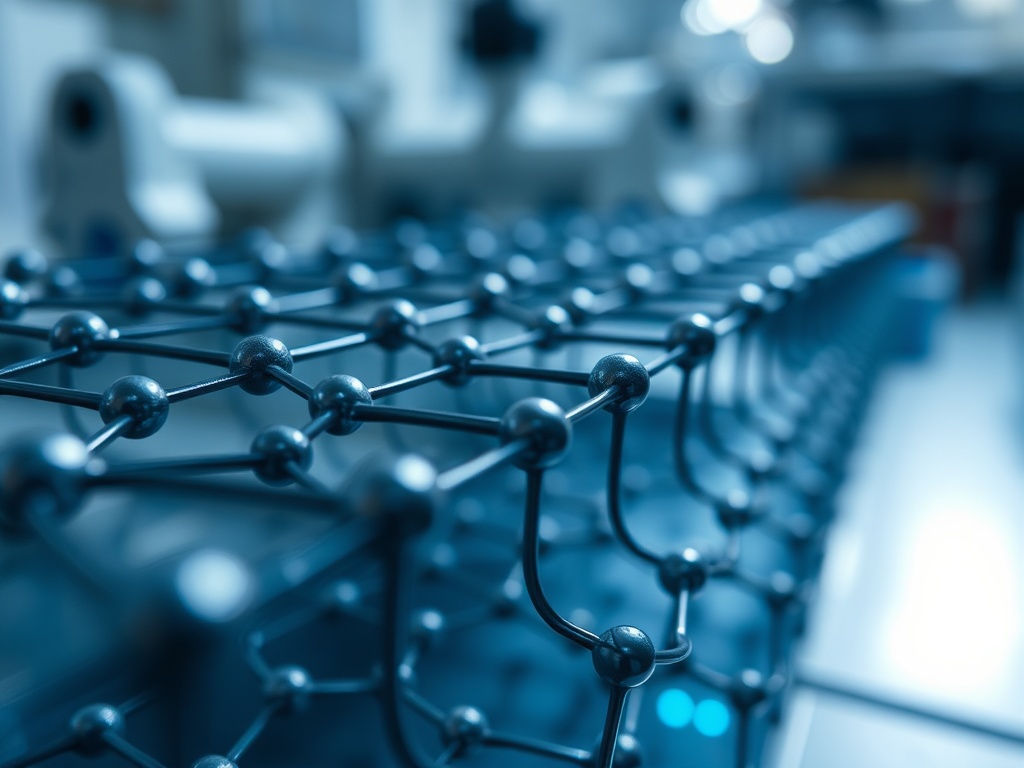
This is where the work from Tel Aviv shifts the conversation. The mechanism they published does not function by breaking and recreating chemical bonds, which is precisely what flash does and what generates heat, degradation, and consumption. Instead, it operates by sliding atomic layers against one another, capitalizing on graphene's superlubricity: the ability of its surfaces to move with near-zero friction. The result is a structural state change —between the Bernal and rhombohedral configurations of graphene— that is reversible, precise, and consumes an infinitesimal fraction of the energy of any known alternative.
Why One Femtojoule Rewrites the Economics of Storage
The logic of marginal cost in technology follows a familiar trajectory: each generation of infrastructure lowers the cost per operation until a radically different architecture appears that redefines the floor. The transistor did this to vacuum tubes. NAND flash did it to magnetic disks. What this graphene work hints at is the next discontinuity along that curve.
When the energy cost per switching event falls below the threshold of one femtojoule, several things happen simultaneously in the hardware economy. First, the heat generated by memory ceases to be a dominant design parameter, collapsing a significant portion of data center cooling system expenditures. Second, the idle consumption of edge devices —industrial sensors, medical implants, wearables— will no longer rely on lithium batteries with frequent recharge cycles. Third, and this is what chip manufacturers are yet to publicly grasp: the barrier to entry for producing competitive memory shifts from building extreme precision lithography equipment to the realm of nanomechanical manipulation processes, an area where the competitive advantages amassed by TSMC, Samsung, or Micron over decades are less determinative.
That shift will not happen overnight. Between a paper in Nature Nanotechnology and a component in mass production lies about five to ten years of manufacturing engineering, integration with existing architectures, and problem-solving that the lab has yet to encounter. But the trajectory is set, and incumbents that are not reading it now will pay for that omission with their margins.
The Most Disruptive Signal: Islands That Talk to Each Other
If the minimal energy consumption is the financial news of the paper, the communication property between islands is the long-term strategic news. Ben-Shalom's team demonstrated that neighboring graphene islands can connect in such a way that a structural change in one propagates signals to its neighbors through mechanical-elastic interactions. The description used by Ben-Shalom himself points directly to brain-inspired computing systems.
This matters because today’s bottleneck for artificial intelligence is not just computing capacity: it’s the data transfer between memory and processor, known in the industry as the memory wall problem. Large language models consume massive amounts of energy not because their mathematical operations are inefficient, but because moving data between where it’s stored and where it’s processed incurs enormous physical costs. An architecture where memory itself can propagate signals analogously to how neuronal synapses do collapses that separation. It’s not just cheaper memory; it’s memory that computes.
Neuromorphic computing has been heralded as imminent for two decades without materializing at scale. The main reason is the absence of a physical substrate that replicates the energy efficiency of biological synapses. A brain synapse operates in the femtojoule range. The Tel Aviv graphene switch operates in that same range. That coincidence is not poetic; it’s a convergence of physics that defines where the leap could finally materialize.
The Time Remaining for Today's Memory Manufacturers
Platform transitions in semiconductors do not follow the pace of software. Investment in factories, supply chains, intellectual property processes, and specialized talent creates inertia measured in decades. This gives incumbents time, but that time is neither unlimited nor free.
The clearest signal that an emerging lab technology is nearing commercial threat is when it starts to be replicated by independent groups across geographies. The publication in Nature Nanotechnology —with implicit validation from Japan’s National Institute for Materials Science as a collaborator— actually activates that process. Research groups in South Korea, Taiwan, and corporate labs at Intel or IBM will read this paper this week, with some already designing replication experiments.
Industry leaders who assume that this type of work remains in the academic domain for decades before touching their operating margins are repeating the mistake of disk drive manufacturers who read early reports on NAND flash in 2000 and filed them away as scientific curiosity. Physics does not negotiate timelines with corporate roadmaps.
Executives shaping long-term strategies in semiconductors, medical devices, or data infrastructure face a defined window of time to decide whether to build capabilities around two-dimensional materials or wait for someone else to do it for them. Those who choose the latter option will not be managing technological risk: they will be ceding the architecture of the next cycle to those who did decide to move.