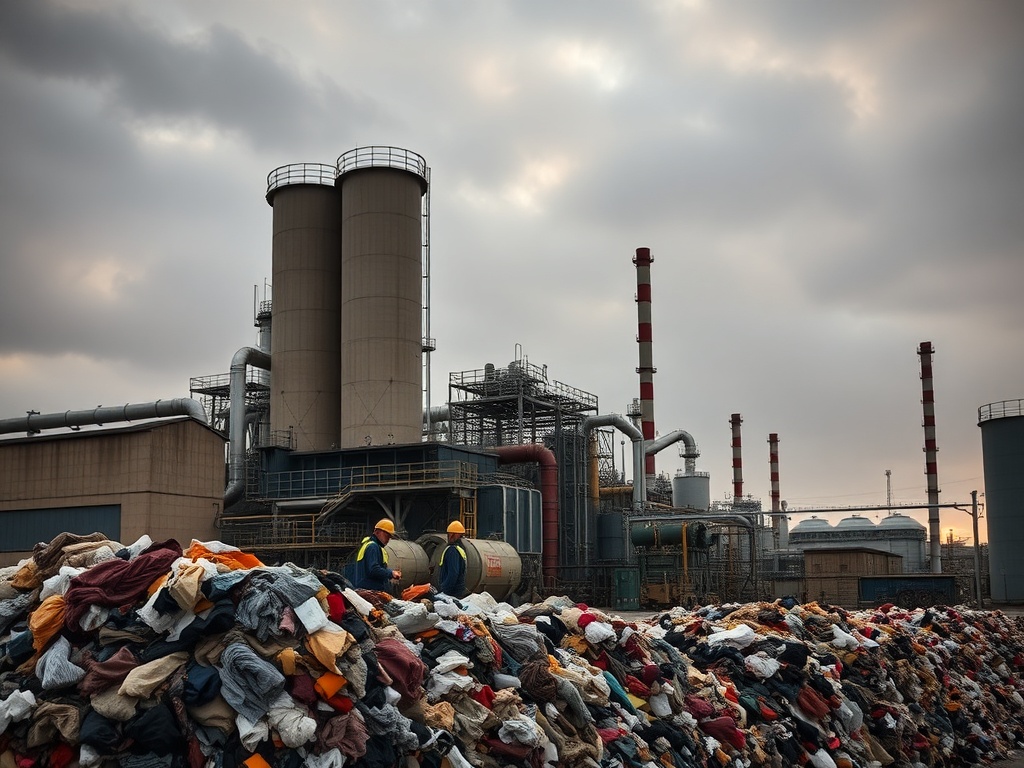

A €135 Million Check Amid an Industry That Has Never Been Able to Recycle Itself
The global textile industry produces between 92 and 100 million tons of waste each year. Less than 1% of that total is recycled from fiber to fiber. The rest ends up incinerated, buried, or exported to countries with fewer regulatory capacities to manage the problem. This structural data is precisely the context in which the news of Reju should be read.
On April 1, 2026, Reju, a textile regeneration company founded with the mission of closing the loop on polyester, received €135 million in funding through the Dutch NIKI program (National Investment Scheme for Climate Projects in Industry). The funds are earmarked for constructing and operating a Regeneration Hub on an industrial scale at the Chemelot chemical park in Sittard-Geleen, Netherlands. The funding covers both the investment phase as well as initial operations, and as stated by Patrik Frisk, the company’s CEO, it represents a critical milestone in the path toward the final investment decision.
In simple terms: the Dutch state is not buying shares. It is reducing the capital risk of a technology that has yet to demonstrate industrial viability. This distinction matters more than it appears.
What Chemelot Reveals About the Project Architecture
Choosing Chemelot was no trivial logistical decision. This industrial park is one of the most integrated chemical complexes in Europe: it offers shared infrastructure for energy, steam, water treatment, and bulk transportation. For a company that needs to process textile waste at industrial volume and convert it into regenerated polyester of quality comparable to virgin polyester, setting up in such an environment means transforming a significant portion of fixed costs into variable costs, taking advantage of existing services instead of building them from scratch.
This is exactly what differentiates a viable textile regeneration project from one that dies during the scaling phase. The leap from the lab to the industrial plant is the point where most clean material technologies collapse: infrastructure costs multiply, startup timelines extend, and private investors withdraw capital before the process matures. Reju is attempting to shorten that trajectory by using existing infrastructure and public capital as a buffer.
The NIKI financing is not an ideological subsidy. It is a mechanism designed to bridge the profitability gap for industrial projects that reduce emissions but, without support, cannot reach the return threshold required by private capital in early stages. The Dutch government’s bet is that once the hub operates at full capacity, the economics of the process will become self-sustaining. If that calculation fails, the €135 million will have paid for industrial learning at a European cost.
The Problem No One in the Industry Has Solved: Scaling Without Losing Input Purity
This is where the technical part that headlines often overlook comes into play. Fiber-to-fiber textile regeneration faces an input problem without parallel in the recycling of aluminum or glass: clothes arrive mixed. Polyester mixed with elastane, cotton, coatings, and dyes that interfere with the chemical process. Separating those mixtures at an industrial scale, at a cost that does not make the final product unviable, is the technical knot that determines whether this industry exists or not.
Reju has developed a chemical regeneration process that, according to its own description, can handle post-consumer textiles and convert them into raw materials for new production. What the announcement does not detail, because it is still in the validation phase at scale, is the actual recovery rate, energy costs per ton processed, and consistent output quality compared to virgin polyester. These three parameters will determine whether textile brands replace their conventional supply chains or if Reju's material becomes a niche ingredient for sustainability collections with marginal volume.
From a portfolio design angle, Reju is operating in what I identify as the riskiest phase of any industrial innovation project: it has already surpassed technical validation in the lab, it has institutional backing, but it has yet to demonstrate that it can produce at a competitive cost with predictable volume. It is precisely at this moment that the governance structure of the project can either save it or sink it. If the Chemelot hub operates with the autonomy and metrics of a startup company, the learning accumulates and is corrected. If public funding and associated political timelines push to measure the hub with the KPIs of a mature industrial plant too early, the project faces pressure that no technology in this phase can absorb without distortion.
The Signal the Netherlands Is Sending to European Private Capital
The decision of the Dutch Ministry of Economic Affairs and Climate to commit €135 million does not occur in a vacuum. There is a deliberate industrial policy logic: the state enters first to reduce perceived risk and enable the entry of private capital in later phases. It is the model that Germany used with the semiconductor industry, the one France applied in green hydrogen, and the one that the Netherlands is now executing in circular materials.
For private investors watching from the outside, this announcement functions as a signal of institutional validation. It does not guarantee that Reju's technology will scale successfully, but it does indicate that the regulatory framework, infrastructure, and political environment are aligned for that scale to be possible. In terms of portfolio management, public capital is playing a derisking function here that private markets were not willing to assume alone.
What remains uncertain is the internal governance of the hub once it begins operations. Companies receiving this type of mixed funding face a specific tension: the reporting deadlines towards the public funder do not always coincide with the technical learning cycles needed by the process. Managing that gap intelligently, without quarterly reports dictating engineering decisions, is the exercise of autonomy that will define whether Chemelot becomes the first industrial textile regeneration hub in Europe or a case study of well-intentioned but poorly executed capital.
Reju has the developing technology, the right location, and now institutional capital. Its long-term viability will depend on whether it can operate the Chemelot hub with the discipline of a company that measures technical learning before measuring operating margin, protecting that exploratory space from the burden of premature scaling expectations.