
Uber Sold an Escape, Not a Ride
Some campaigns sell a product. Others sell a feeling. Then there are those that sell a cover story. Uber’s latest move for St. Patrick's Day falls into that third category, making it worthy of analysis.
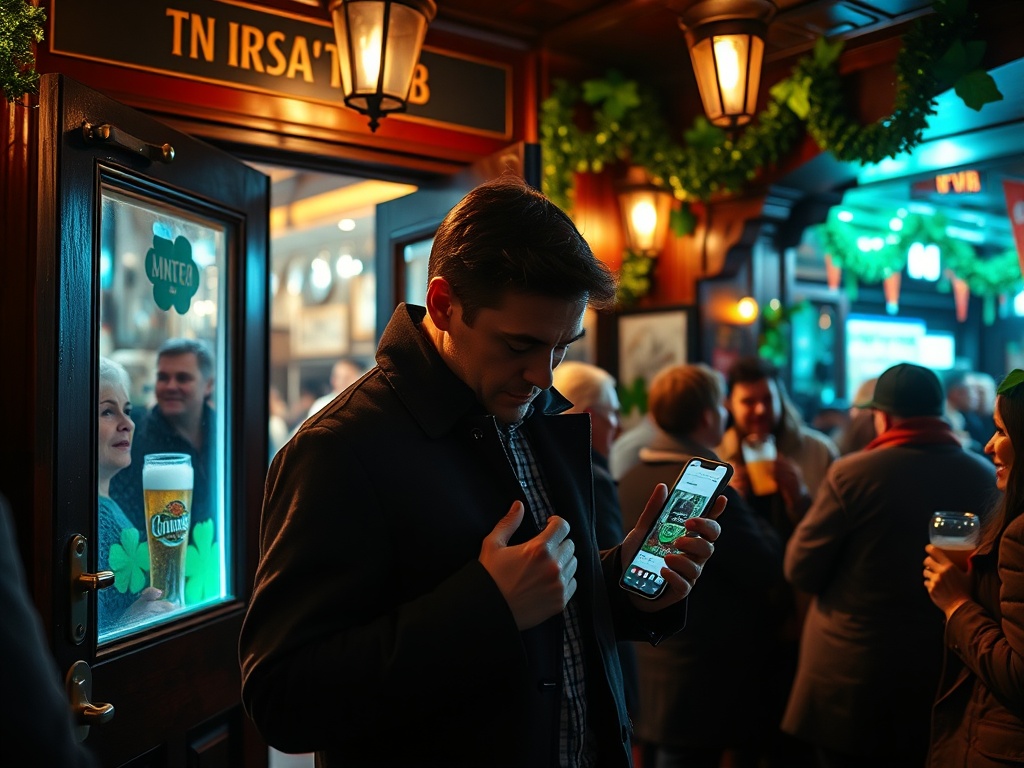
On March 13, 2026, Uber launched "IrishXit", a campaign created in collaboration with Mother New York that takes the cultural phenomenon of the Irish goodbye—leaving a gathering without saying farewell—and uses it as the central theme of its communication. The name is a pun on UberX, its most popular ride option. The result: a 45-second spot featuring Irish television personality Maura Higgins leaving the shoot of the campaign without telling anyone, while the production team searches for her and she enjoys a bath at home. The execution also includes a 17% discount with the code IRISHEXIT17, activations at Irish bars in Orlando, Palm Beach, and Kansas City, along with six and fifteen-second pieces for social media.
However, to reduce this merely to a seasonal campaign would be superficial.
What Uber Diagnosed That Others Ignored
Most brands surrounding St. Patrick's Day compete in the same arena: more green, more leprechauns, more Irish magic. Uber did the opposite. Its strategist at Mother New York, Ana Montoya, articulated it with clinical precision: "Too often, it’s portrayed as a magical day filled with little folks and four-leaf clovers. But in reality, it’s less magic and more like a 24-hour marathon with no finish line in sight."
That line isn't advertising; it’s a consumer behavior diagnosis. And that diagnosis carries statistical weight: according to data the creative team gathered, 50% of millennials admit to having done an Irish exit at least once. This means that the behavior existed widely before Uber named it. The campaign didn’t invent the behavior; it granted it public legitimacy.
Here’s the mechanics of what few are reading correctly: Uber identified that its users were already hiring the service to leave without drama, but they did it with some social guilt or without openly acknowledging it. The campaign didn’t teach them new behavior. It gave them the cultural permission to do it unapologetically. This has a clear functional value—the return ride—but the real weight lies in the emotional and social plane: I want to leave without the awkward ritual of goodbyes, without explanations, without anyone holding me back.
Marisa Siegel, Uber’s mobility marketing lead, summarized it succinctly: "IrishXit is a playful reminder that Uber is your lucky charm when you’re ready to leave." The word when is everything. Not if you decide to leave. When. Uber assumes the user has already made that decision; it just facilitates frictionless execution.
The Economics of a Discount That Isn't Just a Discount
The 17% discount tied to the code IRISHEXIT17 may seem like a standard promotional gesture. Yet it carries a demand-building logic finer than a simple coupon.
St. Patrick's Day is historically one of the highest volume days for app-based transport services, fueled by alcohol consumption and the concentration of nighttime events. In that context, Uber doesn’t need to convince anyone of its existence: demand is already guaranteed. What the campaign does is work on the emotional attribution of the ride. If the user associates their exit from the bar—that moment of relief, of silent escape—with the brand Uber in a specific and almost intimate way, the value of that ride transcends mere transaction. It becomes part of a personal ritual.
This has direct consequences for retention. A user who associates Uber with a moment of emotional well-being—and not just a utilitarian function—is less price-sensitive for future rides and more likely to open the app in similar contexts. The investment in creativity here isn’t just an image expense; it's a bet to compress the user reactivation cycle during high-consumption dates.
Additionally, the field activations at Irish bars in three specific markets—Orlando, Palm Beach, and Kansas City—are not random choices. These are markets where competition for market share in nighttime transport is locally pressured, and where a physical activation with brand presence at the exact point of purchase decision can shift the needle more efficiently than any digital ad.
When Talent is Strategic Architecture
The choice of Maura Higgins as the face of the campaign deserves separate analysis because it isn’t a conventional casting decision. The creative director of Mother New York, Zack Roif, described the criteria with a precision worth quoting much like this: "She’s Irish, completely charming, and adorable, someone who could believably sneak out of a commercial to take a break."
That description contains three stacked strategic variables. The first is cultural authenticity: Higgins is Irish, anchoring the campaign in ethnic credibility without falling into stereotype. The second is parasocial familiarity: her history on Love Island and The Traitors built a close relationship with audiences who see her as someone relatable, not a distant celebrity. The third, and most sophisticated, is storytelling coherence: the fact that she is the one executing the Irish exit from the very commercial isn’t just a comedic trick. It’s a real-time demonstration of the behavior the brand is normalizing.
The result is a meta-structure where the message and the medium are the same thing. The campaign doesn’t describe the Irish exit; it enacts it. That coherence between form and content is what differentiates an ordinary creative execution from one that generates organic conversation and extended reach at no additional cost in media.
The entire production was completed in approximately a week in New York, at a bar in the Meatpacking District where they installed a Guinness mirror as a set prop that the owners requested to keep permanently. That detail—seemingly minor—is actually an indicator of how much value a well-calibrated execution can generate: brand activation becoming a permanent installation without additional budget.
The Job the User Hired Wasn't a Ride
Uber’s IrishXit campaign illustrates that the job the user is hiring isn’t transport, but social liberation without emotional cost. The ride is merely the mechanism; the real advance the consumer seeks is to exit a socially demanding situation with the least friction possible, without guilt, and devoid of the farewell ritual. Uber didn’t compete on price or arrival speed. It competed on understanding that specific moment of human experience in a celebration that extends beyond the point at which one wants to continue. Brands that grasp that distinction—between the product they sell and the advance the user needs—build a position that no competitor can replicate by simply improving their pricing algorithm.