
The Strait of Hormuz: The Hidden Cost of Fuel and Geopolitical Risk Management
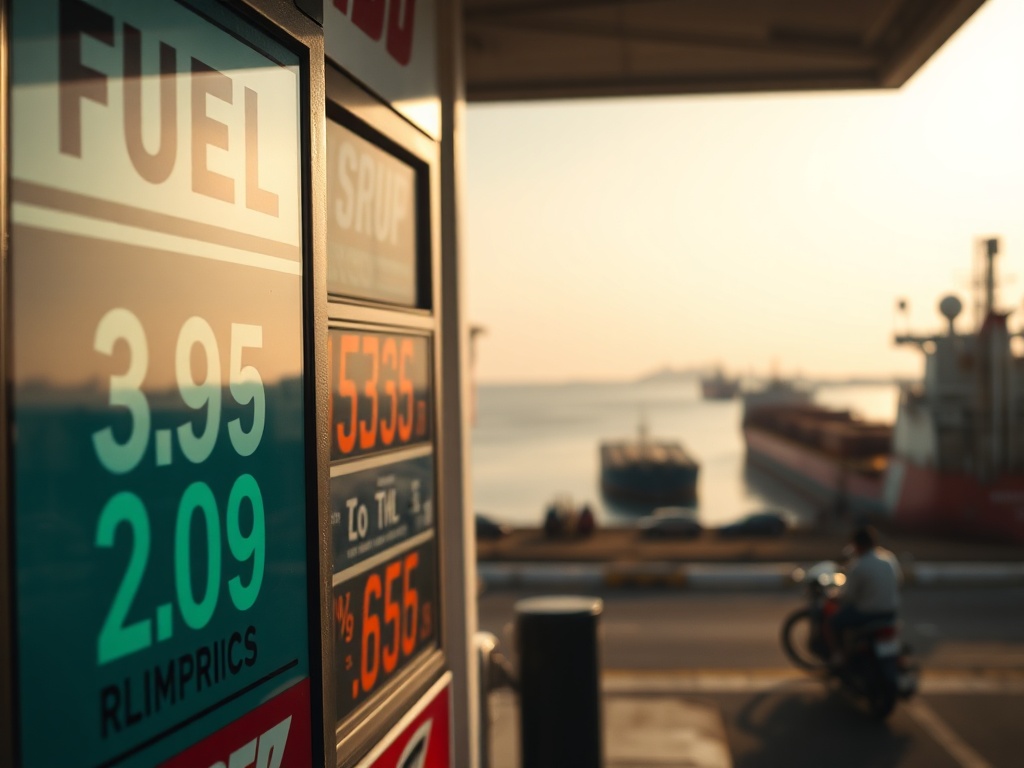
The global energy market faces a structural weakness that cannot be solved with press releases or macro optimism; it requires system design. Following a U.S.-Israeli attack on Iran, Brent crude prices surged over 6%, reaching around $77 per barrel, the highest level since last June, according to CNBC. Meanwhile, the average gas price in the U.S. rose to $2.94 per gallon, nearly 2% higher than the previous week. This spike may seem 'normal' to those accustomed to market routines, but the mechanism driving it is anything but routine: geopolitical shocks translate into consumer shocks within days.
The core of the tension isn't tied to a specific refinery or platform; it’s a bottleneck. The Strait of Hormuz, no more than 21 miles wide at its narrowest point, channeled approximately 20 million barrels per day in 2024, accounting for 20% of global liquid petroleum consumption. This figure doesn’t merely describe a route; it describes systemic dependence. The moment markets begin to assign a probability to a prolonged interruption, it doesn’t take a single barrel short today for gas prices to jump tomorrow.
In terms of sustainability, this compels a shift away from the aesthetic approach and toward an accounting perspective: resilience as balance and as cash flow. Cheap energy is no longer a fundamental condition; it’s a strategic variable.
A Distant Conflict Becomes Domestic Inflation in Real Time
The common narrative states that gas prices rise "because oil prices rise." While true, it's incomplete. What CNBC presents with data and expert voices is the speed of transmission: analysts indicate that increases in crude prices translate into "almost immediate" hikes at the pump. Patrick De Haan, head of petroleum analysis at GasBuddy, projects that the national average in the U.S. will hit $3 per gallon for the first time this year within the next week, driven by a difficult blend: spring seasonal demand plus geopolitical pressure.
This coupling of geopolitics and retail price redefines how a CFO must interpret the concept of "energy risk." It is no longer a secondary risk absorbed by an annual provision; it is an operational risk that manifests in the cost per mile of logistics, in the cost per unit of manufacturing, and in consumption elasticity when fuel prices make everyday life more expensive.
The scenarios outlined by experts depict a range with asymmetric consequences. Ramanan Krishnamoorti, a petroleum engineering professor at the University of Houston, sees a “great margin” for prices to soar: upwards of $100 per barrel in days or weeks if the war persists, and potentially $150 per barrel by the end of the month in a prolonged scenario. Tucker Balch, a finance professor at Emory University, posits a range where a modest conflict might leave crude around $80, while a longer war could push it above $100.
In sustainability terms, these bands are not speculation; they are stress tests. The relevant corporate question is not if the exact number is correct, but which parts of the business will break first when fuel adds friction to the whole economy.
Hormuz as a Systemic ‘Asset’: The Fragility of a Linear Chain
The Strait of Hormuz operates as a critical asset without being on anyone's balance sheet, and that is precisely why it is dangerous. Timothy Fitzgerald, a professor of business economics at the University of Tennessee, describes it as the “most important oil transit choke point in the world.” In 2024, about 20 million barrels daily passed through it. Additionally, a large portion of those flows feeds Asia: nearly 5 million barrels per day went to China and 2 million to India.
The critical point for a corporate reader is not where the oil is consumed, but how price formation occurs. Oil is a global commodity. Although the U.S. may not be the primary destination for those barrels, the price paid by American consumers adjusts for global scarcity expectations, risk premiums, and reconfigurations of routes. A partial disruption raises the marginal price of the barrel that defines the market, and that marginal barrel pulls everything else up.
Herein lies the perspective I employ to read this news through the lens of sustainability: Networks and Circularity, understood not merely as a slogan but as an audit of dependence. A linear system extracts, transports through concentrated routes, refines, and distributes. When a single artery dominates, the system lacks redundancy. Sustainability, in business terms, becomes about building redundancy and flexibility: multiple sources, multiple routes, multiple operational substitutes.
This is not about climate romanticism. It’s about preventing a 21-mile corridor from becoming the trigger that turns a solid quarter into a downward guidance revision.
Energy Costs Are No Longer Prices; They Are Risk Premiums
For years, many companies have treated the energy transition as a chapter of reputation and, at best, as a long-term savings bet. This kind of episode shifts the framework: the transition is also an insurance against volatility.
The historical precedent recalled by CNBC is 2022: following Russia’s invasion of Ukraine, Brent exceeded $139 per barrel, and gas prices in the U.S. averaged $4.32 per gallon. That episode left a lesson the market tends to forget when prices fall: energy can be brutally repriced when the security of supply is broken. Today, with Brent at $77, it is well below that peak, but that is not tranquility; it is space to move upward if the risk materializes.
From a sustainability perspective applied to business, the energy cost consists of two layers. The first is the physical cost of the hydrocarbon. The second is the risk premium the market adds when it perceives fragility in infrastructure, routes, and governance. This premium is volatile and transmits through gasoline, transport, chemicals, and plastics, as the cited experts state.
The financial consequence is direct: energy-intensive industries face margin compression; sectors with price-sensitive demand experience volume declines; and the entire economy endures an implicit tax through prices. The maturity of sustainability, the kind that matters to a CEO, is the kind that reduces exposure to that premium.
Redesigning Resilience: Electrification, Efficiency, and Contracts as Strategy
When the market assumes that oil could reach $100 or $150 in a prolonged conflict, the debate shifts from ideology to economic engineering. Resilience is built with concrete measures, some technological and others contractual.
First, electrification and efficiency are not merely emissions reductions; they are a way to decouple part of the operating cost from a geopolitical commodity. Each process that migrates from liquid fuel to electricity, and every efficiency point in fleets and operations, reduces sensitivity to shocks. The key aspect is timing: it does not get implemented in a week, but is decided today—or it will be paid for tomorrow.
Second, supply architecture matters as much as the source. In a world where Hormuz concentrates 20% of global liquid consumption, the concentration of suppliers and routes becomes a fragility. Diversifying is not a luxury; it is reducing the probability of simultaneous disruptions.
Third, contracts and hedges exist to turn uncertainty into manageable ranges. They do not eliminate costs, but they reduce the extreme volatility that destroys planning. The point is that when episodes like this become recurrent, hedging transitions from being tactical to becoming a permanent policy.
Finally, there is a second-order effect that boards tend to underestimate: social perception. When gas prices rise "almost immediately," political costs also increase almost immediately. That pressure accelerates regulatory decisions, subsidies, or restrictions, quickly reconfiguring the business environment.
Competitive Survival Will Belong to Those Who Design Energy Redundancy
This news story, more than a mere military episode, reveals an equation: a shock in the Middle East can reconfigure retail prices in the United States within days because a 21-mile choke point moves 20% of global liquid hydrocarbons. With that level of concentration, the market does not buy calm; it buys coverage.
The sustainability that will matter in the next decade will not be the one that produces elegant reports, but the one that reduces exposure to geopolitical risk premiums through efficiency, electrification, supply redundancy, and financial discipline. Global leaders who treat energy as a stable input will operate with a false map, while those who redesign their systems to function under permanent volatility will dominate the new normal of capital and commerce.