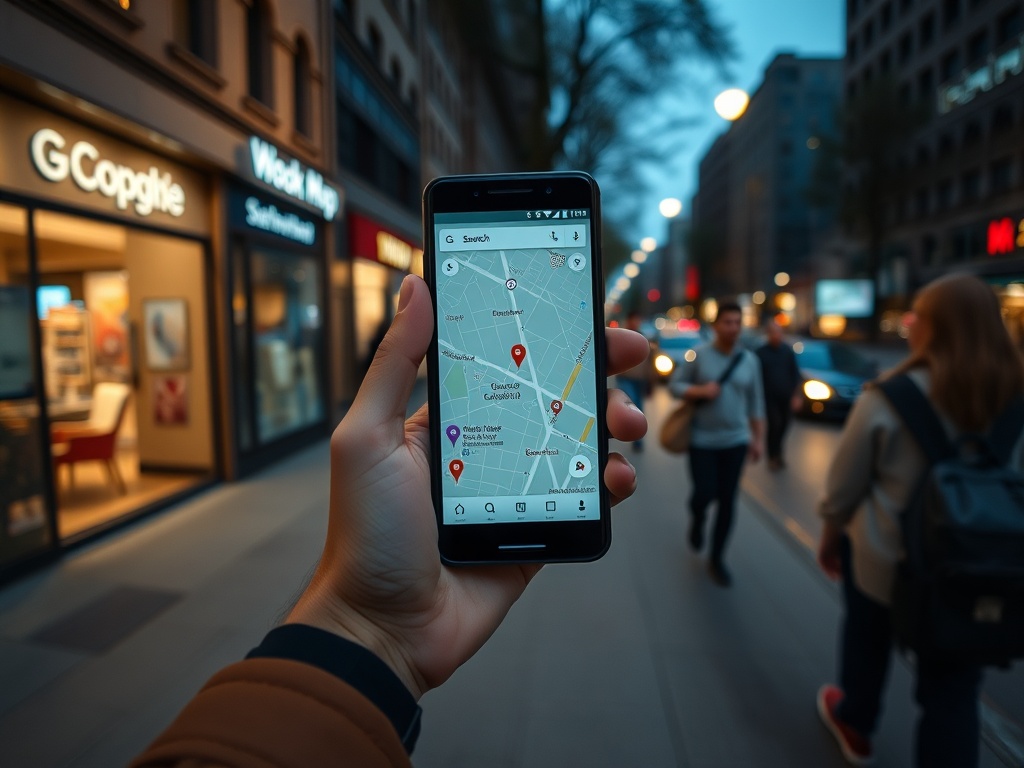

The Map Your Customer Uses to Find You
There’s a scene that plays out millions of times a day, yet most marketing directors haven’t analyzed it with the coldness it deserves. A consumer stands on a corner, feeling hungry, needing a service, or just recalling something that needs resolving. They open their phone and type two words: ‘near me’. What Google returns isn’t the result of their branding campaign; it’s the end result of a chain of hyperlocal signals that their team probably hasn’t measured accurately.
This is the starting point of a technical debate shaking up SEO agencies and digital marketing teams: local search placement varies dramatically by city, device, and the user’s physical proximity, making traditional tracking methods an illusion in many cases.
The Illusion of a Unique Ranking
For years, the benchmark for measuring SEO success was simple: What position does my site appear in for this keyword? That metric has a structural flaw that few teams dared to openly point out: an average national ranking obscures entirely different local realities.
A business might show up as the first organic result on Google when someone searches from a corporate office downtown, yet vanish from the map—literally—when a user performs the same search from a suburban neighborhood a dozen kilometers away. Not because the algorithm is capricious, but because Google interprets search intent based on the coordinates from which it’s launched. The user typing ‘plumber near me’ isn’t searching for the best plumber in the world; they’re looking for the plumber who can arrive in forty minutes.
This is where consumer psychology and technological architecture converge in a way many leaders haven’t yet processed. The user in a proximity search isn’t in comparative evaluation mode. They’re in urgent resolution mode. Their tolerance for friction is minimal. If you don’t show up in the top results during that micro-moment, you don’t exist for that customer. And that customer, in their urgent state of mind, isn’t going to scroll, isn’t going to open a second page, and definitely isn’t going to remember you for next time.
SERP APIs—tools that simulate real searches from specific geographic coordinates—emerged precisely to address this blind diagnosis. They allow agencies and in-house teams to execute programmatic searches from exact locations, separating Google’s map results (the famous ‘local pack’ with three map results) from traditional organic results, and doing so at scale: hundreds of cities, multiple devices, various variations of the same search.
What Technical Data Reveals About Human Behavior
When I analyze the adoption of these tools from a consumer behavior perspective, I see not an SEO problem. I see the symptom of a company that designed its digital strategy for its own ego, not for the operational reality of its customer.
The local consumer operates under a heuristics of accessibility that’s almost automatic: they trust what appears first because they interpret prominence as a signal of relevance. It’s not a rational calculation. It’s a deeply instilled cognitive shortcut. Google reinforces that shortcut by presenting the map results with stars, photos, hours, and real-time distance. That block of information brutally reduces decision anxiety: everything the user needs to make a decision in thirty seconds is right there.
What this means for a marketing director is uncomfortable yet straightforward: if your company isn’t appearing in that block for relevant searches in each of the cities where you operate, you’re paying for visibility that doesn’t exist where it matters most. Not in the abstract sense of ‘your strategy has areas for improvement.’ But in the concrete sense that there are customers with high intent to purchase, within walking distance of your service points, who never find you.
SERP APIs allow for precise auditing of that gap. A team can schedule simulated searches from specific coordinates—not just whole cities, but neighborhoods, shopping areas, even intersections—and build an actual map of visibility. The result is often disturbing for companies that have never done this before: rankings that seemed solid at a national level disintegrate when viewed at street level.
The Fear That Holds Back Correct Investment
There’s a dynamic I repeatedly observe when I present this type of analysis to leadership teams: the intellectual acknowledgment of the problem coexists with operational resistance to solving it. That resistance isn’t irrational; it has a very specific organizational behavior logic.
Adopting a hyperlocal monitoring infrastructure means accepting that the reports marketing was presenting in board meetings were, at best, incomplete. That acknowledgment has an internal political cost that many teams are unwilling to bear. The inertia of the status quo isn’t produced by consumers. It’s generated by leaders who confuse the comfort of aggregated reports with the certainty of real data.
Providers of SERP APIs specialized in local SEO—and the market already has several players with differentiated offerings for agencies and in-house teams—offer exactly the opposite of comfort: granularity that forces uncomfortable decisions. You see which cities are won, which are lost, and which are in a gray area where a marginal investment could tip the scales. That visibility is operationally useful. But first, you have to be willing to look.
The companies adopting these types of tools most quickly aren’t necessarily the largest; they’re the ones that have a more honest understanding of where their demand genuinely originates. A service business with a presence in twenty medium-sized cities that monitors its local visibility accurately can outperform a national chain with a budget ten times as large, but with a digital strategy designed from the headquarters’ perspective, not from the street corner where its next customer stands.
Local Visibility Is an Architectural Decision, Not a Budget One
The discussion about which SERP API to choose—what provider offers better geographic coverage, how granular the device simulation is, how well it separates organic results from those of Maps, how well it scales for operations with hundreds of locations—is a legitimate and necessary technical conversation. But there’s an earlier conversation that few organizations are having with enough honesty.
The accuracy of data only has value if there’s institutional will to act on it. A company can hire the best hyperlocal monitoring tool available and continue making investment decisions based on vanity metrics if its internal culture rewards narrative over diagnosis.
The consumer searching ‘near me’ doesn’t wait. They don’t research your brand story while deciding. They don’t weigh your corporate Net Promoter Score. They evaluate in seconds what comes up in front of them and act. Each week a company operates without precise visibility of how it appears in those high-intent moments is a week of demand that has drifted off to the competition without anyone on the team knowing.
Leaders who continue measuring digital success with averaged national rankings are building a strategy on a blurry photograph of a reality occurring in high definition, at street level, in real-time. The technology to see that reality exists. The decision to look at it is the only one that still depends entirely on them.
The most costly mistake isn’t lack of the tool. It’s having invested the entire budget into making the brand shine nationally while the closest customer, the one about to convert, simply couldn’t find you.