
The Campus as a Balance Sheet: What Silicon Valley Architecture Reveals About Its Business Model
There is an architectural blueprint that never appears in design magazines but determines whether a company survives or collapses: the blueprint of its business model. When I analyze it with the same coldness that a structural engineer examines a beam's load-bearing capacity, I find that decisions about physical space are rarely aesthetic. They are capital decisions.
The story of how Silicon Valley went from building anonymous industrial warehouses to commissioning iconic buildings from Norman Foster or Frank Gehry is not one of refined tastes. It is an X-ray of how an entire sector changed its relationship with risk, permanence, and ultimately, fixed costs.
The Anonymous Warehouse Was a Financial Decision, Not a Philosophical Stance
The Stanford Research Park, opened in 1951, established the genetic code of the tech space in California. Zoning regulations required more than 50% of the land to be designated as open space, large landscape buffers, and ample parking. The visual result was deliberately neutral. But behind that neutrality was a precise operational logic.
Hewlett-Packard didn’t build open-plan workplaces without hierarchies because its founders were idealists about space. They did it because a company operating on the technological frontier needs to be able to double its workforce in six months or cut it in half without the building becoming an anchor. The architecture was, literally, a variable cost disguised as brick. Modular spaces, flexible leasing contracts, and interchangeable office parks served as a buffer against sector volatility.
The most illustrative point of this logic is what architectural historian Gwendolyn Wright described as a deliberately "ephemeral" aesthetic: these buildings did not signal permanence because permanence was a risk that no tech company wanted to assume. Silicon Valley ended up filled with what we might call hermit crab shells: the Mountain View campus that was Silicon Graphics became the headquarters of Google; the Menlo Park campus that was Sun Microsystems turned into Meta's campus. No company had invested so much in the container that a tenant change would be traumatic.
This architecture of variable costs was not creative poverty. It was financial engineering applied to square meters.
When a Company Builds a Palace, It Is Changing Its Bet on the Future
The shift occurs in the 1990s and solidifies in the 2010s with a very specific accounting logic. The companies that begin to invest in campuses designed by signature architects are not startups seeking flexibility: they are companies that have accumulated so much capital, generated so much recurring cash, and established such consolidated market positions that they can afford to transform a variable cost into a long-term fixed asset.
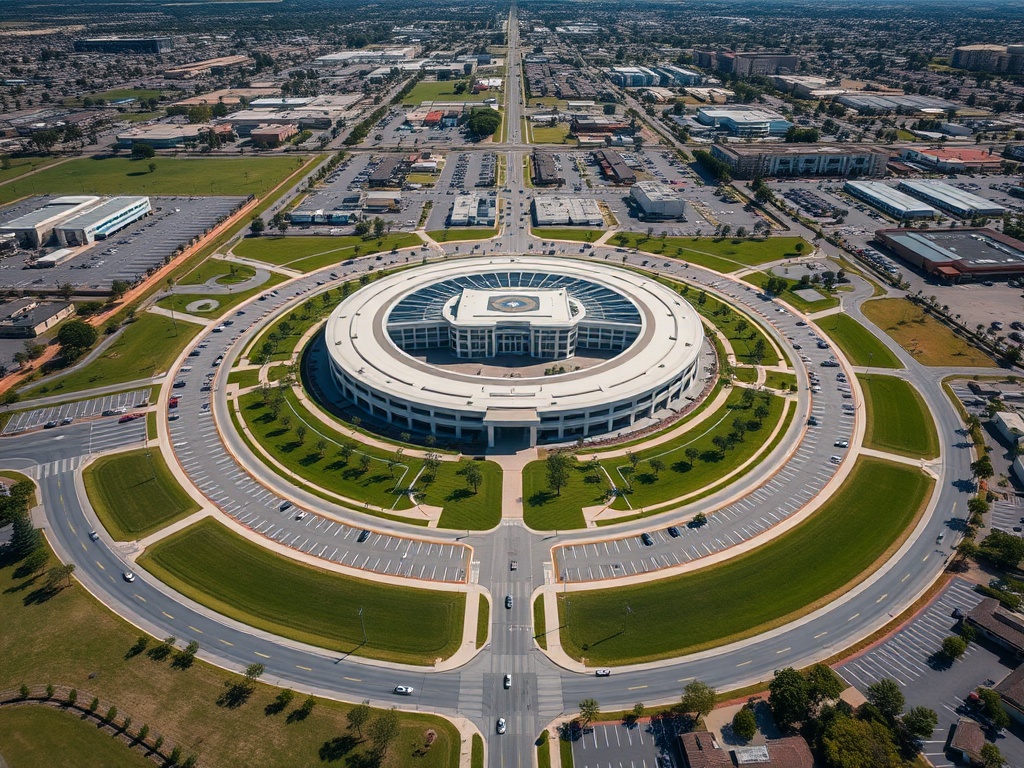
Apple Park is the most extreme case. The project exceeded its initial budget of $3 billion by another $2 billion before even being completed, according to available data from its approval by Cupertino’s City Council in 2013. A 260,000-square-meter campus that consolidates over 13,000 people, with its own energy generation system and more than 80% of the land as green space, is not an operating expense: it is a declaration of permanence inscribed in concrete and glass.
The question a structural analyst must ask is not whether the building is beautiful, but what type of company can absorb that level of fixed cost without breaking its back. The answer: a company that has stopped competing for survival and is competing to attract talent. The battle for talent in the San Francisco Bay Area transformed the campus into a retention tool, a tangible value proposition for engineers with multiple offers on the table. The building became part of the compensation package.
Meta followed a similar trajectory, though with a different piece of the model. Its West Campus, designed by Frank Gehry, is essentially a 430,000-square-foot open-plan warehouse with a rooftop garden. The ground floor is parking. There is no real urban gesture outward. The investment in architectural image is massive, but the design remains introverted, focused inward, toward the employee, not the city. The capital expenditure is justified by retention, not by integration with any community environment.
The Load-Bearing Failure That Blueprints Do Not Show
There is a structural tension that none of these campuses resolves, and it becomes visible when analyzed as assets rather than as design objects. All these projects share a common trait: they are private, car-dependent environments disconnected from the public urban fabric. The Apple campus is a giant ring surrounded by greenery that lacks walkable access from any neighborhood. The Meta campus has no recognizable urban facade. The Google campus, even with its promise of stores, cafes, and bike lanes, was redesigned to a smaller scale after the original land was acquired by LinkedIn.
This disconnection is not an aesthetic problem: it is a medium-term operational vulnerability. The next generation of skilled workers has a documented preference for dense, connected urban environments. Companies that have bet billions on suburban infrastructure are building fixed assets whose appeal as retention tools could erode exactly when they need it most. A fixed cost that loses its utility does not disappear from the balance sheet: it remains there, depreciating.
Nvidia's model offers a different reading. Hiring Gensler to design a campus based on triangles, the shape the company identifies as the basic unit of its computer graphics, and using its own light simulation software during the design process, is a decision that works on multiple levels simultaneously. It reduces design risk by validating the space before construction. It turns the architectural process into a technological showcase. And it communicates to clients, investors, and potential employees that the company possesses enough internal coherence for its product and headquarters to speak the same language.
That is atomization applied to physical space: a specific proposal, for a specific segment, executed through a channel that reinforces the message rather than diluting it.
The Building Is the Model Made Material
What the architectural history of Silicon Valley demonstrates, piece by piece, is that companies do not change the form of their buildings for cultural reasons. They change the form of their buildings when the nature of their competitive advantage shifts. While the advantage was the speed of adaptation, the campus had to be disposable. When the advantage shifted to the ability to attract and retain scarce talent in a labor market saturated with options, the campus transformed into value proposition infrastructure.
The mistake many organizations make in reading these signals is copying the form without understanding the function. Building a striking campus without first having the cash generation model to support it is exactly the type of house of cards that ends up in headlines about massive layoffs and empty square meters. Companies do not go bankrupt because their buildings are ugly nor do they thrive because they are beautiful. They go bankrupt when the pieces of their operational architecture, from fixed costs to employee value proposition, stop articulating into a system that generates measurable value and sustainable cash flows.