
The AI Race is Won on the Ground, Not in the Cloud
On March 4, 2026, in Jakarta, the global campaign for World Engineering Day for Sustainable Development (WED 2026) was officially launched, backed by UNESCO. Among the official partners announced that day was Compass Datacenters, a hyper-scale data center company that, on the surface, appears unremarkable. They build infrastructure for artificial intelligence, cloud computing, and big data, and they do it at scale. That’s all.
But there’s a line in the communication from their CEO, Chris Crosby, that struck me: "Technology alone will not determine the outcome: trust will." This is not PR rhetoric; it is a business hypothesis with direct implications for how this company designs its operations portfolio and how sustainable that design will be in the long run.
Building Slowly to Scale Quickly
The data center industry is under immense pressure. The demand for computational capacity for AI is growing faster than local permits, electrical grids, and communities can cope. The usual response from the sector is to accelerate: more capital, more megawatts, less regulatory friction. Compass chose a different path.
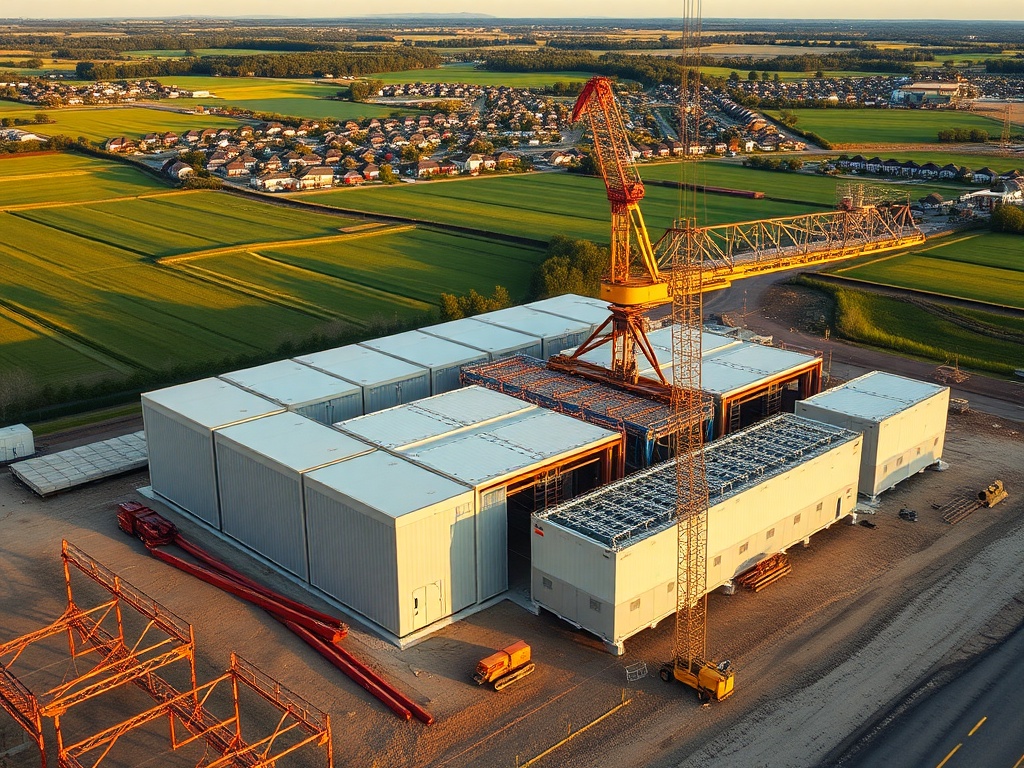
85% of their constructions are completed off-site, using modular manufacturing methods. This is not just an engineering decision; it’s a cost-structure decision. By industrializing construction, the company transforms what has historically been a slow, craft-like process dependent on variable local labor into a predictable supply chain. The visible result is shorter delivery times. The invisible result is that they reduce their exposure to cost overruns, one of the biggest margin destroyers in large-scale infrastructure projects.
Add to that the Zero Waste to Landfill certification they received from UL Solutions at their two campuses in the Toronto area, and the fact that they are the first data center developer to commit to using CarbonCure technology— which mineralizes carbon into concrete— at all their sites. These are not decorative credentials; they are barriers to entry built certification by certification that increase the replication cost for any competitor wishing to enter the same markets with the same credentials.
What Compass is doing, without naming it, is fortifying its core operation with high-cost, intangible assets. This is operational efficiency well executed: not cutting costs, but structuring the business so that each invested dollar creates additional defenses.
The Trap the Sector Isn’t Seeing
Here is where my reading becomes more uncomfortable for the industry.
The dominant narrative in AI infrastructure is that whoever builds faster wins. More installed capacity, more contracts with hyper-scalers, more market share. It’s a pure exploitation logic: optimizing the current model to the limit. The problem with this logic, when applied without counterbalance, is that it generates systemic fragility.
Data center projects face increasing community opposition in multiple geographies. Municipalities are learning. Organized neighbors can hold up permits for months or even years. Local governments, pressured by the massive energy consumption that these projects imply, are legislating more rigorously. A competitor that builds quickly but without a community anchor is quietly accumulating regulatory risk on its balance sheet.
Compass is betting that community consent will become the most expensive bottleneck in the industry before the decade is over. Their “century-long neighbor” philosophy is not corporate altruism; it is the upfront monetization of an asset that competitors have yet to factor into their financial models. If this bet is correct, developers who prioritize speed over community integration today will find their project pipelines stalled in approval processes they couldn't manage.
The partnership with UNESCO and the WFEO—representing over 30 million engineers across more than 100 countries—provides Compass access to a network of institutional credibility that opens conversations with governments evaluating data center proposals against sustainable development criteria. This isn't marketing; it's market expansion with a low customer acquisition cost.
What Compass’s Portfolio Reveals About Who Will Survive
When I analyze Compass's business model from a portfolio perspective, I see a company that has made an uncommon decision in capital-intensive infrastructure sectors: they are exploring a long-term model while exploiting their current business.
Constructing 85% modularly is smart exploitation: it makes the current business more efficient and predictable. Environmental certification, partnership with UNESCO, and co-developing the Green Globes Data Center Campus standard with GBI are active explorations: they are co-building the rules that will govern the industry in 10 years. Who helps write the standards rarely breaks them, and almost always complies before their competitors.
The tension point I observe is internal governance. Maintaining this operational duality—efficiency in the present, long-term bets—requires Compass's C-level to manage two speeds simultaneously. The classic trap in such companies is that the pressure from the current business, which demands scaling capacity to respond to AI demand, ends up eroding the resources and executive attention needed for long-term bets. Certifications are neglected. Institutional alliances become symbolic. The century-long neighbor philosophy becomes just a tagline on a website.
There are no public signs that this is happening at Compass. In fact, the Schneider Electric Sustainability Impact Award they received— for using predictive AI and modular construction to accelerate deliveries and advance sustainability— suggests they are successfully integrating both speeds instead of sacrificing one for the other. But this type of tension can only be sustained with an organizational structure that actively protects the space and budget for long-term bets.
The AI infrastructure industry is at the moment where firms that scale with architecture are separating from those merely accumulating capacity. Compass is building a model where community trust, environmental standards, and modular manufacturing mutually reinforce each other. If that architecture remains coherent as they scale, the model has long-term viability. If the pressure for growth fragments that coherence, they will have solid physical assets and a corporate philosophy that no one believes.