
The SSA Reshapes Its Service Model
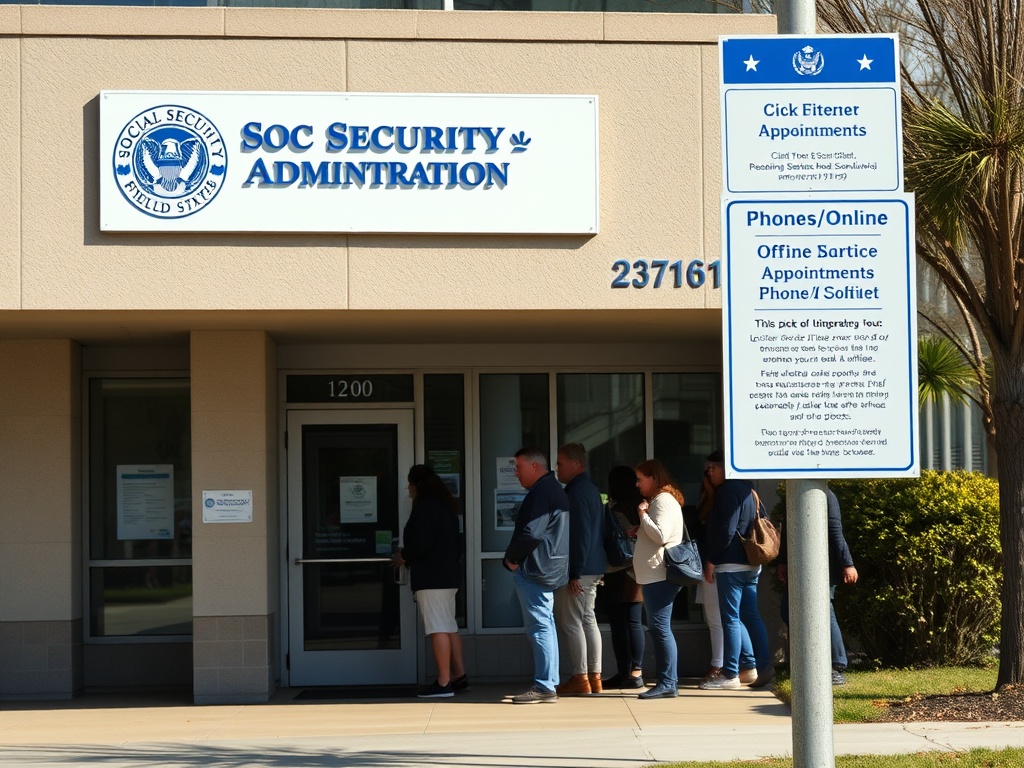
On March 7, 2026, the Social Security Administration (SSA) of the United States begins a transformation that will effectively reconfigure the flow of its demand. The agency will transition from reliance on local field offices to operating a nationwide centralized customer service network for managing appointments, benefits inquiries, and assistance with paperwork. In 2026, the SSA serves approximately 71 million beneficiaries, making any operational adjustments a systemic event.
The announcement carries a crucial clarification: payments will not change. Monthly amounts, schedules, eligibility, and cost-of-living adjustments will remain intact. The shift occurs at the "ground floor" of the system, where calls are received, appointments are scheduled, and cases are pushed towards resolution.
As a business model architect, I interpret this decision as one in which the construction team has been reduced while still being expected to deliver the same building: cutting staff while compensating with redistributed workloads, technology, and access rules. It works if the structure and flows are well-calculated but fails if friction shifts to cases that cannot tolerate standardization.
The Harsh Reality: Fewer Hands, Same Demand, New Routing
Centralization does not occur in a vacuum. It is built on a primary constraint: staff reductions. In 2025, the SSA laid off at least 7,000 workers amid a federal restructuring associated with the Trump administration and the Department of Government Efficiency linked to Elon Musk, as reported in available coverage. Data from January 2026 from the Office of Personnel Management confirms that the SSA lost over 6,000 employees in 2025, with approximately 1,000 field office workers reassigned to the national line 800-772-1213.
Against this backdrop, centralization is primarily a routing solution: instead of each local office absorbing its own demand, the agency seeks to have any available employee, anywhere in the country, handle an appointment or resolve an inquiry. This represents a shift in logic. From a systems design perspective, it transitions from "small local queues" to a "large national queue" with common rules.
The metric that exposes the underlying intention is aggressive: the SSA operates more than 1,200 field offices, but it aims to reduce in-person visits to 15 million in fiscal year 2026 (October 2025 to September 2026), down from 31.6 million in fiscal year 2025. This represents a deliberate 50% reduction in in-person interactions, not a secondary consequence.
The operational question is not whether the SSA can attend to cases, but where the pressure will accumulate. When demand is pushed out of an expensive channel (in-person) towards cheaper channels (web, self-service, callbacks), the system improves if most cases are "catalog cases." It becomes stressed when the proportion of "exception cases" increases.
The Promise of Efficiency: Digitalization, Callbacks, and Wait Times
The SSA Commissioner, Frank J. Bisignano, has framed the change as a tangible service improvement. According to his briefing, there is now 24-hour access to SSA.gov, previously offline 29 hours a week. Additionally, wait times for phone calls on the 800 line have "dropped to single digits" and technology now allows 90% of calls to be resolved through self-service or callbacks.
These figures matter because they describe the type of efficiency the agency is pursuing: converting synchronous human contact (waiting, long calls, transfers) into asynchronous contact (callbacks), and turning human contact into self-service when possible.
Operationally, this resembles replacing a counter with a queue system and work trays. Throughput increases if the back office is not overwhelmed and if initial classification works. If the triage is poor, the system does not crash immediately, but it begins to generate repeated work: returning calls, reopened cases, users trying to enter through another door.
A warning signal is emerging: since January 2025, in-person visits require scheduled appointments, and by August 2025, more than half of retirement or survivor appointments were waiting over four weeks. Additionally, appointments cannot be scheduled more than 40 days in advance, forcing many to persist through multiple attempts.
A scheduling system that doesn’t show availability beyond 40 days is like a construction project that only publishes a schedule for the upcoming week: it reduces unkept promises, but shifts the cost to the user in the form of repetition. With centralization, the risk is that the agency optimizes visible metrics (wait time online, web availability) while hidden costs shift to the fringes of the system.
Structural Risks: Standardizing Complex Cases without Local Context
Critics have pointed out a specific issue: centralized staff may not have the same familiarity with state-specific rules that were previously handled in local offices. This observation is significant. In operations, contextual knowledge acts as an "invisible reinforcement" for the system: it reduces back-and-forth, avoids errors, and speeds up decisions.
When centralization happens, scale is gained, but granularity is lost. It’s a practical law. Successful design does not attempt to deny that loss; it compensates for it. The question is whether the SSA is building that compensation robustly enough, especially after cutting staff.
Stacy Cloyd, an attorney at Legal Aid DC, has criticized that wait times for appointments exceed four weeks for more than half of individuals and that the 40-day window forces repeated calls. AARP has also expressed concern about call center staffing after the cuts. This type of signal, from an engineering perspective, indicates "fatigue" in the system: not necessarily collapse, but the accumulation of micro-frictions.
Centralization may reduce those frictions on average, but increase them in the long queue of non-standard cases: disability, survivors, incomplete documentation, changes in personal data with legal implications, and situations where a brief explanation isn’t enough.
In a building, walls that are not load-bearing can be thinned to gain space, but if a beam is accidentally touched, the structure remains intact until a lateral load is applied. In mass public utilities, that lateral load is often a peak in demand, a regulatory change, or simply the accumulation of complex cases that were never resolved adequately on the first contact.
What is Truly Transforming: The Channel Economy and Service Contract
From an operational model perspective, the SSA is attempting to convert a service that has historically relied heavily on in-person attention into a scheme where digital and phone channels absorb more volume. The explicit ambition of reducing in-person visits by half reveals the economic goal: lower cost per interaction, less pressure on offices, and greater flexibility in personnel allocation.
Such transformations usually come with a temptation: to measure success solely with surface metrics like "wait time" or "percentage of calls resolved." These are useful but incomplete. The real health indicator, although more uncomfortable, is repeated work: how many times a beneficiary must contact to resolve, how many cases re-enter, how much the rate of escalation to specialists rises.
The SSA claims that most people will not notice a difference beyond greater availability. This may be true for the mass of repeatable transactions. The challenge lies at the edges. If complex cases become more difficult to route, the agency pays in another currency: public trust, political pressure, and administrative costs due to errors.
There is a governance element worth noting: a budget proposal approved by the House allocates $50 million for customer service improvements. This suggests two things simultaneously: concern over the deterioration of service and acceptance that the solution will be technological and operational, not simply a return to the previous model.
Coolly viewed, the SSA is executing a "piece change" to survive a capacity shock. It doesn't alter the core product (the benefit); it alters the engine that delivers it. That is real transformation. It is also a gamble: if centralization reduces costs but increases errors or delays in difficult cases, the system does not break immediately on the headline of the day; it fractures in the accumulated experience.
The Right Direction Requires Engineering for Exceptions, Not Just Averages
If implementation is "gradual throughout 2026," as described, success will depend less on the announcement and more on the details: how teams are trained for local variations, how quick paths are constructed for sensitive cases, and how users are prevented from getting caught in a loop of calls and appointments that never open beyond 40 days.
The SSA seems to be optimizing for the majority flow with tools like self-service and callbacks, and this is consistent with its staffing constraints. However, a system of this scale is judged by its ability to handle exceptions without turning them into chronic friction. In design terms, the layout is not validated by the main hallway; it is validated by the emergency exits.