
School District Cuts Aren't Just Austerity: They're a Test of Bimodal Leadership
When an organization loses volume, it often falls into the same temptation: treat the problem as a simple subtraction. Fewer students mean less revenue, fewer staff members. In Fresno Unified School District (FUSD) and Central Unified School District, the equation appears starkly clear. FUSD projects a deficit of $59 million for the 2026-27 school year, with the board passing resolutions on February 25, 2026, to review over 250 positions for potential layoffs, hour reductions, and restructuring, aiming to cut $39 million (with a potential estimated savings of $58.2 million, according to the district itself). Meanwhile, Central Unified plans to eliminate 75 positions and reduce hours for 93 more, after the conclusion of one-time funding. All of this unfolds with statutory deadlines looming: preliminary notices before March 15, hearings, final notifications, and implementation by the end of June.
From a leadership standpoint, a common mistake is to confuse "making the budget" with "restoring viability." Viability demands two things simultaneously: sustaining service today (operational exploitation) and redesigning the structure for future (exploring new ways of operating). In public education, the corporate parallel is direct: "revenue" depends on attendance and enrollment; the "value proposition" hinges on quality perceived by families and the community; and the "operational capacity" materializes in roles that, on a spreadsheet, seem like overhead but are the difference between stability and departure in the classroom.
The Deficit Math Forces Cuts, But Doesn’t Specify Where to Cut
FUSD is facing an adjustment that won’t be resolved with minor gestures. A projected deficit of $59 million for 2026-27, coupled with pressure on minimum reserves (with the state threshold of 2% mentioned to avoid oversight), forces decisions that no organization desires. The district cites low enrollment and attendance as engines driving financial deterioration, and the board-approved process allows for the review of 84 full-time certified staff equivalents and 190 classified positions, along with 63.94 vacancies. Organizationally, this amounts to addressing both "production" and "support" simultaneously, with the risk that the system loses capacity right at the point where value is generated: the classroom and school environment.
The cut structure also reveals an uncomfortable truth: accounting savings are not linear. The district claims the package could save $58.2 million, but also acknowledges that the necessary adjustments exceed what these measures cover, evaluating cuts unrelated to staff. This presents the first leadership dilemma: when staff cuts become the predominant lever, it admits the organization has converted too many costs into fixed human liabilities without an agile mechanism to vary capacity with demand. In businesses, this is corrected through process automation, role redesign, and flexible purchasing; in a school district, options are limited but not nonexistent: intelligent reassignments, consolidation of programs, redesign of central services, and, above all, governance that prioritizes the classroom.
The key operational datum is the timeline. With preliminary notices and an official list pending, the process quickly turns into a legal-administrative affair. This protects labor rights but also pushes decisions based more on compliance with deadlines than on fine design. Solid leadership doesn’t fight the calendar: it uses it to impose clarity, criteria, and internal transparency. A restructuring without explicit criteria ends up appearing arbitrary, even if it is not.
Poorly Designed Cuts Could Accelerate Declining Enrollment
The news highlights the reputational and operational risk: community members and educators warn that cutting support roles damages service and may worsen enrollment declines. That argument isn’t emotional; it’s mechanical. In a system where funding ties to attendance, undermining the school experience can reduce attendance, increase transfers to other alternatives, and deepen the deficit. It’s the classic “contraction circle” seen in businesses when cuts in customer service or quality to improve short-term margins end up losing demand.
Central Unified provides a concrete example of the types of roles often underestimated: instructional aides and special education assistants. The intention to eliminate 75 positions and reduce hours for 93 more is attributed to the expiration of one-time funding. The issue is that these roles are part of the daily operational muscle. In special education, the system also faces compliance obligations that are non-negotiable based on budget. In organizational design terms, this equates to cutting “risk control” and “service continuity” functions, which are preserved in any reputable organization at least as much as sales.
In FUSD, it is noted that much of the impact could be cushioned with reassignments and “bumping” (displacements based on seniority), maintaining benefits and paving the way for reemployment. This labor engineering could lessen the immediate social blow but comes with a hidden cost: the organization enters a “musical chairs” mode. There’s a loss of continuity in teams, fragmentation of local knowledge, and increased coordination burdens on managers and human resources. Without an explicit redesign of processes, bureaucracy grows precisely when trying to trim down.
Here, leadership is measured by a rather unglamorous decision: to protect the capacity that keeps families within the system. In a business, that would mean protecting the product and service; in a district, it means protecting the classroom, safety, support, and basic operation. Cutting without mapping which roles support attendance and retention is managing the past, not securing the future.
Governance and Legitimacy: The Cut Needs an Operational Narrative, Not Just a Financial One
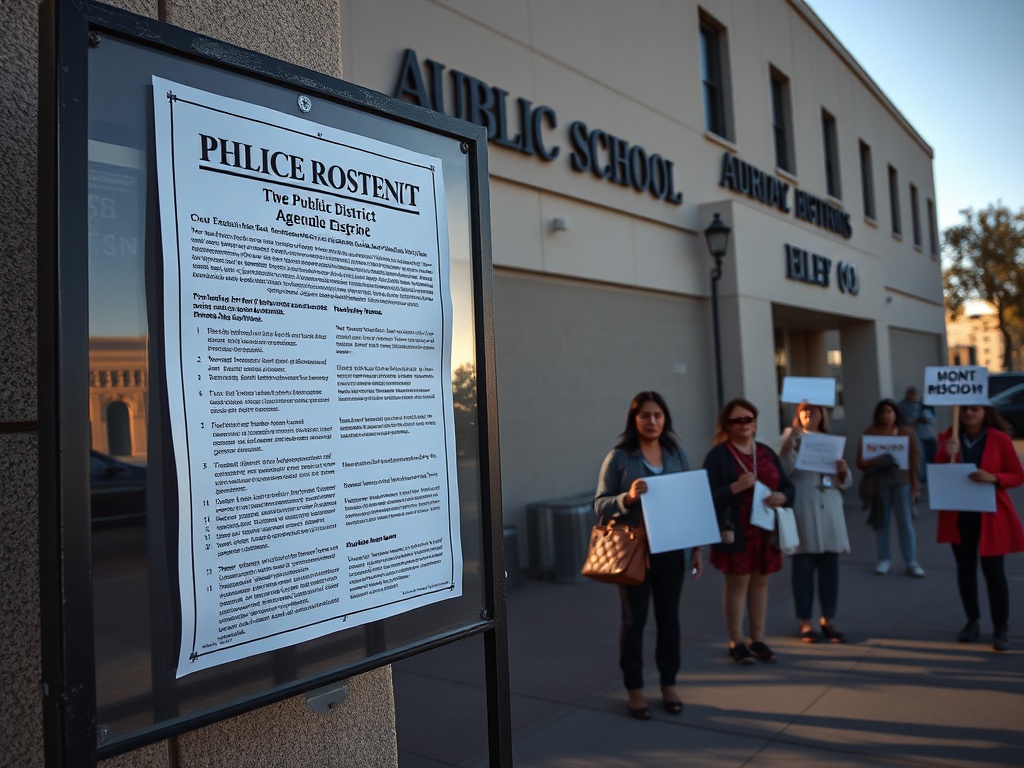
When a board unanimously approves the initiation of a cut process while the community protests and unions announce they will keep pressing, the problem transcends budgetary concerns. It becomes a governance issue: who defines priorities, with what evidence and legitimacy. The coverage mentions union criticisms linked to compensation decisions and the discussion about the use of reserves. Regardless of each party’s position, the lesson for any organization is clear: in major restructuring, legitimacy is an operational asset. Without legitimacy, every measure costs double in time, friction, and execution.
FUSD frames the cut as a response to low enrollment and attendance, warning of the risk of falling below the minimum reserves that would trigger state oversight. That’s an argument of control and compliance. However, the management team needs to complement it with an architecture argument: what gets protected, what gets reduced, what gets simplified, and what gets stopped altogether. If the conversation remains confined to deficit and reserve thresholds, the organization finds itself trapped in the language of defensive accounting. When the narrative is solely defensive, talent interprets that the institution has no plan, only reactions.
An element often overlooked in businesses also resurfaces: the cost of internal transaction. A process involving hearings, deadlines, and relocations consumes leadership hours, strains relationships, and shifts focus away from service. This necessitates leadership that operates at two speeds simultaneously: one to comply with the legality of the process and another to redesign operations post-cutting with a clear blueprint. Organizations that don’t separate these rhythms end up improvising in July with the structure of June.
Redesigning the Portfolio: Cuts Are Insufficient Without Rebalancing the System
From my portfolio lens, the issue isn’t whether cutting is “right” or “wrong.” The point is whether the cut rebalances four fronts: the current engine (daily school service), operational efficiency (district and administration), incubation (new ways to teach and support attendance), and transformation (scaling what works). The news shows much emphasis on engine adjustment and some efficiency, but is less explicit about incubation and transformation.
There are partial signals: an early retirement incentive in 2025 mentions 573 retirements, which would generate $56 million in savings over five years. This is a cost decompression tool, useful to avoid abrupt cuts, but it’s not a redesign strategy. If enrollment has been steadily declining, the system needs to convert part of its fixed costs into adaptable capacity and simultaneously selectively invest in what improves attendance and retention. In businesses, this translates to prioritizing initiatives that sustain demand and reduce friction; in education, it means prioritizing what prevents the contraction circle.
In practice, portfolio redesign in a financially stressed district often includes uncomfortable decisions: consolidating programs with low demand, simplifying administrative layers, reducing process variability among schools, and creating “units” with tactical autonomy to pilot attendance improvements and support services. The typical bureaucratic error is to measure any pilot using the same immediate efficiency standards demanded of a mature system. Pilots should be assessed based on learning and early operational results (attendance, response times, classroom stability), not just instant savings.
The leadership that works in this scenario doesn’t promise that there won’t be pain. It promises the pain will be designed: protect the core that sustains the service, simplify what adds no value, and reserve a minimum capacity to rebuild the operational future of the district.
A Viable Restructuring Protects the Classroom and Buys Time for Transformation
Cuts in FUSD and Central Unified are not an isolated anomaly; they are a signal of structural adjustment when demand changes and extraordinary funds deplete. The merit or failure of the process will not be measured solely by the amount saved, but by the ability to sustain operations without initiating further loss of enrollment and attendance.
A well-governed restructuring separates accounting cuts from organizational redesign. In the cut process, the focus is on maintaining solvency and reserves above minimums. In the redesign process, the focus is on protecting the capacities that sustain service and freeing up resources for operational improvements that stabilize attendance. When both are mixed into a singular budget discussion, the organization lacks the language to decide which roles are “cost” and which are “critical infrastructure.”
The viability of these districts will depend on whether financial adjustments do not suffocate the operational capacity that supports the present and whether the redesign frees up space to explore concrete improvements that secure their future.