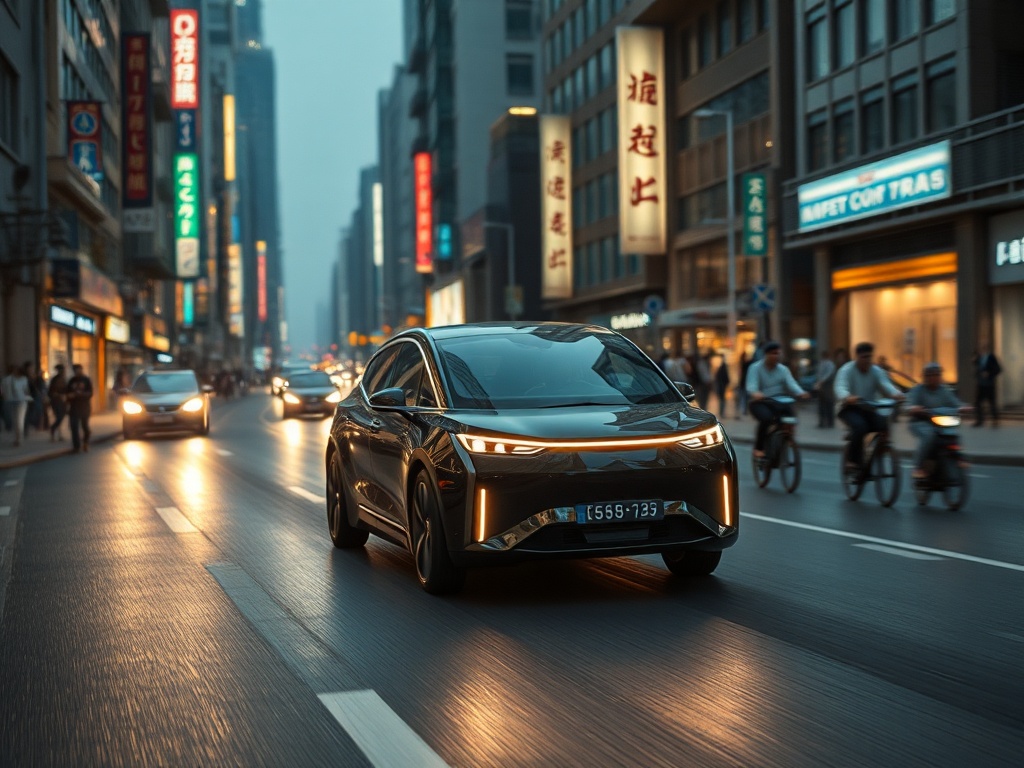

Robotaxis: A Redefinition of Urban Transportation Costs
James Peng, founder and CEO of Pony.ai, does not speak as an engineer enamored with his own technology. He speaks as someone who has calculated the numbers in urban transport and reached a conclusion that very few industries have been able to sustain in modern history: the cost of moving a person from point A to point B can collapse to levels that make any model relying on a human driver untenable. His public thesis is straightforward. "People love driving; they don’t love driving all the time." This distinction isn't consumer philosophy. It's the crack through which a completely different business architecture enters.
Pony.ai is publicly traded and operates fleets of robotaxis in China with a stated expansion into international markets. The company is not betting that people will abandon their cars. It is betting on something more precise and profitable: that there are millions of daily trips that no one enjoys making and that no one would choose to make if they had a comfortable and economical alternative, and that these trips represent a massive market with a service provider structurally trapped in high costs. That provider is, today, any transport company that pays salaries.
When the Driver Stops Being a Variable Cost and Becomes a Bottleneck
Human-driven urban transport has a characteristic that makes it fragile as an industrial model: its main cost does not scale down with volume. A human taxi driver making ten trips a day and one making twenty have proportional labor costs. Break times, legal working hours, traffic variability, and fatigue are factors that no digital platform has been able to eliminate, only redistribute among more drivers. Uber and Didi demonstrated this clearly: they built the largest distribution networks in the history of transport and still couldn't make the cost per kilometer structurally decrease because the driver remained the determining input.
Robotaxis break this mechanics from the ground up. An autonomous vehicle operating 24/7, without mandatory breaks, with no payroll cost per hour, and predictable maintenance improved via software, generates a radically different cost curve as the fleet grows. This isn't industrial science fiction; it’s the same logic that has destroyed the cost of data storage, payment processing, and audiovisual content distribution. In all those cases, human input was replaced by infrastructure that, once built, serves additional demand without proportional costs.
Pony.ai is playing on that same field. The difference from previous cases is that here, the physical asset—the vehicle—still exists and has real costs of depreciation, insurance, and energy. But even with these costs, eliminating the labor component completely changes the unit economics of the service. And when unit economics change, the prices that the market can sustain and the margins that the company can capture also change.
China as a Scale Laboratory, Not a Niche Market
There’s a detail that Western analyses of Pony.ai often underestimate: China is not just the company's domestic market; it’s the environment where regulation, urban density, and user volume allow for iterations at a speed that no other market currently permits. Chinese cities with populations over ten million are dozens in number. The demand for urban transport is structurally massive, and the government has shown a willingness to enable testing zones at a scale that markets like Europe or the United States are still debating in regulatory committees.
This has direct consequences on the data. Each kilometer traveled autonomously under real traffic conditions is a training data point. Each unforeseen situation that the system manages correctly is a measurable risk reduction. The accumulated volume of autonomous kilometers that Pony.ai can generate in China in a year likely exceeds what any competitor can generate in more conservatively regulated markets. And in artificial intelligence applied to driving, data are not just one input among many; they are the competitive advantage itself.
This places Pony.ai in a position that is not just technological. It’s a position of accumulating intangible assets—data, trained models, validated safety protocols—that become progressively harder to replicate for any late entrant. The entry barrier in this sector is not built by patents or initial capital; it is built by time spent in real operation.
The Cost of the Empty Seat and What Happens to the Traditional Automotive Industry
There’s a dimension of this shift that regular financial projections don’t capture well: what happens to the private car as a consumer good once the robotaxi achieves sufficient coverage and a price below the actual cost of owning a vehicle. Urban mobility studies estimate that a private car is parked 90% to 95% of the time. It's the most expensive asset that most families own after their home, and it spends most of its life generating no value.
If the cost per kilometer of a robotaxi falls below the total ownership cost of a vehicle—including insurance, maintenance, depreciation, parking, and fuel—the rational calculation for millions of urban users changes. Not abruptly, because habits and car culture have enormous inertia. But the long-term vector is clear: private vehicle ownership in dense urban environments faces competitive pressure that didn’t exist a decade ago.
This impacts car manufacturers, insurers, parking operators, and the consumer finance chain linked to vehicle purchases. Not all these effects are immediate or uniform, but they all point in the same direction. Pony.ai is not selling fancier taxis. It is participating in the reconfiguration of how cities allocate space, capital, and time to transportation.
Survival in Urban Mobility Depends on Who Controls the Cost Per Kilometer
Automotive industry leaders, transport platforms, and urban infrastructure funds must process this moment with the same coldness that the music industry should have processed audio compression in 1999 but failed to do. Autonomous technology is not competing within the existing rules of transport. It’s rewriting the cost equation that supports those rules.
The organizations that survive this shift will be those that stop optimizing their current models and start building positions in the new cost structure: fleets with less reliance on human labor, proprietary data infrastructure, early regulatory agreements, and the ability to operate with margins that today seem impossible because they are assessed on a cost basis that will have changed irreversibly in ten years. Those who do not understand that the marginal cost of the autonomous kilometer is the variable that reorganizes the entire industry will come late to a conversation that has already begun.