
REalloys Prices Western Independence on Rare Earths
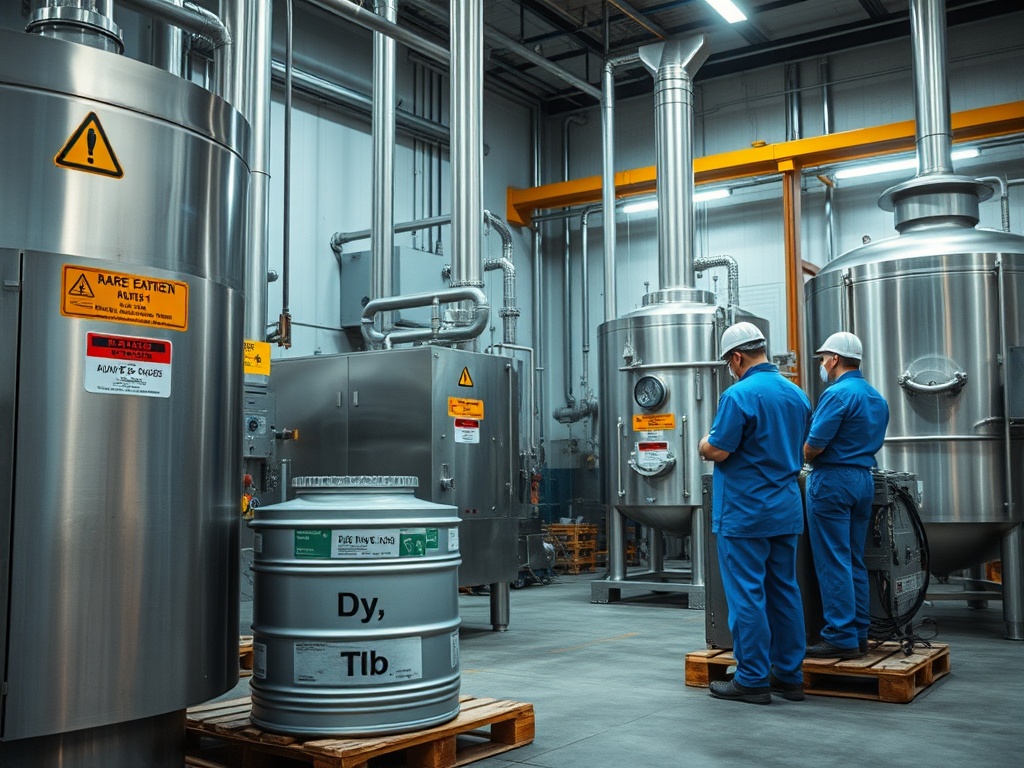
REalloys (NASDAQ: ALOY) announced on March 11, 2026, a move that effectively seeks to change its competitive category: a fully funded buildout of $50 million for what it describes as the largest heavy rare earth metallization facility outside of China, in operational partnership with the Saskatchewan Research Council (SRC) to build equipment in Saskatoon, relocate it to Ohio, and operate under 100% ownership of REalloys. The concrete promise isn't mere industrial rhetoric: 30 tons annually of metallic dysprosium and 15 tons annually of metallic terbium when the asset is fully scaled, with initial startup planned for early to mid-2027. The plant would integrate with its existing operations in Euclid, Ohio, meaning the downstream link where the metal ultimately transforms into an economic component for magnets and industrial applications.
This announcement becomes more interesting due to what it doesn’t explicitly say but is implied in the numbers and the timeline. REalloys is attempting to convert a geopolitical vulnerability into a commercial advantage: producing heavy metals that meet U.S. Department of Defense procurement standards in 2027, under restrictions that prohibit sourcing from China, Russia, Iran, and North Korea. There lies the market urgency, not the market with speeches. The company makes it clear: the facility aims to comply with 10 U.S.C. §4872 and DFARS 252.225-7052. The signal to buyers is simple: “buyable” supply for defense and for any value chain wanting to shield itself from blockades.
The Move Is Not Just a Plant, It's Insurance Against Dy and Tb Bottlenecks
In rare earths, talking about installed capacity often feels like smoke if it doesn’t land at the missing link. Here, the missing link is not the complete magnet or even the separation of oxides; the historical bottleneck for the West lies in converting oxides into metal, particularly in heavy metals like dysprosium and terbium, which drive the performance of high-performing magnets and are heavily concentrated in China.
REalloys points out that it understands scarcity in its most operational form: what is purchased and certified for a defense program are not intentions, but specifications and traceability. That’s why the announcement emphasizes “metallization” and regulatory compliance. Chairman Stephen duMont frames it as an explicit bridge: “the metallization capacity connecting Canadian oxide production with magnet manufacturing in the U.S.” according to the statement. That phrase, although it may seem like marketing, is actually a risk map: Canada provides upstream processing, the U.S. absorbs regulated demand, and pays for compliance.
There’s another tactical element often overlooked: REalloys states that the equipment will be built in Saskatoon with SRC and then moved to Ohio, where REalloys will retain 100% ownership. This detail tastes of political risk management and execution control. Building with a public-technology partner that already operates critical infrastructure, while simultaneously bringing the asset to the territory where regulated demand lives, reduces future commercial friction. What they’re buying is speed to reach purchases that are finalized with audits, not presentations.
Investor sentiment also reveals useful insights. Following the announcement, the stock traded at $17.77, with a +549% increase over 12 months, but still 31% below the annual high of $26.90. That pattern is not merely volatility: it indicates the market attempting to assign probability to industrial execution in a historically failed chain in the West. The premium is paid for narrative, while the discount arises from the challenge of delivering certified tons of metal on time.
Financing and Control Architecture to Ensure Capex Does Not Undermine Strategy
The announcement unites two aspects that almost always get separated in industrial projects: the “we will build” and “it’s paid for.” REalloys indicates that the estimated cost of the buildout is $40 million and that it is covered by a $50 million expanded public offering closed in parallel. That $10 million margin, without further detail, acts as a cushion for typical contingencies of equipment, integration, relocation, and commissioning. It doesn’t eliminate risk, but it prevents the classic failure due to underfunding that forces specification cuts right when the buyer demands standards.
From my product lens, what’s relevant isn’t the size of the check but the type of risk they are attempting to eliminate first. REalloys is prioritizing a point that enables sales with legal restrictions in 2027. This suggests that the “customer” isn’t the spot market for oxides or the press release holder; the customer is any actor with explicit source prohibitions, including defense and industrial value chains that align with those rules to avoid getting caught. When your customer has rules, your value proposition is compliance plus continuity.
The previous agreement from December 2025 also matters because it provides supply structure. The news reminds us that REalloys invests in expanding the SRC Rare Earth Processing Facility (REPF) in exchange for access to 80% of its high-purity NdPr production and Dy/Tb oxides. SRC, for its part, has invested $250 million in the facility. In other words, REalloys is trying to build a chain where upstream does not rely on fragile promises. The REPF, in Phase 1, will process 3,000 metric tons annually of monazite and recycled oxides to produce 525 tons/year of NdPr and 45 tons/year of Dy/Tb, with commissioning in 2026 and the first commercial production in early 2027. That timeline matches with metallization in 2027. It doesn’t line up perfectly, but at least it’s chained.
The architecture recalls a hard rule: in critical chains, margins are not captured by the one “holding the resource,” but by the one who eliminates the bottleneck and can sign contracts with penalties and certification. With Dy and Tb, that bottleneck is precisely the metal in specification. The capex here isn’t an aesthetic bet; it’s an attempt to position itself where the buyer has no acceptable Plan B.
Validation in the Regulated Market, Not in the Laboratory
In heavy industry, the equivalent of “validation” is not launching an app: it is securing purchase commitments that survive audits. REalloys is trying to validate itself in the most demanding segment, the one that pays for traceability and continuity. The very reason for the announcement revolves around the DoD standards in 2027. It’s a specific way to put a price on willingness to pay: if your metal doesn’t qualify, your market evaporates. If it qualifies, your product has relative captive demand.
SRC also reinforces that understanding from the institutional side. Mike Crabtree, president and CEO of SRC, states that the alliance creates “the first end-to-end rare earth metal capability in the western hemisphere,” according to the statement. Beyond the superlative, there is a business thesis: if the chain is complete, the customer stops buying "loose components" and starts buying continuity. In defense and clean energy, continuity is valuable.
Now, the operational risk remains intact and must be addressed plainly. REalloys’ CEO, Leonard Sternheim, has previously described in cited interviews within the briefing that the process is subject to “technical, procurement, and economic challenges” and that “establishing new capacity without that experience is dangerous.” That is the heart of this story: winning doesn’t go to those who announce, but to those who commission and maintain quality lot by lot.
The benchmark market also imposes discipline. China dominates more than 90% of global refining and nearly all output of heavy metals. When an industry is so concentrated, the cost of slipping on a facility is double: you lose money and you lose time, and the incumbent capitalizes on time with prices and contracts. The only defense there is to reduce uncertainty by design: ensured chain, regulatory compliance, and focus on the link for which the customer signs.
The Trap Is to Scale Before Closing Repeatable Sales
The announcement also reveals a grander ambition: to integrate metallization with magnet manufacturing in Euclid, Ohio, with a platform that mentions 2,000 tons/year of pilot magnet manufacturing and a Phase 2 that could scale to 15,000 tons/year. That path makes industrial sense, but it also concentrates the highest strategic danger: confusing technical capacity with repeatable sales.
Here, the order matters. If REalloys delivers specification-compliant metallic Dy and Tb, it enables high-performance magnets and opens commercial discussions with buyers who today cannot source without risk of breach. If it does not deliver, the rest of the vision collapses into a castle of underutilized assets. In other words, the correct step is to turn the metallization plant into a machine for contracts, not a symbol of sovereignty.
The briefing adds an additional point about sourcing: the REPF would have feedstock secured for five years from mining, recycling, and partners, including a non-binding offtake with AltynGroup Kazakhstan from iron ore tailings. This helps to diversify, but “non-binding” is not the same as guaranteed supply. In chains where the end customer penalizes non-compliance, commercial discipline is measured by executable agreements and operational redundancy.
REalloys’ strategy seems aimed at this by assembling a portfolio of feedstocks and partnering with an operator that has already invested $250 million and has years of experience fine-tuning processes of monazite cracking and uranium and thorium removal. The nuance is that this complexity, precisely, is where timelines break. If 2027 is the year of the standard, any slip turns the “largest outside of China” into a costly late asset.
The executive reading is clear. The announcement has good incentive engineering: secured financing, focus on the Dy/Tb bottleneck, and alignment with regulated demand that pays for compliance. What is lacking, which will only be seen in time, is repeatable commercial evidence: fulfilled specifications, consistent batches, contracts that survive audits, and frictionless logistics.
Execution Will Win When the Plant Is a Contract, Not a Milestone
REalloys is attempting to buy independence for Western buyers at the exact point where it hurts the most: specification-compliant heavy metals with acceptable provenance. The market may reward it if the timeline holds and the metallization in Ohio produces consistent quality Dy and Tb, because that output is what unlocks purchases in defense and in industries that are already aligning with those rules.
My diagnosis is that this move is less of an “industrial bet” and more of a test of commercial credibility. The company is pressured to convert engineering and capex into a stable flow of product that passes audits and integrates without surprises with downstream manufacturing. There, it will be determined whether the +549% annual increase was rational anticipation or excessive faith.
Business growth only occurs when the illusion of a perfect plan is abandoned and constant validation with the real customer is embraced.