
Papa John’s Restructures: Store Closures, Reductions and Revamping Operations
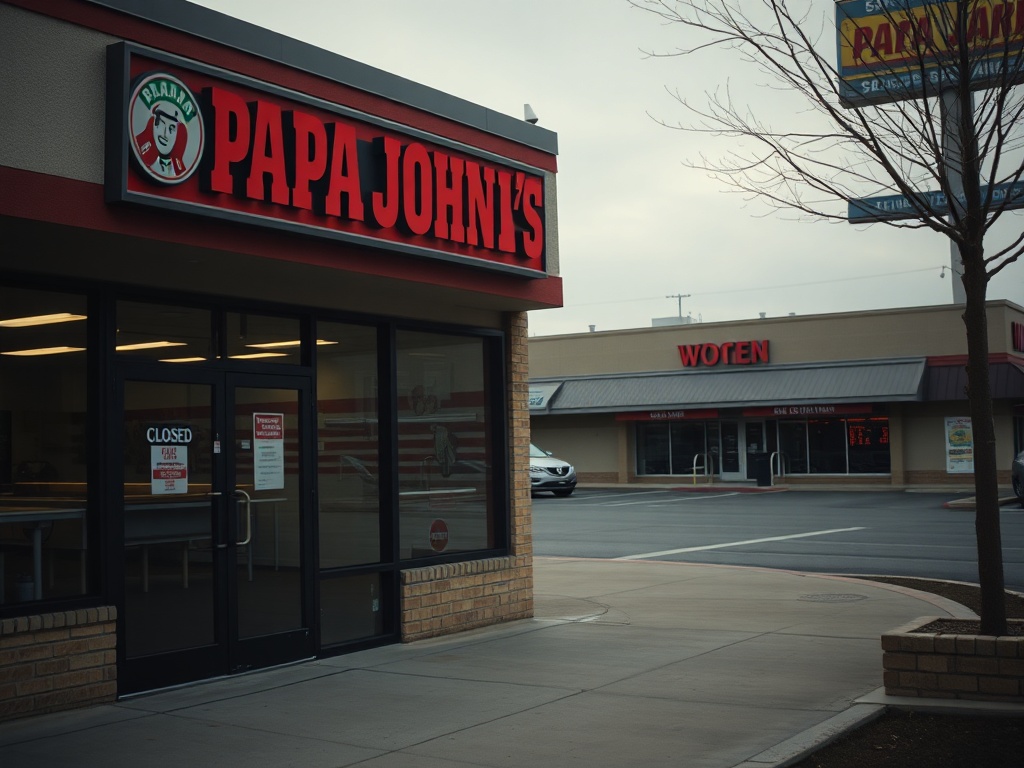
Papa John’s has announced plans to close approximately 300 underperforming restaurants in North America by the end of 2027, with 200 closures scheduled for 2026 and 100 for 2027, in addition to a 7% reduction in its corporate workforce. This information was shared on February 26, 2026, during their fourth-quarter earnings call, as part of the second year of their transformation plan. The company also outlined a review of costs that are invisible to customers, aiming for savings of at least $25 million by 2027 ($13 million in 2026) and a simplification of the menu that will eliminate items like Papadias and Papa Bites.
In essence, this news seems like yet another round of “efficiency”; however, it signals something much deeper: Papa John’s is acknowledging that part of its “network” is no longer viable. A restaurant that isn’t achieving adequate volume, is aging, and lacks a clear improvement strategy is not merely a weak sales point; it is a component draining operational focus, quality, and profitability from the entire system.
As of the end of Q4, on December 28, 2025, the company operated 6,083 restaurants across about 50 countries and territories, including roughly 3,500 locations in North America. The closures will mainly target franchised units that have been in operation for more than a decade and have average unit volumes below $600,000—a threshold indicating the store “does not meet brand expectations” or lacks a path for sustainable improvement. Meanwhile, recent financial performance shows increasing pressure: in Q4 2025, revenues reached $498 million, down 6% year-on-year, and net income was $9 million, compared to $15 million a year earlier. In North America, comparable sales fell by 2% in the quarter, whereas international business grew by 5%.
Closing 300 Locations: Not Retreating but Recalibrating
When a chain decides to close hundreds of locations, the relevant data is not the gross number but rather the underlying technical reason: the network has ceased to be homogeneous. Papa John’s is admitting that part of its “fleet” is unhealthy. The operating criteria that drives this decision is straightforward: AUV below $600,000 in aging units. This indicator serves as a stress test. If a location fails to produce adequate volume, operational leverage turns against it: labor, energy, rents, and service complexities erode margins and force discounts to maintain traffic.
The company framed this as "portfolio optimization" and "fleet health." Translated into engineering terms: they are removing parts that can no longer meet minimum tolerances. In retail and fast food, keeping underperforming locations can often be justified by a vague promise of “coverage” or “brand presence.” This becomes a vanity metric if there is no cash flow. Papa John’s appears to prioritize a colder logic: either a location improves with a verifiable plan, or it will close to prevent the entire system from covering the costs.
Additionally, the structure of this measure also suggests an additional intention: sales transfer. The company acknowledged that certain locations allow customer traffic to shift to nearby restaurants. This is crucial because the closure may not necessarily result in net revenue loss if customers continue purchasing from the same brand, but from units that offer better cost structures and performance. It’s a form of consolidation: fewer unproductive square feet, increased sales density where operations can truly scale.
The 7% Corporate Workforce Reduction: A Necessary Adjustment
The 7% corporate workforce reduction is presented in the official narrative as a pursuit of flexibility and enhanced execution. In a franchise business model, the risk presented is dual. If too much core support is trimmed, consistency in operational support for franchisees, brand control, and speed to market may be lost. Conversely, if too little is cut, a bureaucracy that isn’t justified by real margins continues to grow.
The critical data point here is the timing: closures, menu simplification, and corporate layoffs are occurring simultaneously. That signals that the problem was not merely one of sales, but of complexity. In a pizza chain, customers are purchasing not just ingredients; they are buying predictability. Each additional layer on the menu and every new initiative requiring training, inventory, and novel standards adds friction: more waste, more errors, more variability. If your network has already experienced negative comparable sales in North America (the company indicated declines in seven of the last eight quarters in that market), any additional friction compounds fatigue.
Viewing the corporate cuts with prudence, it may be an effort to eliminate costs that do not impact customers directly. The CEO himself described an “integral” review of customer-unrelated costs, alongside corporate and field resources. The structural reading is clear: Papa John’s needs the center to become a driver of standardization and profitability again, rather than an administrative building growing through inertia. The danger, however, lies in slashing at the very points that uphold execution discipline. In franchise chains, the center is the nervous system: if it thins out without redesigning processes, franchisees end up absorbing hidden costs, and the brand fragments.
Menu Simplification: An Operational Discipline with Short-term Sales Cost
Papa John’s plans to remove Papadias and Papa Bites. The company expects pressure on comparable sales in North America in 2026 because of this review. It’s significant that they openly admit this, as it indicates their acceptance of a loss in commercial “noise” to regain operational control.
In operations, the menu serves as the blueprint. Each new product is an additional column: it demands supply chain management, storage space, preparation times, cooking control, quality assurance, and the capability of teams to execute during peak hours. When comparable sales are under pressure, the typical temptation is to introduce novelties to create demand spikes. However, if the network is not prepared, those spikes devolve into failures: longer delivery times, inconsistencies, and increased complaints. Ultimately, innovation ceases to signify growth and transforms into entropy.
The intriguing signal is the focus: the company has stated a desire to be “the best pizza makers” and over time, “the best bakers,” in addition to driving innovation in affordable sides and increasing sales of products beyond pizza in pilot markets. This nuance matters. Growth will not stem from an infinite menu but from boosting ticket sales through add-ons that do not disrupt production lines. In other words: selling more without building complexity that operations cannot sustain.
Yet, this kind of cleansing carries a real risk: if those products were acting as hooks for specific segments, their removal may open a window for competitors to capture demand. In a market where delivery apps and aggregators are pressing margins, losing volume could be more costly than it appears. Hence, the order matters: simplifying without replacing with a clear and efficient offering is akin to removing a temporary support before the concrete has set.
True Transformation Lies in Incentive Distribution Between Brand and Franchisees
Most of the closures are concentrated in franchised locations. This detail is the political piece of the puzzle. A franchise with low AUV presents a dilemma for both the operator and the brand: the operator sees return on investment eroding while the brand experiences a degradation in experience and standards. Closing stores is a tough decision because it impacts the franchisee but may also be the only way to prevent the network from dragging along “zombie” units that survive through discounts or deteriorating quality.
The company also mentioned an accelerated refranchising initiative, with plans for owned stores in North America to eventually drop to a mid-single-digit percentage in the long term. This move, if executed with discipline, converts fixed costs into variable ones and reduces direct exposure to domestic market volatility. But it does not eliminate risk; it merely redistributes it. The internal operational question is already defined by the facts: how to maintain standards, innovation, and supply chain integrity when the end operator is not the company.
Simultaneously, Papa John’s plans to open between 180 and 220 new restaurants in 2026, prioritizing international locations. This illustrates the architecture of their gamble: pruning North America where unit economics are lacking while pursuing growth in regions where the curve remains upward. The system may work if the brand can accomplish two simultaneous tasks: (1) ensure that closures do not destroy demand but redirect it, and (2) ensure that international expansion does not replicate the same errors of complexity and portfolio dispersion.
The market is already discounting some pain: shares closed at $31.85 on February 26, 2026, having fallen 31% year-to-date. This reaction isn’t a moral judgment; it’s a thermometer: investors discern that the structure requires reinforcement and that the process will have costs.
The Final Blueprint: Less Unproductive Square Feet, More Cash per Unit
This announcement is not a promise of growth; it’s a foundational effort. Papa John’s is primarily attempting to regain the basic physics of the business: each restaurant must be a unit that can support its own weight and yield surplus. The 300 closures aim to eliminate points where volume underperforms, the buildings are aging, and improvement is not mechanically feasible. The 7% corporate cut and the $25 million in savings reflect an attempt to lessen internal friction so that execution can become consistent again. And the menu simplification signals that they understand complexity carries costs, even if disguised as innovation.
The transformation will ultimately be measured by one criterion: whether the company can channel demand toward healthy units, ensuring that franchisees possess a defendable unit economic model while the corporate center maintains standards without inflating.