
The Land No One Wanted but Everyone Needs
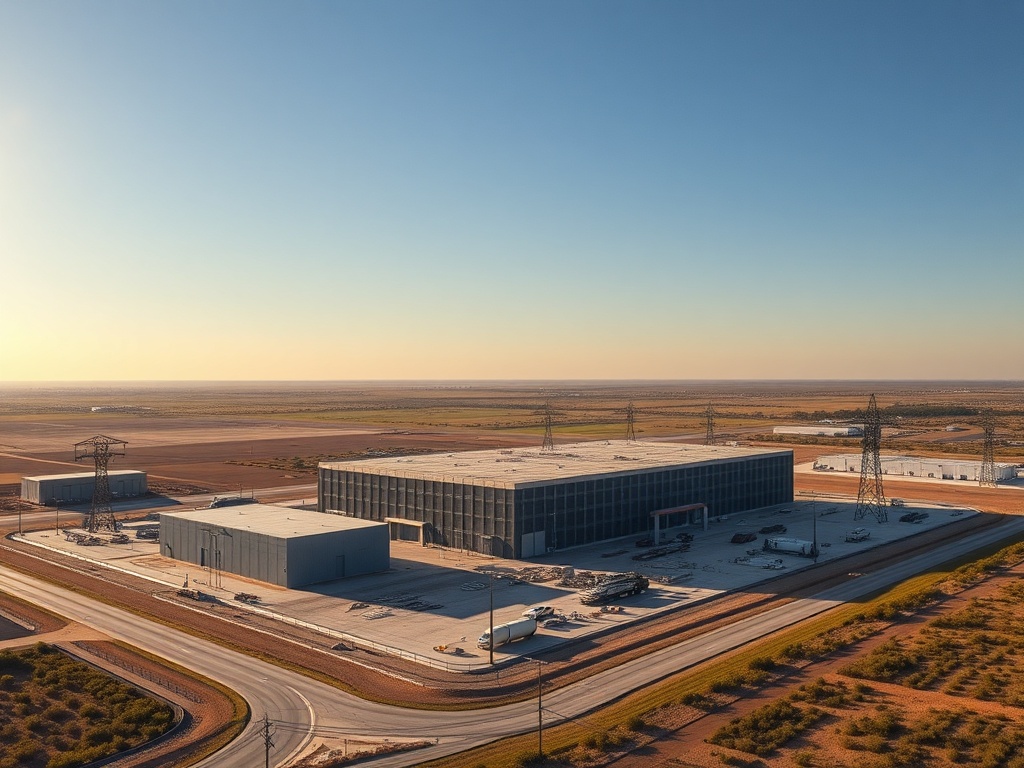
In early 2025, President Donald Trump announced the Stargate project from the White House, branding it as America’s most ambitious effort to secure leadership in artificial intelligence. The physical epicenter of this promise was Abilene, Texas: a midsize city that suddenly became the construction site of the largest computing campus in the country, built by infrastructure company Crusoe alongside OpenAI and Oracle.
Just weeks later, OpenAI decided not to proceed with an expansion adjacent to that same campus. Crusoe announced on Friday that Microsoft would take over that space: two new buildings that the industry calls 'AI factories' and a power generation plant on the same parcel in Abilene. The result is that the two most influential companies in the sector, connected through billions in cross-investment, will literally be neighbors in Texas, building parallel infrastructure for workloads that are still not entirely defined.
This isn’t a story about land or building permits. It’s a story about who controls the physical layer of artificial intelligence and what happens to a project when the urgency to announce it outweighs the clarity on how to operate it.
When Infrastructure Precedes the Business Model
The pattern described by this news has a specific mechanic: massive capacity is built in anticipation of demand that does not yet exist in the projected form. It’s not inherently irresponsible, but it's a bet with asymmetric consequences. If demand arrives in the right form, the entity with the infrastructure gains decades of advantage. If not, it ends up with costly assets that do not return value within the timeline capital expects.
OpenAI operates under this logic particularly intensely. Its Stargate project, as outlined in the agreement with Crusoe and Oracle, is designed to train and deploy language models at a scale that no company in the sector has yet achieved. However, the decision not to extend that campus at this stage suggests that the organization is calibrating its infrastructure expansion with more discipline than initial headlines implied. Building a campus that the President announces on his first day in office creates political and media pressure that can quickly dissociate from internal operating logic.
Microsoft, for its part, is stepping into that space from a radically different position. Its cloud business—Azure—has existing contracts, active clients, and workloads that are already generating revenue today. For Microsoft, every square foot of computing capacity in Abilene is not a future bet: it’s capacity that can be allocated to enterprise accounts that are already in the queue. This difference in the existing demand base creates completely different risks associated with the same property for each company.
The Geography of Power in AI is Not Metaphorical
The fact that these two organizations end up as physical neighbors in Texas is not just a journalistic curiosity. It has concrete implications for how the most scarce resources in this industry are distributed: electricity, cooling water, fiber connectivity, and specialized labor for data center operations.
Abilene was not chosen by accident. Texas offers a regulatory framework that facilitates the construction of private energy infrastructure, and the region has access to scalable generation sources that can grow alongside the demand from data centers. The power generation plant that Crusoe will build for Microsoft on the same site is, in this context, as strategic as the servers it will support. Whoever controls on-site power generation is not reliant on the regional grid to ensure operational continuity, mitigating one of the most challenging risks in large-scale computing operations.
This geographic concentration also creates dependencies that do not appear in any balance sheet. If a contractual dispute, severe weather event, or regulatory change impacts the Abilene site, it simultaneously affects two of the organizations with the most influence over AI development globally. The efficiency of sharing adjacent infrastructure comes at the cost of a correlation of risks that business continuity departments typically aim to eliminate, not maximize.
What Crusoe Understands Better Than Its Clients
The least visible actor in this story is precisely the one with the strongest position: Crusoe, the company that develops and operates the campus. Regardless of whether the tenant of the new building is OpenAI or Microsoft, Crusoe gets paid for construction and operations. Its model does not rely on OpenAI’s language models generating projected revenue, nor on Azure growing at the rate that Satya Nadella champions to shareholders. Crusoe has turned the uncertainty of who will win the AI race into an asset because whoever wins will need the infrastructure they build.
This is the mechanic that industry analysts tend to underestimate when evaluating the sector. Most of the value in an AI infrastructure expansion is not captured in the layer of models or applications, but in the physical layer that makes them possible. And that layer has economic characteristics that are much closer to industrial real estate than to consumer technology: long contracts, depreciable assets, more predictable margins, and a competitive edge built through accumulating land, permits, and relationships with energy operators.
Microsoft’s move in Abilene confirms that big tech companies understand this. The question the market has yet to resolve is how much of that infrastructure is being built for actual demand over the next twenty-four months, and how much is anticipating demand that may take five years to materialize at a scale that justifies the current investment.
Infrastructure Doesn’t Hire Technology; It Hires Certainty
Microsoft’s move in Texas precisely illustrates the work organizations are hiring when investing in AI infrastructure at this scale: they are not purchasing computing capacity; they are purchasing operational certainty against a demand that already exists and that they cannot satisfy from their current facilities. OpenAI, in contrast, is at a stage where it is still defining precisely what that demand will look like and at what pace it will arrive.
The success of this physical expansion model will ultimately demonstrate that the real work companies were contracting was not access to artificial intelligence, but the ability to assure their own customers that the infrastructure sustaining them does not falter.