
Lenovo's Nearly Doubled AI Revenue Reveals a Silent Redesign with Record-Breaking Figures
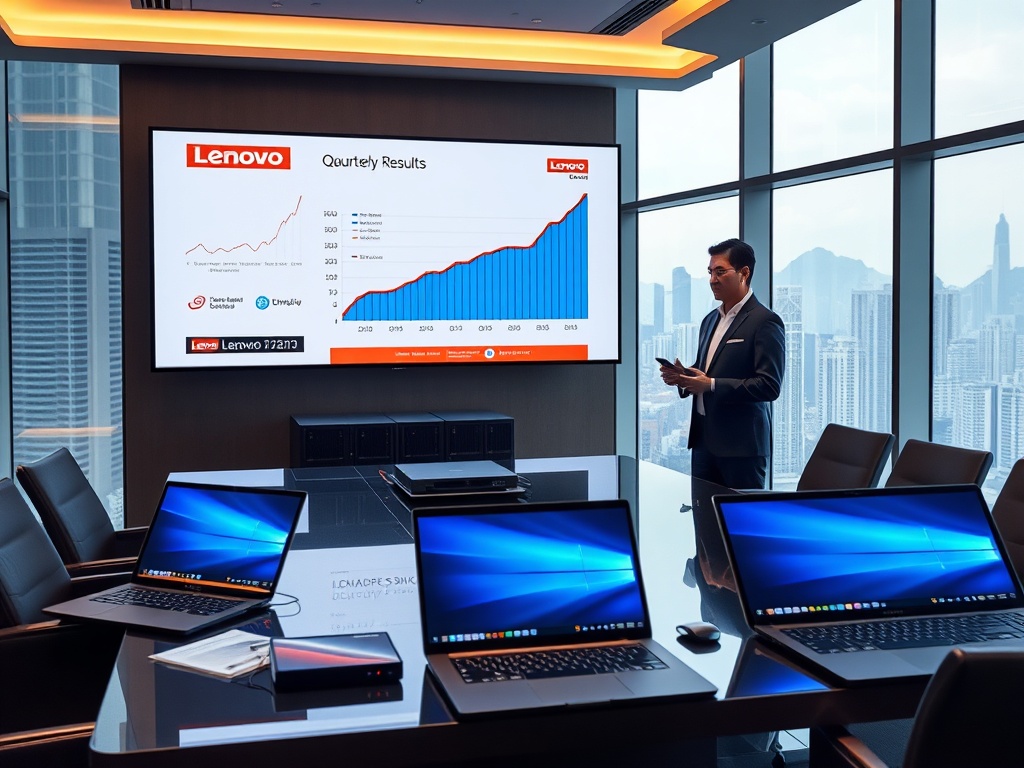
There are results that surprise, and there are results that force you to re-read a company's organizational chart. The numbers that Lenovo published on May 22, 2026, fall into the second category. Revenue for the March quarter reached $21.6 billion, a growth of 27% year-over-year — the highest rate in five years — and net income jumped dramatically to $521 million. The company's shares in Hong Kong rose nearly 20% in a single session, becoming the largest percentage gainer in the Hang Seng index that day. But the number that best explains the market's movement is not found in margins or PC volumes: it lies in the fact that AI-related revenue grew 84% in the quarter and accounted for 38% of the group's total revenue.
That is not an emerging segment. That is nearly half of the business.
For those who observe companies through the lens of organizational design, this kind of result is not manufactured in a single quarter. It is manufactured — or destroyed — much earlier: in decisions about where autonomy is allocated, what metrics are used to measure each unit, and how much oxygen a new business gets before it is required to behave like the mature business. Lenovo's leap in AI revenue is not just a lucky streak of demand; it is the external signal that something was correctly configured internally for long enough to become a revenue source at this scale.
The 38% That Rewrites the Thesis of a Hardware Company
Lenovo was for decades a company that the market classified, with a certain condescension, as a PC manufacturer. Profitable, yes. Solid in volume, also. But without the kind of growth story that generates reratings of stock market multiples. The world of mature hardware has that effect: it traps companies in a narrative of efficiency and market share defense, making them difficult to see as vehicles for expansion.
What changed was not PC demand — the global personal computer market remains a slow-cycle business — but rather the composition of Lenovo's portfolio and, more importantly, the decision to measure it differently. The company built a category it calls AI-related revenue, which encompasses three distinct types of products and services: devices — PCs and phones — with built-in neural processing units; servers with graphics processing units oriented toward artificial intelligence workloads; and services associated with that hardware. The fact that 38% of total revenue comes from that category means Lenovo is not selling a technological promise on its balance sheet: it is converting real demand into real billings, quarter after quarter.
The market read it correctly. A 20% jump in share price in a single session is not explained solely by revenue growth, however large. It is explained by a narrative reclassification: investors are reassessing whether Lenovo is a mature hardware manufacturer with marginal AI exposure, or whether it is an AI infrastructure and devices company with an established hardware base. The difference between those two descriptions, in terms of the multiples applied, is enormous.
Chairman and CEO Yuanqing Yang stated it explicitly in the earnings release: the company aims to become a $100 billion revenue company within the next two years. With a current market capitalization of around $24 billion, the target implies revenue growth that cannot be sustained by the conventional PC base alone. AI is not the vehicle of that ambition; it is the necessary condition for that ambition to be technically achievable.
A Well-Configured Portfolio or Demand That Arrived at Just the Right Time
There is an organizational design question that this result immediately triggers: Did Lenovo build AI capability before the demand existed, or did the demand arrive before Lenovo had time to ruin the internal configuration of that segment?
The answer matters because it determines whether the result is repeatable or whether it depends on external conditions that may not be sustained. In companies that manage complex portfolios — mature hardware, next-generation devices, enterprise services — the most frequent risk is not a lack of strategic vision. It is measuring the new business with the same instruments as the established business, before the new business has had time to build its own performance curves. When that happens, the organization condemns what should not yet have been required to demonstrate the same results as the core.
What Lenovo's revenue structure suggests is that the company avoided, at least partially, that mistake. The AI category grew 84% in a single quarter and already represents more than a third of the group's total. To reach that point, the company must have protected that segment during a period when its metrics were not comparable to those of the mature business. A business that represented, say, 10% or 15% of the portfolio two years ago and today reaches 38% did not get there because someone pushed it with urgency in the last quarter. It got there because it had enough space to grow before being required to behave like the PC division.
Lenovo describes its positioning as a "Hybrid AI" strategy: personal artificial intelligence distributed across end-user devices, combined with an enterprise AI business oriented toward helping customers extract value from their data. That two-speed architecture — consumer and enterprise, hardware and services — has a reasonable portfolio logic. The consumer segment with AI-enabled PCs and phones generates volume and renewal of replacement cycles. The enterprise segment, with GPU servers and data services, generates the kind of contractual relationships and higher margins that a conventional hardware market can hardly produce.
The risk in this configuration is that the two speeds begin to compete for resources and organizational attention instead of feeding each other. The GPU server business competes with very different players than the home PC segment. The success metrics are different, the sales cycles are different, and the tolerance for operating margin is different. Maintaining those two tracks with the same coherence as AI volume scales will be the true indicator of whether the organizational design is up to the moment or whether it will begin to crack when pressure mounts.
The Arithmetic of $100 Billion and the Memory Problem
Yuanqing Yang put on the table a number that markets are taking seriously: $100 billion in revenue within two years. With the results of the most recent fiscal year reflecting revenue in the range of $69 billion according to available data, the target implies growing approximately 45% over the current base within a relatively short period. In the context of an AI demand cycle that is accelerating across both devices and infrastructure, the projection is not impossible, but it requires the 38% of AI-related revenue to continue expanding in proportion to the total — not merely holding steady.
That is where the most interesting structural tension lies. Lenovo's AI revenue depends on sophisticated hardware: neural processors in PCs, GPUs in servers. That hardware has critical inputs with their own markets, and the most volatile of them is memory. A lateral signal in the coverage from the same day of results — referenced as external analytical context — pointed precisely to that vector: memory prices are under upward pressure, which directly affects the manufacturing costs of Lenovo's AI devices. If memory prices continue to rise, the company faces margin pressure that can moderate the enthusiasm generated by revenue growth, regardless of how much demand exists in the market.
This is the kind of tension that defines whether a company growing in revenue can also grow in profitability. Lenovo recorded $521 million in net income in the quarter, a dramatic increase compared to previous periods, but which in relation to $21.6 billion in revenue implies a net margin of around 2.4%. For a company aspiring to $100 billion, sustaining that profitability under input cost pressure while simultaneously scaling in two very different market segments requires a financial architecture discipline that goes well beyond favorable demand timing.
The fact that Lenovo remains the world's number one PC manufacturer with a global market share of 24.4% gives it a considerable base of scale. That leadership position is not trivial: it implies negotiating power with suppliers, an established distribution infrastructure, and a brand with global coverage. In a replacement cycle accelerated by the adoption of devices with AI processing capabilities, that market share becomes an asset that can be monetized in ways that were not available in the previous conventional hardware cycle.
When the Mature Business Finances the New One Without Suffocating It
Lenovo's result illustrates, with concrete numbers, one of the most frequent design problems in companies managing portfolios with assets at very different stages: how does the mature business finance the new one without becoming its premature judge?
Lenovo's PC division is a consolidated business, with tight margins, well-established product cycles, and very clearly defined performance metrics. If the organization had applied the same efficiency and margin metrics to its AI initiatives from the start — demanding immediate profitability or volumes comparable to the installed PC base — those initiatives would have died before reaching critical mass. The 38% of total revenue that the AI segment represents today could not exist if, at some point over the past few years, someone in the chain of command had decided that that business needed to demonstrate the same returns as the ThinkPad division before receiving more resources.
That this did not happen — or that at least it did not happen in a fatal way — is a design signal that deserves more attention than the stock market headline. The autonomy with which a new segment can operate within a large organization determines, more than any strategic declaration, whether the company has a genuine capacity to reinvent itself or merely the appearance of having one.
The case also has direct implications for the technology infrastructure sector more broadly. AI demand had, for months, been concentrated in the market narrative around chip manufacturers and cloud providers. Lenovo demonstrates that this demand is already arriving with force at the layer of endpoint hardware and enterprise servers. That has consequences for direct competitors in the PC and server segments, but also for component suppliers, system integrators, and consultants advising companies in transition toward hybrid AI infrastructure.
The company that for decades was perceived as the efficient but unglamorous link in the global technology chain is achieving something that very few hardware companies have managed: convincing the market that its core business is not a limitation on growth, but rather the platform from which a higher-value segment can scale. That cannot be explained by favorable external demand alone. It is explained by internal decisions that, at some point before the results were visible, someone made correctly about where to place autonomy, with what metrics to measure the future, and how much time to give it before requiring it to behave like the past.
When a segment representing 38% of total revenue grows at 84% in a single quarter, the internal structure that allowed it matters just as much as the result itself. Lenovo built enough organizational space for that segment to come into existence before having to justify itself against the standards of the business that was financing it. That is the design that does not appear in earnings releases, but that explains why some companies have results like these and others do not.